


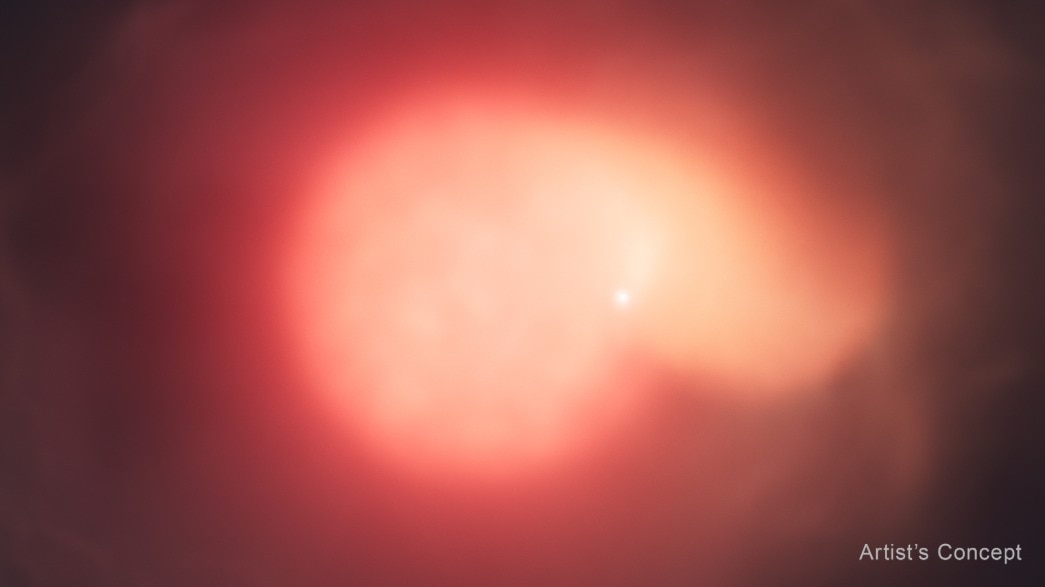
An artist's concept showing the merger of two stars. Published in the journal Nature on November 18, the research examined an unusual stellar system nicknamed Little Bao and Big Bao.
Researchers pieced together years of observations to reconstruct how the smaller star gradually moved into its giant companion before a powerful eruption in October 2025.HOW ONE STAR SWALLOWED ANOTHERThe story began in 2018, when astronomers noticed that the giant star was gradually becoming brighter. Over the next seven years, it continued to glow more intensely before erupting in October 2025.
Researchers believe the smaller star had entered the outer gas layers of its much larger companion and was gradually spiralling towards its centre.As it moved through the surrounding gas, the smaller star experienced resistance, much like an object moving through a thick fluid. This slowed its movement and released energy, making the giant system increasingly bright.The final eruption provided another important clue.
An artist's concept shows the faint glow of the mergin stars in the Andromeda Galaxy. Only about 10% of the giant star's outer gas was thrown into space, while the energy released suggested that the smaller star had reached the giant's core.Together, these observations point towards one possible scenario — the two stars merging.A SIGNIFICANT DISCOVERYThe process, known as a common-envelope phase, is an important but poorly understood part of how stars evolve.It happens when an ageing star expands so much that it engulfs a nearby companion.The two then move through a shared envelope of gas, potentially ending in a merger.Although astronomers have long suspected that such interactions occur, directly observing the process has been difficult.
An artist's concept of the post-eruption phase of the star in the Andromeda Galaxy. Karambelkar and his colleagues' findings provide evidence of this process unfolding over several years.However, thick clouds of dust still hide what remains of the system, and scientists will need years or even decades of further observations to understand its final state.The team hopes to identify similar systems before they erupt, offering astronomers more opportunities to study how stars merge and transform.- Ends