


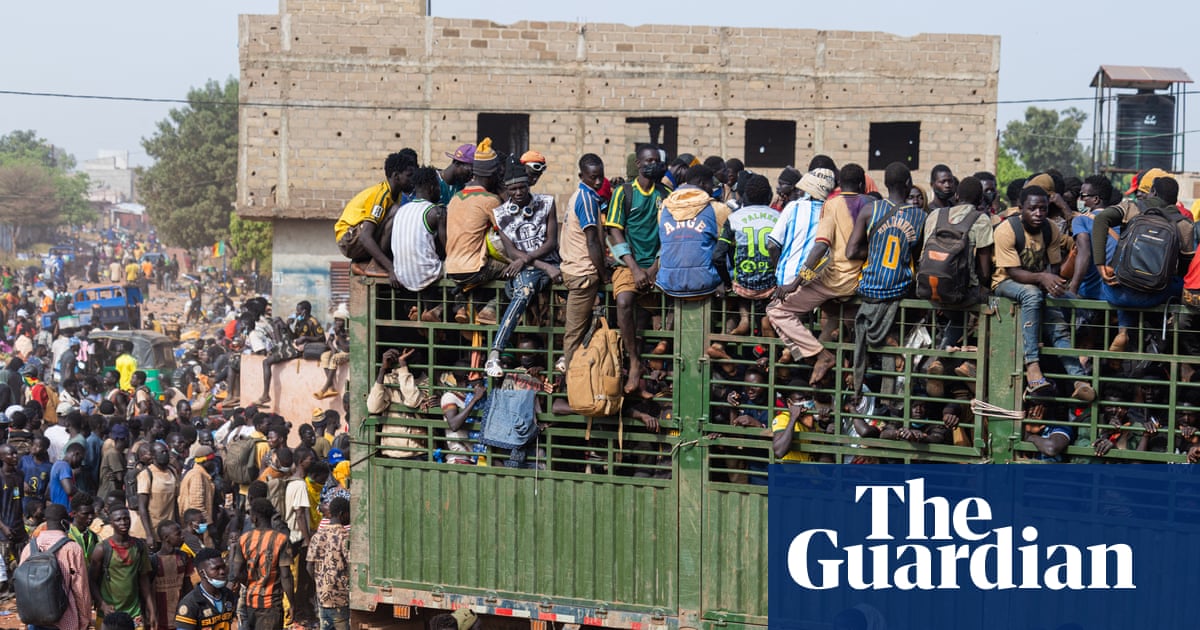
In the border town of Kourémalé, split between Guinea and Mali, thousands of families have been trudging across the frontier over the past week after a sudden ban on illegal artisanal mining triggered a wave of displacement and a regional diplomatic dispute.Some, like Seydou Traore, a miner in his 30s from Burkina Faso, made the 78-mile trek from Kourémalé to Ouezzindougou, farther inward. Last week, he gathered a small bundle of his belongings and fled Guinea after security forces ordered him and fellow miners to leave.“We worked hard there, honestly,” he told Agence France-Presse (AFP). “Then one day everything changed.
We were told to leave immediately, without even enough time to collect our tools or savings.”He is among tens of thousands of people displaced across west Africa this month after Guinean authorities enforced the ban, citing the need to curb river pollution and deforestation, caused by large-scale illegal mining across the country, especially in the Siguiri area in the north-east.Displaced miners head to Mali. More than 300,000 people in Guinea eke out a living as illegal miners, according to the UN.
Photograph: AFP/Getty ImagesIn the days that followed, security agents raided mining hotspots, confiscating equipment and arresting 1,263 people. They also expelled thousands more: Mali says up to 160,000 miners fled into the Malian part of Kourémalé and as far as the capital, Bamako.
At least six women have given birth in Mali since the displacement began in Guinea.On 11 November, more than a week later, deadly violence broke out in the Balato community in Siguri, between security agents and miners erecting barricades. At least 10 people were killed and 13 others wounded, and three military vehicles were set alight.The crackdown has triggered a regional diplomatic dispute: in a statement released on 12 November after a meeting in Ouagadougou, the Alliance of Sahel States said it recognised countries’ authority to enforce their laws, while voicing concern about the decree and expulsions.Tiffany Wognaih, a senior analyst for the Francophone west and central Africa at geopolitical risk advisory JS Held, said illegal artisanal mining was widespread in the region, “especially in areas that aren’t necessarily continuously monitored by government presence”.More than 300,000 people in Guinea eke out a living as illegal miners, according to data from the UN Environment Programme.Many countries in the region lack comprehensive official numbers on gold export and processing.
Conakry has remained defiant in the face of its neighbours’ displeasure. Mamady Doumbouya’s administration has grand ambitions to make Guinea a dominant mining force in the region and increase state revenues by tracking most of the value chain for resources such as gold.skip past newsletter promotionafter newsletter promotionA man from Messé village in Kayes, Mali, washes wet sand in search of traces of gold amalgam.
Photograph: Kalolaine Fainu/The GuardianThe ban on illegal mining was announced a day after Guinea’s first gold refinery, the Nimba Gold Refinery, was officially launched with a declared annual processing capacity of 733 tonnes, far above the country’s annual gold output of 72 tonnes.“If you’re opening a gold refinery, you need official supplies of gold to flow through the country’s channels,” Wognaih said. “And if a lot of it is being exported out of the country through illegal means and channels, then you don’t have enough processing in the country or showing up on official export figures.”A year ago, the vast Simandou mine came on stream after nearly three decades of delay, to exploit one of the world’s biggest iron ore deposits. The $20bn project has rapidly ramped up shipments in the run-up to an annual target of 120m tonnes.Meanwhile, concern is mounting within the Sahel states that the influx will exacerbate a humanitarian crisis that the military juntas are already struggling to contain amid insecurity and soaring living costs.“These people are vulnerable,” a Malian security ministry official told AFP about the new arrivals. “We are looking at ways to prevent them from being approached by terrorist networks.”