


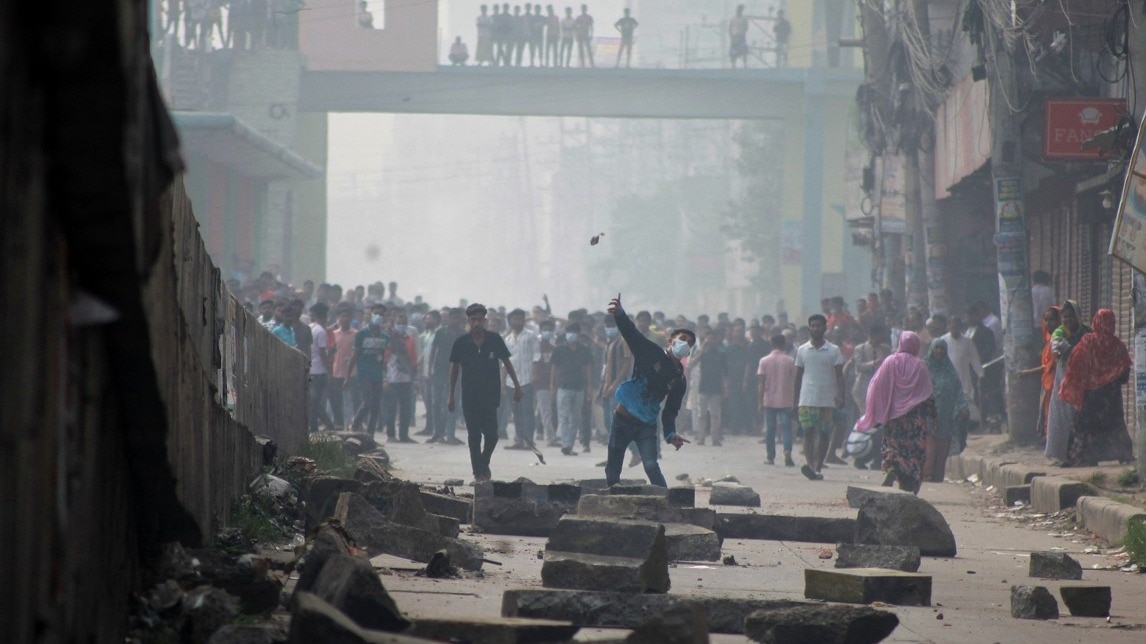
The protests took place across the industrial hubs of Ashulia, Gazipur and Narayanganj, with demonstrators blocking the Dhaka-Aricha, Dhaka-Tangail and Dhaka-Mymensingh highways.A garment worker throws back a tear gas cannister during a protest demanding increase in minimum wages near Dhaka on November 17, 2026. (AFP photo) Garment workers in Bangladesh on Tuesday staged fresh demonstrations over their demand for a substantial rise in minimum wages, clashed with pilice and blocked three major highways, prompting authorities to deploy more than 1,000 paramilitary personnel across key industrial areas near Dhaka.Security personnel used tear gas, sound grenades and batons to disperse protesters as the agitation disrupted traffic and forced several factories to suspend operations, news agency PTI reported.The protests took place across the industrial hubs of Ashulia, Gazipur and Narayanganj, with demonstrators blocking the Dhaka-Aricha, Dhaka-Tangail and Dhaka-Mymensingh highways.The road blockades triggered lengthy traffic jams, leaving commuters stranded and disrupting movement across the industrial belt. The Border Guard Bangladesh (BGB) confirmed deploying 42 platoons of personnel in the affected areas.Authorities also used drones to monitor the situation and track the movement of garment workers.
Police said two of the three highways had been cleared, although intermittent blockades continued to affect traffic on the Dhaka-Mymensingh route.LABOUR UNREST BEGAN IN OCTOBER The demonstrations are part of weeks of intermittent labour unrest that began in late October across the country's major garment-producing regions.Workers are demanding an increase in the minimum monthly wage from the existing Tk 12,500 (USD 100) to Tk 30,000 (USD 240), arguing that their earnings have failed to keep pace with rising expenses.Rising costs of food, housing, transportation and healthcare have intensified workers' demands for better pay and improved living conditions.The unrest also affected factory operations, with at least 37 garment factories across the industrial belt declared closed on Tuesday, according to police.Several other units temporarily halted production after workers walked out of their workplaces to participate in the demonstrations, the report added.In Dhaka's Mirpur area, garment workers gathered near the Darus Salam and Shah Ali police station jurisdictions and attempted to march towards the Mirpur-10 roundabout.Police intercepted the demonstrators and subsequently fired sound grenades to disperse the gathering around 10.30 am, Mirpur police station Officer-in-Charge Hafizur Rahman said, according to local media reports.In Savar, protesters blocked the Dhaka-Aricha Highway near Fulbaria around 11 am, disrupting traffic in both directions. The blockade continued for approximately 50 minutes, resulting in long queues of vehicles.Clashes were also reported in Hemayetpur and parts of Ashulia, including Khejur Bagan and Jamgora.
Protesters allegedly set tyres and waste materials on fire to block roads, prompting security personnel to use tear gas and sound grenades.Some demonstrators reportedly threw bricks and stones at police and BGB personnel attempting to clear the highways.GOVT CONSIDERS LABOURS' DEMANDSThe government has meanwhile initiated discussions on revising wages. A six-member Minimum Wage Board was constituted on November 1, comprising representatives of workers, factory owners and the government, under the chairmanship of a senior district judge.The board has held two meetings, on November 4 and 9, and was initially expected to finalise its recommendations by the end of November.
However, its November 16 meeting was postponed.The board subsequently announced that its next meeting would take place on November 23, when the factory owners' representative is expected to present a proposed pay structure.Authorities have announced that the revised wage structure will come into effect from December 1, with workers expected to receive their first salaries under the new arrangement in January.GARMENTS: BANGLADESH'S EXPORT ENGINEBangladesh's garment industry, the world's second-largest apparel exporter after China, employs more than four million people and contributes over 80 per cent of the country's export earnings.Major international brands, including H&M, Zara and Gap, source garments from the country.Factory owners have warned that continued unrest during the peak production period for spring and summer orders could delay shipments, undermine international buyers' confidence and trigger order cancellations.With the November 23 wage board meeting approaching, the government's ability to reach an agreement between workers and factory owners will be crucial.Until a revised pay structure is finalised and implemented, the possibility of further demonstrations and disruptions across Bangladesh's garment-producing centres remains.- Ends