


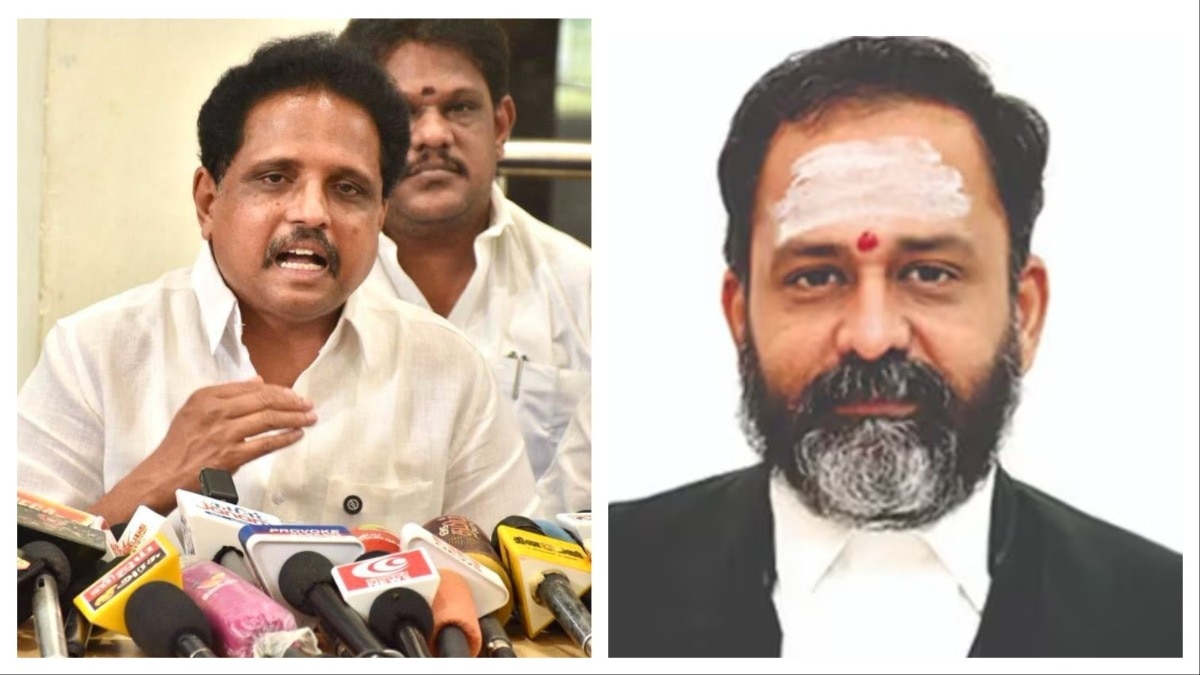
Rejecting the criticism over his alleged use of a luxury vehicle and branded clothing, Venkatesan said his public standing should be judged by his views and actions rather than superficial observations about his lifestyle.CPI(M) MP Su Venkatesan (left) and Madras High Court judge Justice GR Swaminathan. CPI(M) Parliamentarian Su Venkatesan on Tuesday reacted sharply to Madras High Court judge Justice GR Swaminathan’s remarks on the MP's lifestyle, asserting that he has never owned a car and describing the judge's comments as a "cheap personal attack".Rejecting the criticism over his alleged use of a luxury vehicle and branded clothing, Venkatesan said his public standing should be judged by his views and actions rather than superficial observations about his lifestyle.On Monday, Justice GR Swaminathan criticised Venkatesan for questioning his judicial responsibilities, also targeting his lifestyle by referring to his alleged Mercedes-Benz travel and branded clothing and footwear.In a statement issued on his official social media account on Tuesday, the Madurai Lok Sabha MP reacted to the criticism, saying it was made without verifying facts and reflected bias.
He clarified that the car in which he was seen arriving at a railway station did not belong to him, adding that he had never owned a car."I have been criticised for the car I arrived in at the railway station. When such criticism is made without checking the facts, based on superficial observation, it reveals bias and becomes a personal attack.
It is a cheap personal attack. It is not my car; I have never owned a car to this day," he said.
Venkatesan also defended his choice of travel class, maintaining that his train journey was in accordance with the official travel entitlements available to Members of Parliament.Responding to the judge's comparison between their respective travel arrangements, he said a person's ideological position or the strength of an argument could not be determined by the class in which they travelled.Reiterating his commitment to communist ideology, Venkatesan said he took pride in being part of the Left movement and credited the ideology with encouraging critical thinking and questioning."Communism taught me to question. When that question provokes a response, the validity of the question is affirmed.
No slander can destroy this lesson," he added.He further said Left leaders were often questioned about their clothes, vehicles and personal choices, but maintained that they remained accountable to the party's principles of "purity and simplicity".TAMIL NADU CPI(M) SECRETARY REACTSThe controversy also drew a strong response from CPI(M) Tamil Nadu secretary P Shanmugam, who condemned the judge's remarks and urged the Chief Justice to initiate appropriate action.Accusing Justice Swaminathan of repeatedly departing from judicial norms and decorum, Shanmugam alleged that his public statements reflected personal and ideological biases, including what he described as "Varnashrama bias and malice".The exchange follows Justice Swaminathan's remarks during an open-court hearing on Monday, when he took exception to Venkatesan's criticism of his judicial responsibilities.WHAT'S THE CONTROVERSY ABOUT?The disagreement originated after Justice Swaminathan, speaking at a book launch, suggested that spiritual books on the late Kanchi Shankaracharya be placed in the vacant shelves of the Periyar Arivulagam Library in Coimbatore as an "atonement" for the alleged irregularities in book procurement.The judge later clarified during a contempt hearing concerning the library procurement issue that his suggestion was made in jest.Venkatesan had criticised the suggestion on Sunday, arguing that alleged corruption in library procurement was a criminal matter that required legal action.He maintained that punishing corruption was a judge's responsibility, while prescribing atonement for sins was the role of astrologers.With the MP rejecting the personal allegations and the CPI(M) leadership demanding action, the controversy has now widened into a debate over judicial conduct, ideological differences and the propriety of personal remarks from the bench.- EndsWith PTI inputs