


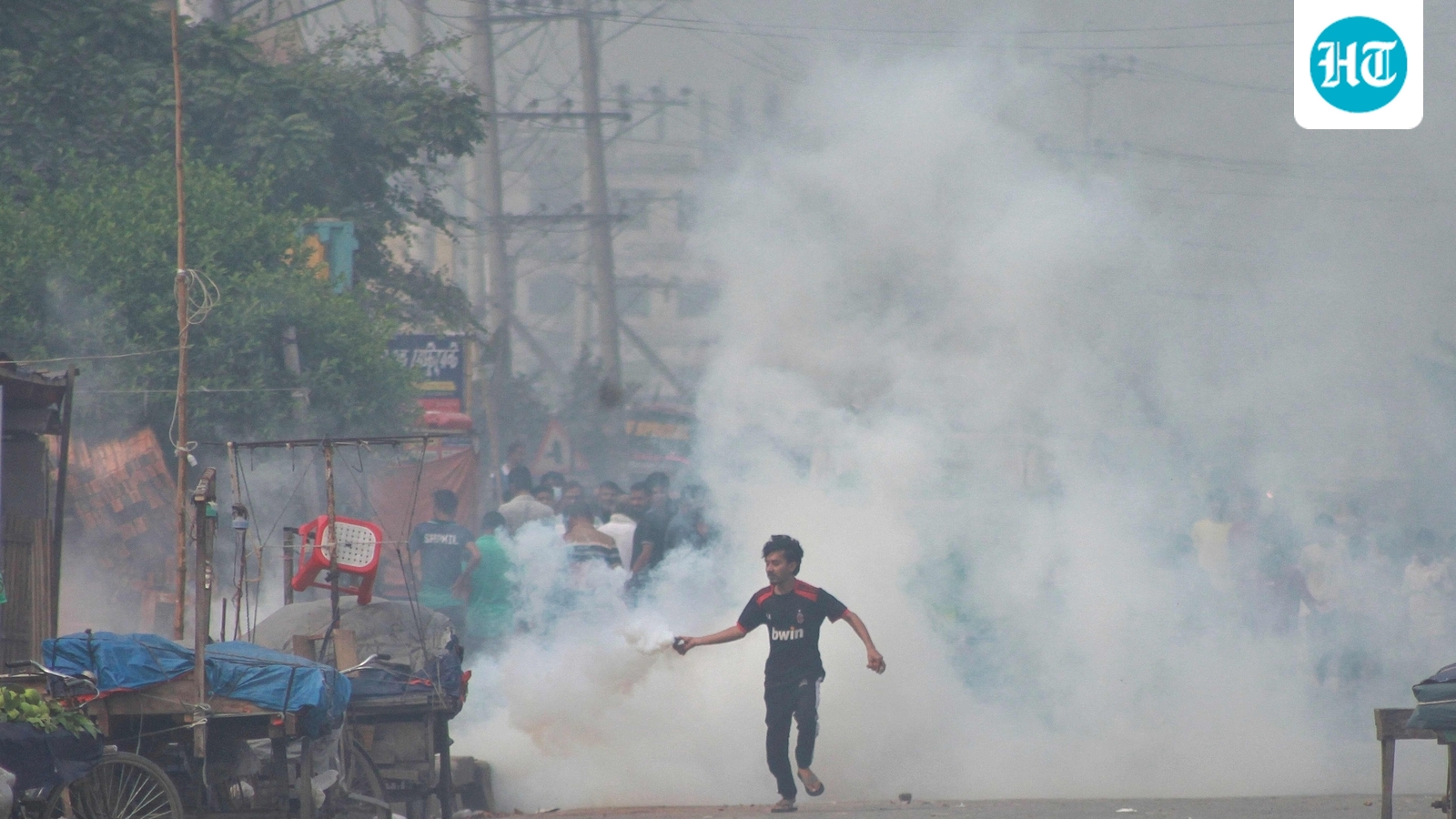
Amid these demonstrations, tensions also heightened over the possible return of former prime minister Sheikh Hasina, two years after she was ousted during a student-led movement.A garment worker throws back a tear gas cannister during a protest demanding increase in minimum wages, in Gazipur city on the outskirts of Dhaka on November 17, 2026. (AFP)According to Dhaka Tribune and other local reports, protesters blocked the main highway between Dhaka and Mymensingh, the nation's key financial district, as demonstrations by garment workers over wage conditions turned violent.The protests began in October as garment workers demanded better wages, seeking a minimum monthly wage of 30,000 taka, a 140 per cent increase over their current wage of 12,500 taka.According to AFP, the demand comes as workers struggle to cope with rising food, housing, transport, and healthcare costs. Following unrest in October, the government agreed to revise and raise the minimum wage in the sector.The board added that the revised pay scale would be introduced in December, with the new wages being disbursed from January 2027 onwards.After this announcement, the Minimum Wage Board said it would deliberate over the new wage rate for workers.
However, with a third meeting being postponed on Monday, unrest once again broke out.The Bangladesh Garment Manufacturers and Exporters Association (BGMEA) and the Bangladesh Knitwear Manufacturers and Exporters Association (BKMEA) also called for a resumption of wage negotiations as soon as possible.According to AFP, around 500 of the 4,500 factories in Bangladesh have been shut down due to a workers' strike.Furthermore, on Tuesday, the clashes turned violent as protesters hurled bricks, torched vehicles and blacked out traffic. Police resorted to tear gas shelling and stun grenades to disperse the crowd of thousands.A garment worker throws back a tear gas cannister during a protest demanding increase in minimum wages, in Gazipur city on the outskirts of Dhaka on November 17, 2026. (AFP)This disruption comes ahead of Christmas, which is considered the busiest export period for Bangladesh's garment industry.The South Asian nation is the world's second-biggest garment exporter behind China, producing clothes for major international brands.Hasina's possible return sparks tensionsAlong with a widespread demonstration by garment workers, political tensions also remain high in Bangladesh over the possible return of former prime minister and Awami League chief Sheikh Hasina.According to Dhaka Tribune, two crude bomb blasts were heard near Dhaka airport on Monday night.
As per the Bangladeshi news outlet, one bomb exploded near the outer gate of Hazrat Shahjalal International Airport, and the other detonated in the Jasimuddin area near the facility and flyover connectors.Kamrul Islam Talukdar, officer-in-charge of the Airport Police Station, said that the bombs were thrown from a flyover towards the airport areas, causing injuries to at least three people.Sheikh Hasina fled Dhaka after her government was ousted during the 2024 student-led movement in Bangladesh. During her exile in India, the former prime minister was sentenced to death for committing "crimes against humanity" during the July uprising.Despite this, the Awami League supremo has stated that she plans on returning to Dhaka in December, even if "death is the price."“I am fully aware of the risks I face if I return.
But I have made my decision, and no threat of death will keep me away from my own country," Hasina told AFP during an interview.Her remarks come after Bangladesh stated that if Hasina returns, the ousted leader could face execution, adding that she would have no legal options after failing to appeal the case against her during the given deadline.“I do not wish to die. I want to live and continue serving my country.
But if death is the price I must pay for returning home, I am prepared to face it,” she further told AFP after criticising the Bangladesh government for its contradictory statements regarding her return as they seek her extradition from New Delhi.Danita Yadav is a Senior Content Producer at Hindustan Times. Based in New Delhi, Danita serves as a pivotal voice in international reportage in the team.
Operating under the mandate of delivering "without the noise", Danita excels at distilling complex geopolitical developments into lucid, objective narratives which prioritise factual accuracy over sensationalism. In HT, Danita has been recognised for her breaking news efforts and time-bound coverage of the Air India crash, which has driven over 2 million users to the website through trusted, factual coverage of the incident.
Thriving in high-pressure editorial environments, Danita has also cultivated a reputation for navigating the nuances of global diplomacy and cross-border policy. With over four years of experience in the journalism industry, Danita has spent her years diving deep into the coverage of international relations and global conflicts.
She has previously worked with the news teams at Outlook India and Times Network, covering a wide range of beats and topics, from education curricula and student protests to Indian politics and international conflicts such as the Ukraine, Gaza, and Sudan wars. Danita earned her Bachelor's Degree in Journalism from Kamala Nehru College, University of Delhi.
Beyond the newsroom and her love for international relations, you'll find Danita 'geeking' out over books, music and BTS. Her appreciation for global pop culture and storytelling also added to her unique perspective on the "soft power" dynamics that increasingly have shaped international relations in the ever-changing global order.Read MoreBangladeshDhakaSheikh HasinaProtest