


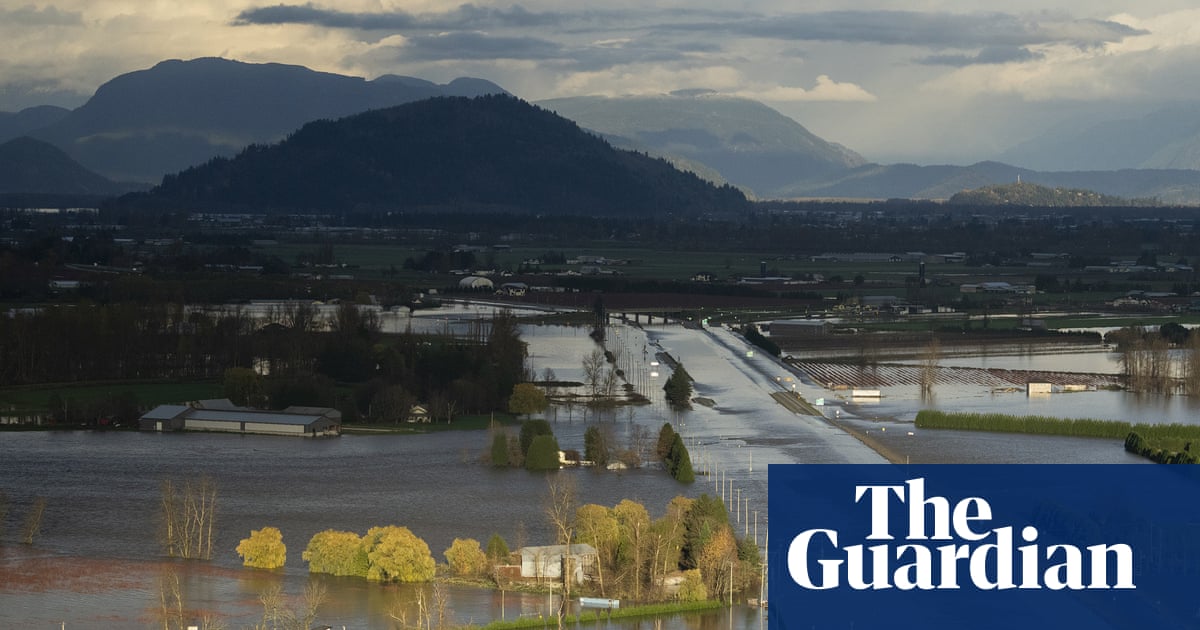
Location: Agassiz, Canada Disaster: Southern British Columbia floods, 2021 In 2021, Chelsey Sharpe was working part-time as a yoga instructor when a mudslide swept her car off the highway. Climate change made the heavy rains behind that mudslide and the 2021 floods across southern British Columbia more likely.Around Remembrance Day, I was visiting one of my best friends in the Okanagan.
The weekend was full of dance parties with my niece and nephew, authentic Mexican cuisine, fresh homemade churros, and games.I didn’t really want to go home. I took my time leaving.
I finally got on the road at about 2 or 3pm and, because of road closures, found myself on Highway 7 driving through Agassiz. I didn’t know why the roads were closed.
I thought it was just weather. I didn’t take this route ever.Chelsey Sharpe at the site of the mudslide in Agassiz, British Columbia, Canada.
Photograph: Jennifer Gauthier/Climate Disaster ProjectI remember stopping at a farmer’s market in Keremeos at about 4pm. The sun was starting to set.
I made multiple stops to take pictures of the sunset and the sky. I wanted to capture the way the sun was reflecting on the clouds.
It was oranges, pinks, and tons of different colours.As I was approaching Princeton, rain started to set in. It was a steady patter on my windshield.
I was listening to Snoop Dogg on Joe Rogan. Then my phone lost data.
All I heard for a good hour was silence and the rain.There was a ton of traffic when Highway 1 and Highway 3 were starting to merge near Hope. Traffic was crawling.
Typically, this road trip takes four to five hours. I’d been on the road for about six hours at that point.
I remember thinking: “When I get to Hope, I’m going to see if there is a motel that I can just pull in at and stay the night.”When I was passing through Hope, the city was blacked out. There was no power anywhere.
It was very eerie. You could see candlelight shining through the windows of homes and small businesses.
It was not an option to stop there. My GPS said I would be home in about 90 minutes.
I thought: “That’s OK. I’ll just keep going.”At about 7pm, traffic was starting to pick up on the stretch between Hope and Agassiz.
The cars around me helped illuminate some of the road, but it was really hard to see because it was so dark. I noticed a tree was starting to fall a little ways up the mountain.
I thought: “At the speed that I’m going relative to where the tree is falling, if I try to slow down the tree will hit me.” I made a split decision to speed up.I eased on the accelerator, because I thought if I could get past the tree then I’d be fine. My podcast started to kick back on, and I was like: “Oh, great.
We have service again.”A split second later my car was hit, almost like a freight train crashed into the passenger side. It was being pushed and careened.
I was tumbling down and then, all of a sudden, I stopped moving. It must have lasted for a minute or less, but time stood still.I was gripping my steering wheel as hard as I could, and I heard screams.
I realised it was me screaming. In my screams, I heard the sound of a car horn blaring.
I realised it was my car.The Sumas prairie flooding near Abbotsford, British Columbia, in 2021. Photograph: Zuma Press, Inc/AlamyMy car was leaning up slightly.
I remember my headlights were shining, but I couldn’t see anything. I didn’t register that I was in a pile of debris.
My car was surrounded with fallen trees, big boulders, and so much mud.I realised: “Oh my God, this is an emergency.” Because I heard people outside my car, I started yelling: “Help! Help!” Then I started to clue in that anyone there at that moment would be in the same position that I was.
They were also in need of help.I had my phone with me and an old iPhone for music. I went into my centre console, pulled out my music phone, and held on to it just in case.
Then, I pulled on the cord that my phone was plugged into. It came back empty.
I reached down near my feet to where the cord came from. I stuck my hand into about a foot of muddy, dark water.Even though my old iPhone didn’t have a sim card, it could still connect to emergency lines.
I called 911. An operator put me through to an ambulance line.
I explained: “I’ve been hit by a mudslide about an hour outside Hope, but I don’t know where I am.” The woman on the other line said: “Can you get out of your car?”It’s funny how my brain was starting to turn back on as I realised I needed to get out of this situation. “I don’t know, maybe,” I said. I click the button to undo my seatbelt and it doesn’t work.
I frantically start clicking it and, by some miracle, it comes out.I looked up and noticed my sunroof had broken because a big tree fell on it. I got up and shimmied myself out around the tree and broken glass.
I perched on top of this big tree trunk on my car. I looked around and it was very dark.
There was some light from my vehicle because it was still running. We were in a body of water.
I saw a patch of trees off to my left, but everywhere else around me was clear. The mudslide had taken out everything.A vehicle with four UBC [University of British Columbia] students was behind my car.
They must have been 19 or 20. A lot of them were in T-shirts.
Some were barefoot. They were all huddled under one jacket.
There was another car off to my right with the two women. We called out to each other.
We confirmed we were all alive. Way off to the left, I saw a light coming from a pickup truck with a man and his wife.
They were too far to see or hear.A home and outbuildings surrounded by water in Abbotsford, where days of heavy rain left properties flooded and roads impassable. Photograph: Jonathan Hayward/API was watching the raindrops fall into the water and the water level slowly rise over the brake lights of my car.
My car started to die. The lights shut off.Time kept ticking away.
There were very long stretches of darkness. At about 8.30, I was thinking: “We’ll be out of here by 10pm.” Then, 10pm rolled around.
I remember thinking: “We’ll be out of here by midnight.”A lot of the time on my car was spent shivering. I was wearing my moccasins, soccer pants and a white zip-up cotton hoodie that was soaking wet.I was so tense from shivering, the muscles in my quads felt as if they were charley horsing [cramping].
I knew that when we breathe, our body relaxes on the exhale. I spent time taking very intentional deep breaths to stretch out my limbs and give my mind something to focus on.
I remember trying to meditate, putting myself in the perspective of the forest. I told myself these trees are here all the time.
The animals are here all the time. I was just passing through.
But I got scared that I would fall in the water, so I would open my eyes.My imagination was starting to play around. I thought of boats coming across the water.
I thought of a helicopter coming and scooping us up. Some of these fantasies were not realistic.
That was just my desperation wanting to get out and feeling as if I didn’t have what it took to get out of there on my own.When I would call 911, my calls would sometimes get disconnected. At one point, I was put through to the Agassiz fire department, where I connected with the fire chief, Corey.
I remember asking Corey at about 11.30pm if there was any way he could call my dad and merge our phone calls.I took my best guess at his phone number. I said: “Hey, Dad, I just want you to know that I’m OK.
I was hit by a mudslide a couple of hours ago. I’m sitting on top of my car right now, waiting for a search and rescue.
Can you pick me up at some point tonight?” He was shocked. “Yes, of course,” he said. I remained on the phone with Corey consistently throughout the rest of the night.At one point, one of the UBC students began to have an asthma attack and didn’t have access to his inhaler.
Corey, via me, instructed one of the students to check his pulse, one of the students to count to 10. I relayed that information to Corey, who was monitoring the student’s vitals to make sure he was stable.Flooded farmland in Sumas prairie, Abbotsford, after atmospheric river storms brought torrential rainfall to parts of British Columbia in November 2021.
Photograph: Canadian Press Enterprises, Inc./AlamyEventually, 1am rolled around, and I remember seeing the beam of search and rescue lights far out in the distance. They were navigating fallen power lines and fallen trees.
Over the next hour or two, rescue made their way closer to where we were. One of the guys yelled out: “Do you think you can make your way over to where we are, and then we can help you navigate back to the road?”I said: “You want us to get in the swamp?” This was what I’d been avoiding for the last five hours.I unzipped my sweater because it was soaking wet and weighing me down.
I started to climb over the back of my car and the big tree that was there. I was perched on this tree trunk like a frog.
When it was time to start moving, I was paralyzed by fear. I thought the swamp was going to suck me in.I looked up, and one of the search and rescue crew had waded over to where we were.
He reached his hand out to me, and I grabbed it. I felt the courage to get in the water.
I had my hand on his shoulder until we were out of the waist-deep water.The search and rescue team guided us through boulders and rocks. I remember seeing a crumpled up “Beware of Rockfall” sign in the debris.All nine of us eventually completed the hour-long trek back to solid ground.Once we were settled on a bus, I borrowed somebody’s phone to call my dad and let him know that we were out and going to Chilliwack general hospital.
It was tricky for the team to navigate the roads to the hospital because there were so many hazards. When we got to the hospital at about 4am they triaged us.
I had some soft-tissue damage. The couple that was in the truck were being assessed for a concussion.After my dad got to the hospital at about 5am, I started to feel this horrible gut pain.
I didn’t even register that I had to pee so badly. The fear and being in survival mode had shut down that part of my body.We got on the road about 6am.
My dad was bringing me back to my house, where I lived with my roommates Ruth and Ava. It was still raining a lot.
I closed my eyes and fell asleep. My dad drove through a puddle on the passenger side, the side the slide hit me on.
That jerked me awake. It felt like I was back in that moment.
It was PTSD.My dad dropped me home roughly 12 hours after the slide. I’m standing in the foyer, and Ruth walks out of her room.
I’m wearing a hospital gown, my hair was in a bun, half out and caked in mud. She was like: “What happened?”People navigate flood waters in Abbotsford in the aftermath of the storms that triggered devastating floods and landslides across British Columbia in 2021.
Photograph: Jennifer Gauthier/ReutersI took a shower and there was dirt all over the bathroom floor. I cuddled my cat and went to bed.
I was in and out of sleep throughout that day. I remember Tuesday, I felt like I had internal bleeding or something.
I called my dad and was like: “I think I need to go to the hospital. I am in so much pain.” Then, I started my cycle.
It was regular cramps that you get around your cycle. Because I was safer, my system started to release all of the cortisol that embedded itself into my core, amplifying that pain times 10.I started to go back and reassess every decision I had made that day.
Had I not made stops, would I have made it through and gotten home that evening? There was another slide in Lillooet on Highway 99.
A couple died and left behind a two-year-old daughter. I remember thinking, why?
Who decides who gets to stay and who has to leave? These are questions that we ask and will never know.For about a year after the mudslide happened, I would consistently have dreams about the end of the world.
It was asteroids, earthquakes – scary situations I couldn’t do anything about. A lot of them involved floods.
Sometimes I was thriving in the apocalypse, and sometimes I was struggling to survive. I experience a lot more anxiety.
I do my best to deal with it because I don’t want fear to run the show.I took time off work to take care of myself. I received help as soon as I could.
It put me in a position to get my education in counselling. I am able to make a difference with people in their lives.
I wouldn’t want to relive the slide, but I’m grateful for the lessons I’ve learned, for the perspective it’s given me, and for the way that it’s helped me realise that I need to live a life that feels aligned.Even if you’re in a situation that feels out of control, when you change the way that you’re showing up inside of that circumstance, the outcome inevitably changes. My hope is that anyone who is reading this realises they are empowered inside of their own life, and they can make a big difference, even if we feel small.