


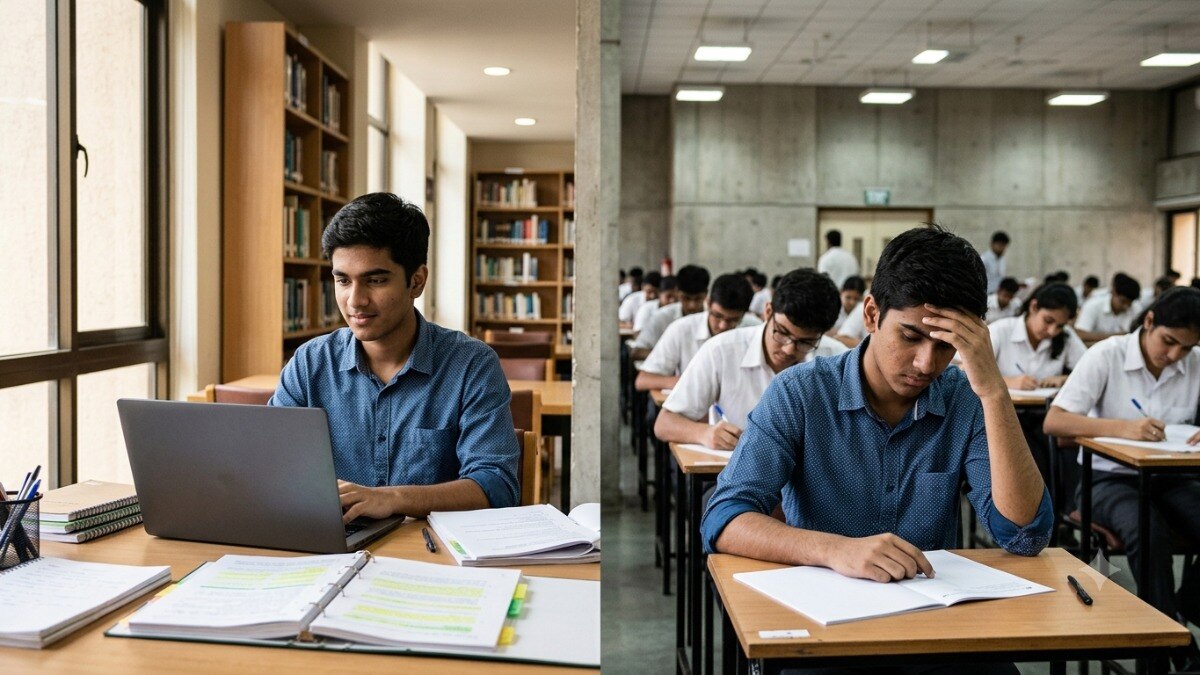
New Delhi: Artificial intelligence has evolved into a regular academic companion for students in India and across the globe. While these digital tools can streamline assignments and elevate the quality of written work, mounting evidence introduces a critical dilemma regarding whether students are truly absorbing knowledge or merely leaning on technology to finish tasks.
Data from a FICCI-EY-Parthenon report titled From AI Adoption to Readiness: Preparing Indian Higher Education for the AI Era indicates that AI integration is deeply rooted in modern college routines. Roughly 23 percent of students employ artificial intelligence daily for schoolwork, while an additional 43 percent turn to these tools multiple times a week, leaving only one percent who report never utilizing them.
Academic research stands out as the primary application, cited by 84 percent of students, followed closely by writing assistance at 76 percent, clarifying challenging subjects at 68 percent, and proofreading at 63 percent. These functions certainly make education more accessible by helping learners organize thoughts and refine arguments.
However, educators emphasize a fundamental difference between utilizing an application to grasp a complex concept and prompting the software to generate a final answer submitted without comprehension. This distinction matters because polished assignments do not guarantee genuine cognitive progress.
A separate study featured in the World Bank's World Development Report 2026 sheds light on this exact vulnerability. The investigation monitored students across grades 7 through 12 in China between 2022 and 2025 as generative artificial intelligence utilization expanded from near zero to approximately 80 percent within the sample group.
In the six months following the introduction of AI, participants experienced an 18 percent gradual improvement in their homework grades. Conversely, their monthly proctored in-class examination scores dropped by 20 percent.
This divergence indicates that while students grew more adept at finishing deliverables, they struggled to cultivate the foundational skills and knowledge required for independent execution. The research also revealed that students who maintained steady independent study habits alongside technology use suffered less severe drops in exam outcomes, pointing to student effort as a vital mediating factor.
Furthermore, the preliminary Chinese study indicated that lifetime users of artificial intelligence scored between 5 and 7 percent lower on high-stakes senior high school and college entrance evaluations, with negative consequences compounding over extended exposure periods. Authors of the report noted, however, that these specific findings were non-peer-reviewed at the time of publication and should be viewed as preliminary.
The core apprehension centers around technology assuming too much of the cognitive load. A student who uses a chatbot to dissect a complex mathematical formula gains a helpful tutor, but another who simply copies the output misses the critical cognitive friction necessary to tackle similar problems unaided.
The World Bank explores this exact phenomenon regarding the potential erosion of human skills and deep learning. Similar anxieties resonate within Indian higher education circles, where the FICCI-EY-Parthenon study highlights worries about overreliance, academic integrity, and a grey zone separating ethical study aids from unauthorized shortcuts.
As campuses grapple with these shifts, traditional assessment structures face unprecedented stress. Flawless essays and structured projects can no longer serve as foolproof indicators of true student mastery or autonomous capability.
Simply prohibiting artificial intelligence is unlikely to resolve the challenge, particularly when students turn to automated helpers to cope with heavy workloads, linguistic barriers, or gaps in classroom instruction. Instead, institutions must address underlying pressures while defining clear boundaries for permissible use.
Educators suggest pivoting toward evaluation methods that test actual comprehension, such as oral defenses, supervised problem-solving, and interactive discussions. Ultimately, the benchmark for students remains straightforward: after leveraging technology to draft an assignment, can they articulate their reasoning and solve a parallel problem independently?