


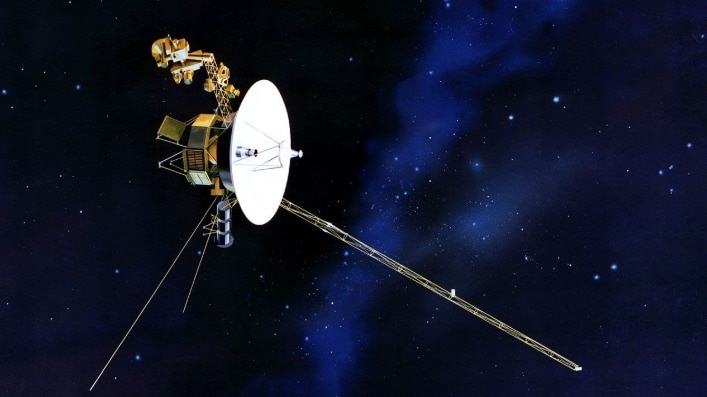
Nasa's Voyager 1 is expected to reach one light-day from Earth today, travelling nearly 25.9 billion kilometres after a journey of almost 50 years.An artist's concept of Nasa's Voyager spacecraft with its antenna pointing to Earth. Nasa’s Voyager 1 is expected to reach a distance of one light-day from Earth on Wednesday, November 18, becoming the first human-made object to travel so far into space.At that point, the spacecraft will be about 25.9 billion kilometres from Earth; so distant that even a signal travelling at the speed of light will take a full 24 hours to reach it.The milestone is expected at 3:46 pm IST, nearly 50 years after Voyager 1 began its journey.It is the farthest-travelling human-made object, and its achievement will pave the way to understanding the enormous distances that need to be traversed in space exploration.
An artist's concept of Voyager 1 travelling throguh space. WHAT IS A LIGHT DAY?A light-day is not a measure of time but instead describes the distance light travels in one day, or 24 hours.Light moves at about 2,99,000 kilometres every second.
Over a full day, it covers roughly 25.9 billion kilometres. The term works much like a light-year, which is the distance light travels in a year.Astronomers use such measures because distances in space are so vast that kilometres can become difficult to picture.At one light-day away, a message sent from Earth to Voyager 1 takes 24 hours to arrive.
A reply would take another 24 hours to return, meaning a simple exchange could take about two days.THE LONG JOURNEY OF VOYAGER 1Nasa launched Voyager 1 on September 5, 1977, to study Jupiter and Saturn. Nasa's Voyager 1 spacecraft is seen launching from Florida in 1977.
It flew past Jupiter in 1979 and Saturn in 1980, sending back close-up observations that helped scientists learn more about the planets, their moons and their rings.The spacecraft also captured the famous “Pale Blue Dot” image of Earth in 1990, showing our planet as a tiny speck against the darkness of space.In 2012, Voyager 1 became the first spacecraft to enter interstellar space, the region beyond the vast bubble of particles and magnetic fields created by the Sun.Despite operating for far longer than its original mission, Voyager 1 is still sending scientific and engineering data to Earth. Engineers secure the cover over the Voyager 1 Golden Record.
It also carries a Golden Record, a gold-plated disc containing sounds and images from our planet, intended as a message from humanity to any life that might encounter it.Travelling at about 61,000 kilometres per hour, Voyager 1 has taken nearly five decades to cover a distance light crosses in a single day.- Ends