


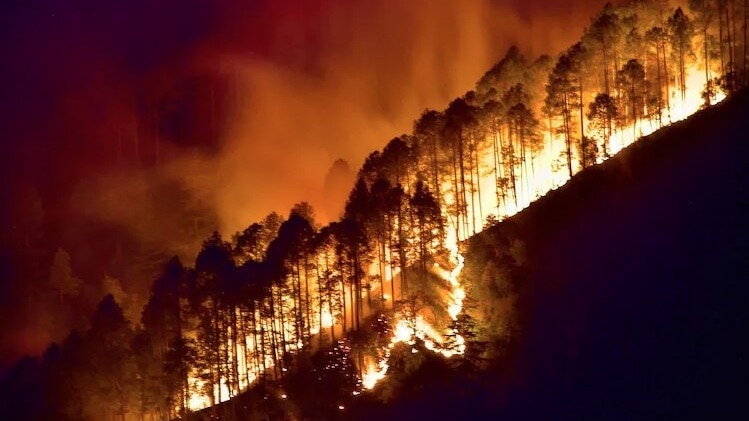
Jamaica, Sri Lanka and Spain were the countries most affected by extreme weather in 2025, while India ranked among the 10 worst hit over three decades.An image showing a forest fire incident in the Himalayas. Extreme weather events have killed more than 9,00,000 people, affected 5.5 billion and caused economic losses exceeding $4.7 trillion worldwide over the past three decades, according to the Climate Risk Index (CRI) 2027 released by Germanwatch at the COP31 climate conference in Antalya, Turkey.The report analysed nearly 10,000 climate-related disasters, including heatwaves, tropical cyclones, storms and floods, between 1996 and 2025.Their work has highlighted how lower-income countries, despite contributing relatively little to greenhouse gas emissions, often suffer the greatest consequences.
Houses damaged by the flash flood are seen along the Trishuli River in Nepal. POORER COUNTRIES FARE THE WORSTThe long-term assessment places Dominica among the most affected countries, followed by Myanmar and Honduras.
The Philippines ranks seventh, while India is in 10th place. The report identifies two broad groups; countries hit by exceptionally destructive disasters and those repeatedly exposed to extreme weather.Dominica, Myanmar and Honduras represent the first, while India and the Philippines fall in the latter category.
An aerial view shows mudslide debris and floodwaters. Laura Schafer, one of the report's authors, said the Bahamas was the only high-income country among the ten most affected nations, adding that repeated tropical cyclones had destroyed infrastructure that countries had already rebuilt.Vera Kunzel, another co-author, said climate change was turning exceptional disasters into recurring threats.JAMAICA, SRI LANKA, SPAIN HIT THE HARDEST IN 2025For 2025, the index ranks Jamaica, Sri Lanka and Spain as the three most affected countries, followed by Thailand, the Philippines and Pakistan.
A man rides his bicycle in the aftermath of Hurricane Melissa. Category 5 Hurricane Melissa killed 62 people in Jamaica and caused damage estimated at almost half of the country's GDP that year.In Sri Lanka, Cyclone Ditwah killed 823 people and affected more than 1.7 million.
It triggered landslides and caused an estimated $4.1 billion in losses, resulting in the country's worst flood disaster in 20 years, the report said.Spain experienced its hottest summer on record at the time in 2025, alongside a heatwave, three storms and three wildfires. An aerial images shows a wildfire in Spain.
Its ranking shows that wealthier countries are also vulnerable to multiple climate hazards.HEATWAVES KILLED THE MOSTHeatwaves caused the highest number of deaths over the 30-year period, while storms accounted for the greatest economic damage.Extreme weather killed around 35,000 people worldwide in 2025 alone. A boy offers water to another boy after playing cricket during a heatwave.
Germanwatch said the actual toll, particularly from heat-related illnesses, is likely higher because many deaths go unreported in poorer countries.“The human toll of inaction is alarming, and it shows that the situation is becoming increasingly dramatic,” said Lisa Schultheib, a co-author of the index.CLIMATE FINANCE AND ADAPTATION REMAIN CRTICALThe report calls for greater investment in early warning systems, flood protection, heat action plans and resilient infrastructure, alongside faster emissions cuts and increased financial support for vulnerable countries."The CRI results reinforce adaptation as one of the most cost-effective investments in human security and prosperity, including in Europe," said co-author David Eckstein.Germanwatch has published the index since 2006, and assesses deaths, the number of people affected and economic damage, using disaster data from the International Disaster Database (EM-DAT) and socioeconomic information from the International Monetary Fund and the World Bank.The organisation cautions that poorer countries often lack comprehensive systems to record deaths and losses, meaning the actual impacts may be underestimated.For countries such as India, repeated exposure to extreme weather makes climate resilience essential to protecting lives, livelihoods and long-term development.- Ends