


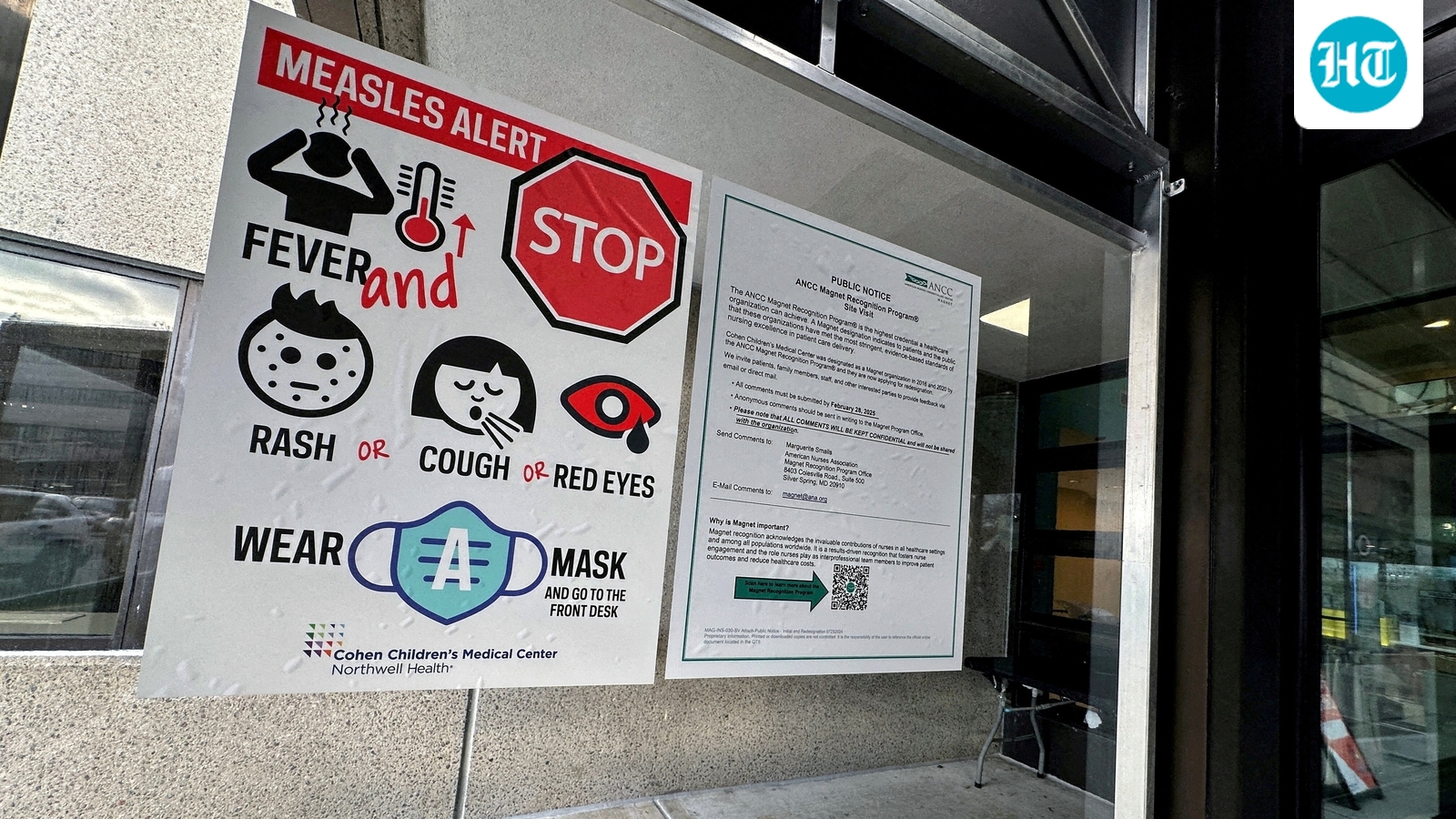
The US and Mexico have lost their long-standing measles elimination status after the disease spread rapidly through communities, a group of public health experts said on Tuesday.A measles alert sign hangs outside the entrance to the Cohen Children's Medical Center in New Hyde Park, New York. (REUTERS)The determination followed a review of the evidence by the Pan American Health Organization which found strains of the virus has been circulating for more than a year in both countries. The US, Mexico and Bolivia lost the designation, PAHO reported.While the designation is merely a label, the loss signals these countries no longer have control over the spread of measles.
PAHO meets annually to review the evidence and determine the loss of status.Also Read | Why is the US seeing over 1,600 measles cases in 2026, the worst outbreak in decades?“They need to stop the transmission as soon as possible and after that keeping the country without endemic transmission for at least 12 months,” PAHO Director Jarbas Barbosa said in a press briefing Tuesday.Daniel Salas, executive manager of PAHO’s Special Program for Comprehensive Immunization, said he expects the US to present a plan to return to elimination in the coming weeks. PAHO will submit recommendations to countries that lost the status in the coming days.
Guatemala and Peru are also experiencing significant outbreaks.“Losing a designation doesn’t mean we abandon an evidence-based approach,” said CDC Director Erica Schwartz in a statement. “It means we remain focused on stopping outbreaks.”The Centers for Disease Control and Prevention has confirmed 5,412 cases so far in 2026, more than double last year’s total and the highest number since 1991. The US officially eliminated measles in 2000 following years of a dedicated public communications push to get people vaccinated.
Mexico eliminated the disease in 2016.Last year, Canada lost its designation following an outbreak that infected more than 5,000 people. In October, the country declared the outbreak over, but it will need to prove that it has stopped transmission for a year.
PAHO will review that data in 2027.In the US, measles, mumps and rubella vaccinations have been declining since the pandemic, allowing the disease to take hold again. Under Health and Human Services Secretary Robert F.
Kennedy Jr., the nation has seen a record number of infections and 10 people have died this year. Kennedy, who previously led an anti-vaccine organization, has claimed some of the deaths may be fabricated and has touted unproven treatments for an infection.In a post on X, Kennedy said he recommends the MMR vaccine. “We will stop measles outbreaks, protect American families, and work to regain US measles elimination status,” he wrote.The CDC says it’s provided about $100 million in additional funding nationwide to strengthen prevention and response to measles and other vaccine-preventable diseases.“It is unthinkable that people in the United States should be dying from measles in 2026,” said Wendy Armstrong, president of the Infectious Diseases Society of America.PAHO’s Barbosa addressed the ways misinformation has impacted vaccine hesitancy, saying that nurses and physicians need to translate scientific information for patients.“Health authorities also need to be prepared to respond to misinformation,” he added, “providing clear transparent information to the families and communities so that they can make the best decision to protect their children, which is to get them vaccinated.”Rapidly spreadingPennsylvania has seen the largest outbreak in the US this year, recording more than 1,500 cases since it began in April and seven measles-associated deaths.
Dozens of pregnant women in Pennsylvania have tested positive for the disease and one of the state’s reported deaths was a woman who had recently given birth.Between Jan. 1, 2025, and Sept.
28, 2026, 112 pregnant women in the US had a confirmed measles case during pregnancy, according to a preliminary study from the New England Journal of Medicine released Monday. Complications included maternal pneumonia, preterm delivery and neonatal complications.
At least 13 babies were born infected with measles in the past two years, the study found.The state health department has rushed to offer vaccines and reach the undervaccinated Amish and Mennonite populations. In September and October, healthcare workers delivered more than 118,000 doses of the MMR.But it was Utah’s cases that led to the US’s loss of elimination status.
The state’s outbreak began in June 2025 and has continued to spread, infecting more than 700 people.In Mexico, a measles outbreak began in the southern state of Oaxaca in February 2025 and then took hold of the northern state of Chihuahua, which later became the epicenter of the outbreak. The country has logged 20,701 cases since the outbreak started — a level of transmission not seen since the previous pandemic that ended in 1990.
This year through Nov. 12, there have been 14,087 confirmed cases across all 32 states.
The death count stands at 50.The nation has rolled out an intense vaccination campaign and administered more than 41 million doses. There isn’t much public debate about immunizations in Mexico, but there are huge gaps in availability and access to healthcare and medicine, particularly in more remote parts of the country.On Tuesday, Mexico’s Deputy Health Secretary Rafael Valdés Vázquez said the nation aims to regain its measles-free status in 2028 after ramping up vaccine efforts.
He said active measles cases have fallen more than 90% from the outbreak’s peak in February, with just 14 cases currently.Marcela Flores, Bolivia’s health minister, said Tuesday that the country has reduced measles cases by 83% this year, following a restructuring of its epidemiological response. Bolivia is focusing on vaccination campaigns, case monitoring, border controls and coordination with local governments to get the virus under control, she said.Return to US eliminationTo achieve elimination status again, a country must prove that the chain of transmission has been stopped and that it’s bolstered its surveillance capabilities.“This needs to be a priority,” said David Margolius, public health director in Cleveland.
Global coordination in tracking the disease, strong vaccination messaging and more resources are needed, he said on a call Monday with other public health leaders and reporters.The Trump administration has worked to upend the childhood vaccine schedule, with some of their moves tied up in federal court. In August, President Donald Trump signed an executive order directing HHS to break up the MMR immunization into three separate shots — a process that would be costly and time consuming for drugmakers.
The move also means children would have to get more shots for protection, potentially increasing vaccine hesitancy in parents.The MMR is 97% effective in preventing disease after two doses, according to the CDC. Measles is a highly contagious disease, infecting up to 90% of unvaccinated people exposed to the disease.