


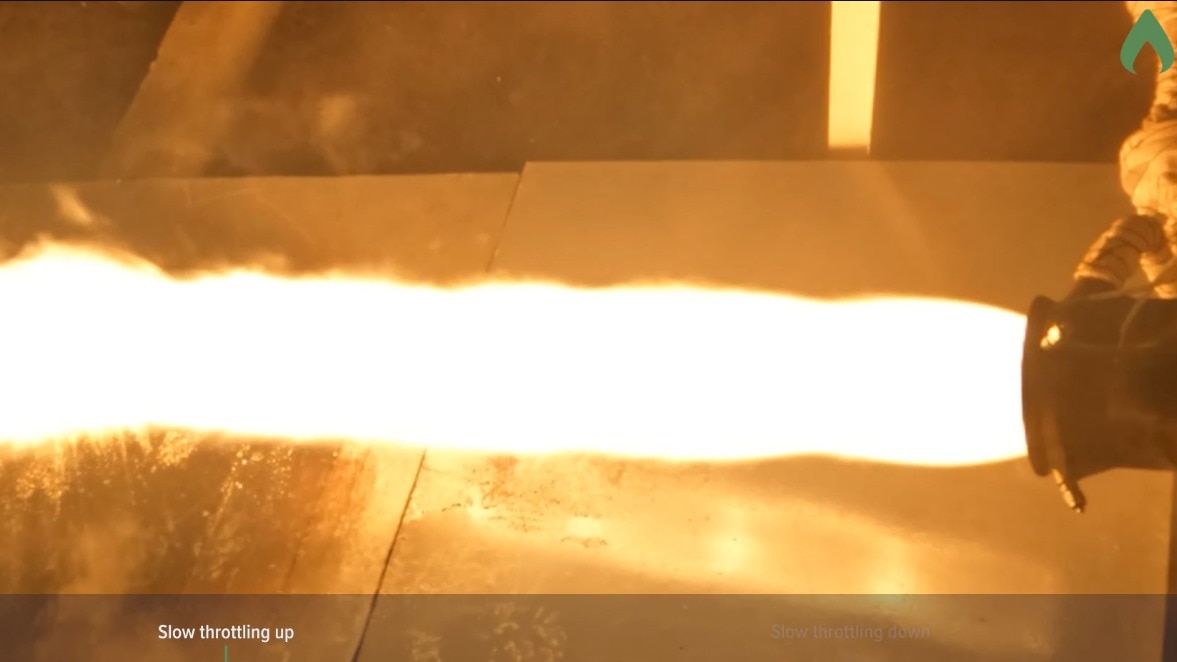
Known as Mach diamonds, these patterns are formed by shock waves in high-speed exhaust gases.Humbled to share a video of our electric motor-driven Agnilet engine's test firing as we get ready for Mission - 02. We can see the mach diamonds slowly emerge as we gradually throttle up.
We can also see the mach diamonds slowly disappear as we throttle down. For context - Agnilet already flew as a pressure-fed engine in our Mission - 01 on Agnibaan SOrTeD.
This is a pump-driven Agnilet. Still single piece.
Still fully 3d printed. Still semi cryo.
Now with 3d printed pumps too. More context - This also brings back our older horizontal semi-cryogenic engine test facility into action which will allow engine testing and flight qualification activities to happen in parallel. @srinathr155 @moin_spm @satchakra_iitm @iitmadras @IITMIC @iitm_respark @isro @INSPACeIND @ANRFIndia @tdbgoi @IndiaDST @startupindia @makeinindia @TIDCO_1965 @TN_SIPCOT @TheStartupTN @Guidance_TN @AP_EDB @startup_mission #Agnibaan #AgniletRocketEngine #Agnilet #ElectricPumpFedEngines #SinglePieceEngine #3dprinting #AdditiveManufacturing— AgniKul Cosmos (@AgnikulCosmos) November 18, 2026A STEP-UP AFTER FIRST FLIGHTThe upgraded engine is powered by electric motor-driven pumps that push fuel into the combustion chamber.
This is a change from the pressure-fed system used in Agnibaan SOrTeD, the company's first suborbital test flight in May 2024. In a pressure-fed engine, high-pressure gas forces fuel and oxidiser from their tanks into the engine.A pump-fed system uses mechanical pumps to do this, potentially allowing lighter tanks and more control over how much propellant reaches the engine.
Agnikul says the one-metre-tall Agnite retains its single-piece, 3D-printed construction. A screengrab shows the ricket engine test.
Its semi-cryogenic propulsion system uses liquid oxygen and a kerosene-based fuel. The recent firing included tests at different thrust levels, helping engineers study how the engine responds when its power is adjusted.The company has also used a horizontal test stand, which offers a clearer view of the engine's exhaust plume and allows testing activity to continue alongside work on other hardware.WHAT IS AGNIKUL'S MISSION-02?Founded in 2017 at IIT Madras, Agnikul is developing Agnibaan to carry small satellites into low Earth orbit.The May 30, 2024, mission, Agnibaan SOrTeD, was a 66-second suborbital flight designed to test the rocket's engine, flight control and other systems.
It was India's first rocket launch from a privately developed launchpad. An image of Agnibaan, after its first launch, Mission-02 is expected to take the company closer to an orbital launch and demonstrate technologies for recovering and reusing rocket hardware.Agnikul has outlined plans for a reusable booster and an upper stage designed for extended use in space, although a firm launch date has not been announced.The push towards reusability is significant because recovering and flying rocket hardware again could reduce the cost of future launches.In September 2026, the government announced Rs 200 crore in research and development support for Agnikul's fully reusable Agnibaan programme, aimed at developing a launch system capable of repeated missions.- Ends