


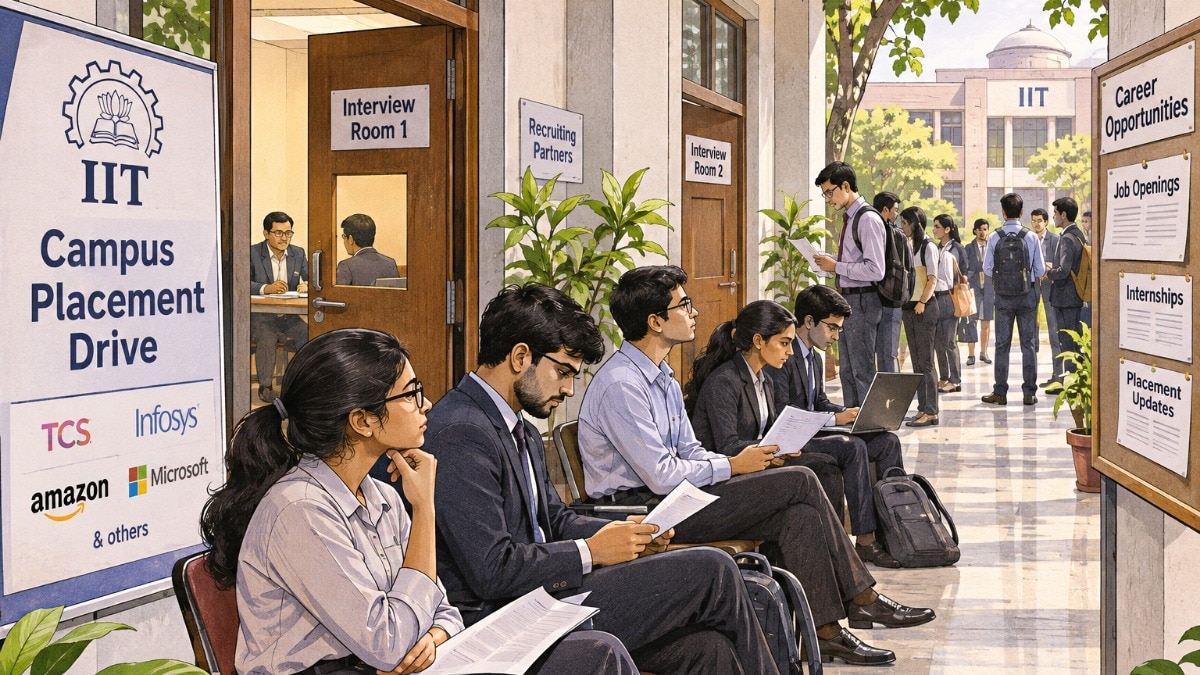
Every year, companies visit college campuses in search of talent that can serve their organisations in the long run. For students, these recruitment drives offer an opportunity to secure jobs, often with attractive pay packages.However, the hiring process, which moved largely online after the Covid-19 pandemic, is once again witnessing a shift towards in-person assessments and interviews.
Concerns over impersonation, cheating and the use of unauthorised assistance during online recruitment have prompted companies to reconsider the process.Several Indian Institutes of Technology (IITs), including newer gen IITs, have reported a growing preference among recruiters for offline placement drives.Responses received by India Today from several institutes indicate that companies are increasingly seeking to conduct recruitment activities in person, particularly for the 2026-27 placement cycle. The change comes at a time when online hiring has become an established part of campus recruitment.
The format allowed companies to conduct assessments across institutions without the need for physical visits and helped expand the reach of recruitment drives.A recent report by Mint also pointed to this change, noting that several IITs had confirmed a preference among recruiters for in-person tests and interviews for the batch of 2027. According to the report, the proportion of companies opting for such a format has risen to 60-70 per cent, compared with 40-50 per cent in the previous year."Industry reporting has highlighted instances involving impersonation, external assistance and unauthorised use of AI tools during assessments," told Professor Daviender Narang, Director, Jaipuria Institute of Management Ghaziabad to India Today.The concerns are not limited to the examination stage.Online interviews have also raised questions about candidates receiving assistance from others, sharing questions or using tools that may not be permitted during the selection process.In the wake of industry, as tech giants have religiously said, programmers are already using AI to write code.ONLINE HIRING FACES QUESTIONS OVER VERIFICATIONSpeaking to India Today, Professor Indranil Manna, former director of IIT Kanpur and current director of BIT Mesra, said the institute does not consider online assessments inherently unreliable, nor does it view offline testing as the only solution.He, however, acknowledged that online recruitment can present challenges, including impersonation, unauthorised assistance, sharing of questions and other forms of malpractice.The recruitment process has also become more complex with the growing use of AI tools.While such tools have found a place in coding and programming, the use of them during assessments has raised concerns.Companies generally conduct multiple rounds of selection during campus placements.These may include initial aptitude and technical assessments, followed by interviews, group discussions or problem-solving exercises, depending on the requirements of the recruiter.While the initial rounds are often conducted online, the later stages may require direct interaction with candidates.The use of online platforms, as shared with India Today by several institutes, has also led recruiters to introduce additional safeguards.
These include identity checks, webcam and microphone monitoring, browser restrictions and screen activity tracking.INSTITUTES STRENGTHEN CHECKS DURING PLACEMENT PROCESSInstitutes, meanwhile, have their own procedures to ensure that students taking part in campus recruitment meet the prescribed eligibility criteria and follow the rules of the selection process.At BIT and IITs, the placement process includes verification of students' credentials through supporting documents and faculty coordinators.Academic details, including CGPA and backlogs, are obtained directly from the institute's enterprise resource planning (ERP) system rather than being entered independently by students.The institute also uses its official placement portal to verify students' eligibility against the criteria set by recruiters.For assessments conducted on campus, the Institutes provides computer and internet facilities.The placement guidelines restrict students from carrying mobile phones and other personal belongings into examination halls and computer laboratories during written and online tests.The institute also noted that recruiters may use technology-based safeguards, depending on the assessment platform and their requirements.These include AI-enabled remote proctoring, webcam and microphone monitoring, browser lockdown, screen activity tracking, identity verification and alerts for suspicious activity.The return of companies to IIT and other campuses does not, therefore, mark a rejection of online recruitment altogether.Rather, it points to the efforts being made by recruiters and institutions to address the limitations of a process in the AI age that became common during the pandemic.- Ends