


When Mr Justice Bennathan sentenced Russell Brand to 10 and a half years in prison, there was a notable shift in the characterisation of victims of sexual assault. “Whatever women wear, wherever they go, whatever they drink, they retain the right to say no, and to demand justice from the criminal courts when sexual predators like you, Russell Brand, act without their consent,” the judge said.In 1977 it was a completely different story. Justices Roskill, Wien and Slynn allowed the convicted rapist Queen’s Guardsman Tom Holdsworth to walk free on appeal after his rape conviction because of his “promising army career”.
The same year, Judge Zigmond gave the rapist of a three-year-old girl just a suspended sentence, telling her mother: “You will forget it and so will your little girl.” Judge Peter Mason gave a six-month sentence to Maurice Markham, a rapist from the Royal Navy, because “it would be a shame if the country loses your services”.Much has changed in the criminal justice system over the last 50 years, but the prevalence of rape continues to have a pernicious impact. According to Rape Crisis England and Wales one in four women over the age of 16 have been raped, with two in five rapes carried out by a partner, and six in seven perpetrated by someone the women knew.
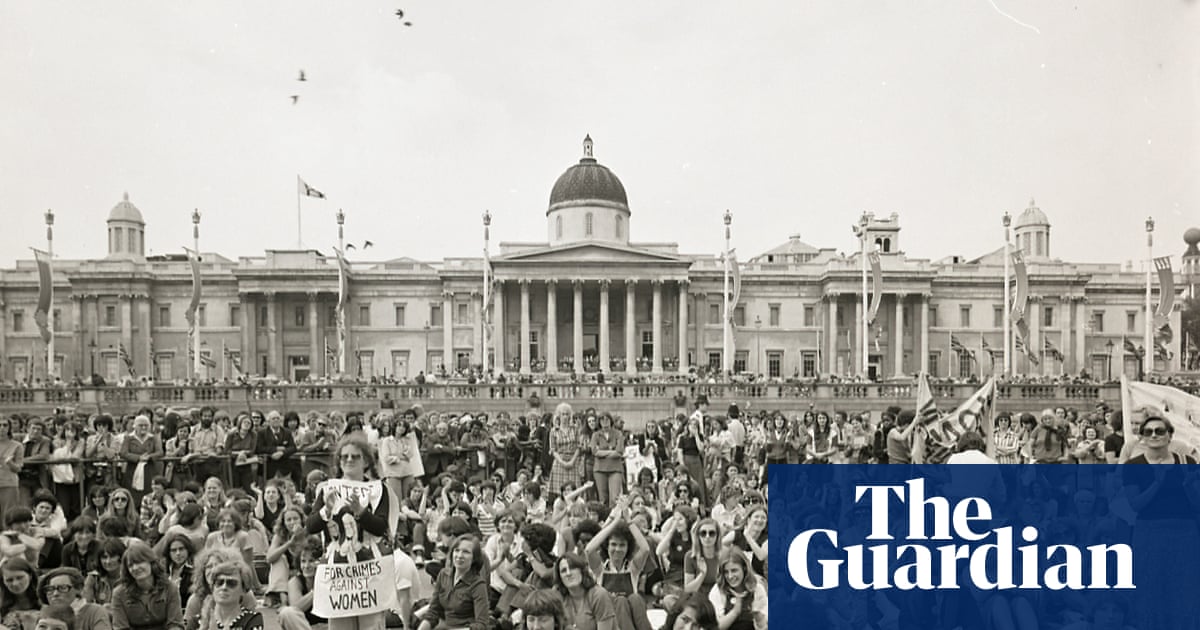
In 2024, 71,227 rapes were recorded by police, but only 2.7% of the cases led to an alleged rapist being charged that year.On 16 July 1977 a ‘summons to a public trial’ was organised by WAR campaigners in Trafalgar Square, London. Photograph: Robert WorkmanThe campaigning organisation Women Against Rape this week marks its 50th anniversary.
It has fought for decades against a system that has often been weighted against victims, and is depositing its extensive archive at the Bishopsgate Institute to mark this milestone.According to Ruth Hall, now in her 70s and one of the founders, WAR was set up by a small group of people she described as “ordinary women”.The group drew up a statement of aims, photocopied on to green sheets of paper, recognising the power imbalance that came from men usually having greater financial means than women. They called for rape within marriage to be recognised as a crime and for women’s sexual histories not to routinely be part of rape trials, along with practical steps to protect women out at night such as better street lighting.Hall says one of the early chants of the group was: “Yes means yes and no means no, however we dress and wherever we go.”“Women were furious,” says the longtime WAR campaigner Lisa Longstaff, describing its early days. “Grassroots women got together because we were so absolutely outraged about how rape was treated.”Campaigning for rape in marriage to be criminalised was not a quick win, but that made the victory particularly important to WAR.
Fifty years ago, rape in marriage was legal and being raped by a man you knew, or in a position of authority, was routinely dismissed. Rape in marriage was finally criminalised in 1991 after years of campaigning.On 16 July 1977 a “summons to a public trial” was organised by campaigners in Trafalgar Square, London.
Women filled the square as rape and violence against women were put on mock trial by female activists, who staged the prosecution flanked by the square’s famous lions.‘We organised the Trafalgar Square protest in just a few weeks,’ says Ruth Hall, one of WAR’s founders. Photograph: Robert Workman“It was a time when everything was being questioned,” says Hall. “It was very exciting.
We organised the Trafalgar Square protest in just a few weeks, having our planning meetings in a disused bank with water pouring down the walls. In those days we only had leaflets and the phone to get the message out to women about the protest.”The same year, in protest against the three appeal court judges who allowed Holdsworth to walk free, a group of women got into the Athenaeum, the judges’ club in Pall Mall, and dropped a banner from the first-floor balcony.In 1995, WAR brought the first private prosecution for rape in England and Wales after a man attacked two sex workers.
He was convicted on the same evidence the Crown Prosecution Service had dismissed as “insufficient”.Establishing that refugee women seeking asylum from rape, domestic violence and other torture are entitled to protection has been another key part of the group’s campaigning work.“We set a precedent in 1997 that due to the impact of trauma, a woman had been ‘unable, not unwilling’ to report rape,” says Longstaff.“We are still up against institutional misogyny but things are really changing. We have always said men in positions of power and authority should not be above the law, including celebrities.
Finally, some of them are being treated as the criminals they are.” Information and support for anyone affected by rape or sexual abuse issues is available from the following organisations. In the UK, Rape Crisis offers support on 0808 500 2222 in England and Wales, 0808 801 0302 in Scotland, or 0800 0246 991 in Northern Ireland.
In the US, Rainn offers support on 800-656-4673. In Australia, support is available at 1800Respect (1800 737 732).
Other international helplines can be found at ibiblio.org/rcip/internl.html