


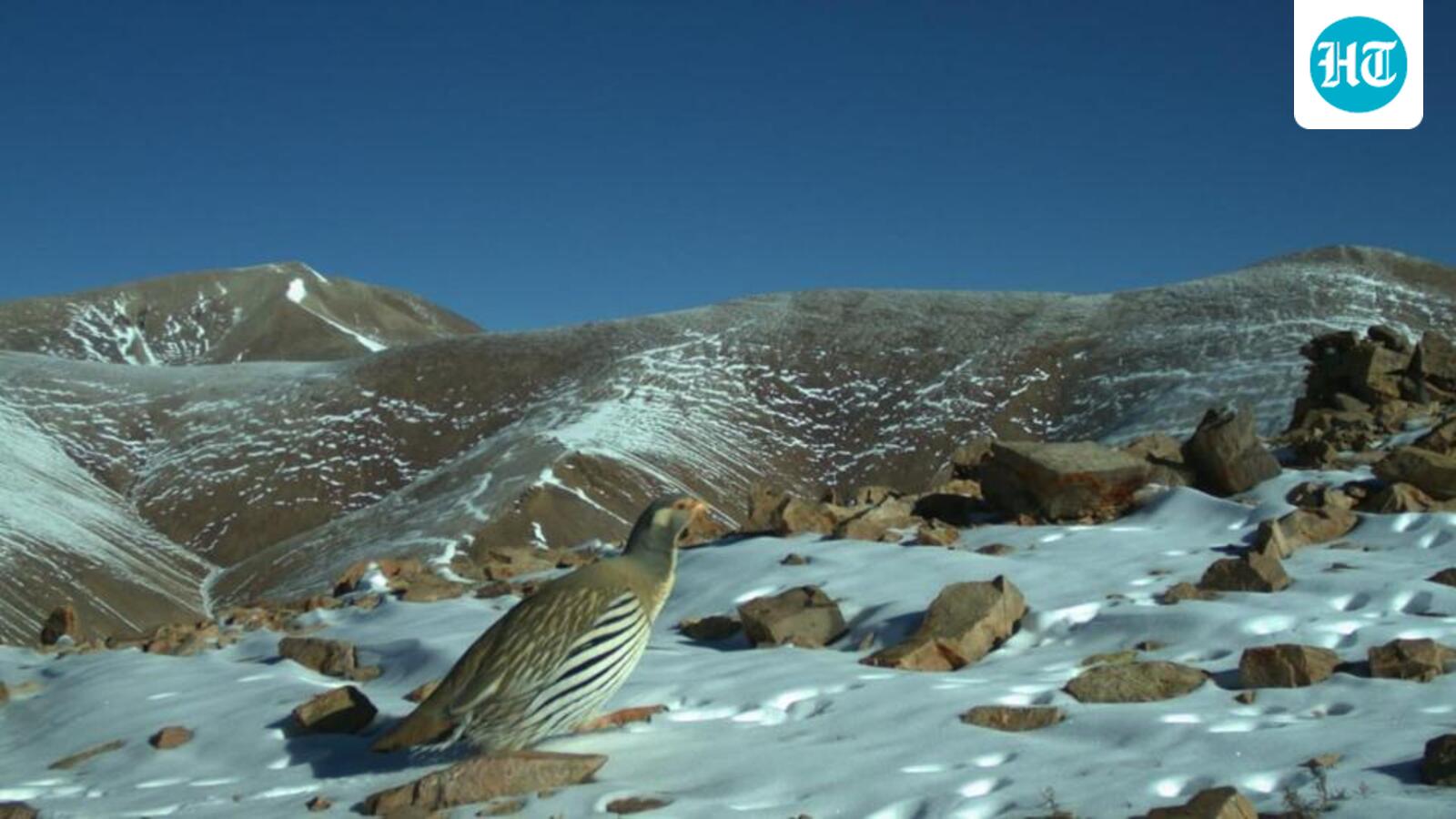
Nearly half of the bird species recorded on camera traps across Uttarakhand’s high-altitude Gangotri landscape have been documented above their previously published upper elevational limits, according to a new study by scientists from the Wildlife Institute of India (WII).In the study, repeated detection was defined as at least two above-limit detection records across at least two camera stations. Across the 55 detected species, 14 species met this criterion. (HT Sourced Photo)According to researchers Anuj Joshi, Vineet Dubey, Ranjana Pal, Jeyaraj Antony Johnson and Sambandam Sathyakumar (from the Wildlife Institute of India, Dehradun) and Ranjana Pal (from the Nature Conservation Foundation, Mysuru), the study examined 551 confirmed bird detection events across 55 species gathered over three years (between 2016 and 2018) from 228 camera trap stations spanning elevations of 2,500 to 5,250 metres above sea level in the Bhagirathi river basin, covering parts of Gangotri National Park and adjoining areas of the Uttarkashi Forest Division.
The study was published online on November 19, 2026, in the journal Environmental Monitoring and Assessment.Out of the 55 bird species detected in the study, 26 species were recorded at least once above their published upper elevational limits (accounting for 137 above-limit records overall), while 14 species showed repeated above-limit detections across multiple camera stations.Dubey, who is the project scientist at WII for the National Mission for Sustaining the Himalayan Ecosystem, said, “The 14 bird species that showed repeated above-limit detections across multiple camera stations in the Gangotri landscape included the Olive-backed Pipit, Trumpeter Finch, Himalayan Beautiful Rosefinch, Pink-browed Rosefinch, Snow Pigeon, Plain Mountain Finch, Himalayan Monal, Black-winged Snowfinch, Tibetan Snowfinch, Blue Whistling Thrush, Rufous-vented Tit, Black Redstart, Black-throated Accentor and Himalayan Snowcock.”Some species also appeared far higher than their published upper limits, including Vanellus indicus (red-wattled lapwing, maximum exceedance of 3,286 m), Sturnia pagodarum (Brahminy starling, 2,466 m), Anthus hodgsoni (Olive-backed Pipit, 2,091 m), Gallicrex cinerea (watercock, 1,717 m), Bucanetes githagineus (Trumpeter Finch, 1,647 m), and Upupa epops (hoopoe, 1,572 m). The study pointed out that several of these large exceedances came from small numbers of detections and require verification rather than being taken as direct evidence of long-term shifts.The team also checked detections against mapped IUCN geographic ranges and found individual sightings extending beyond those boundaries, led by bird species Montifringilla henrici (1,258.62 km), Bucanetes githagineus (661.90 km), Eremophila alpestris (249.59 km), Vanellus indicus (171.04 km), and Tetraogallus tibetanus (155.28 km).“Targeted bird surveys and repeated observations will be needed to determine whether these records represent persistent local populations, transient occurrences, or gaps in existing distributional information,” Dubey said.In the study, repeated detection was defined as at least two above-limit detection records across at least two camera stations.
Across the 55 detected species, 14 species met this criterion.Dubey said, “Though the Himalayan region is widely recognised as sensitive to warming, we have cautioned against treating these contemporary snapshots as proof of recent, climate-driven upward range shifts. For that, more long-range research in time and geography is needed to establish a proper scientific correlation.”The researchers also pointed out that broad-scale distribution maps and published elevation ceilings are not always exact at fine local scales in rugged mountain terrain, adding that camera traps were originally set up primarily for large mammals and ground-dwelling Galliformes, which means bird records were incidental and did not measure species occupancy or true absence.ABOUT THE AUTHORNeeraj Santoshi is the Chief of Bureau for Hindustan Times in Uttarakhand, where he leads the state reporting team while covering government, politics, environment, wildlife, Uttarakhand High Court, and issues shaping the Himalayan region.
With more than two decades in journalism across conflict zones, he has covered politically sensitive regions and environmentally fragile landscapes, and focused on stories that combine public interest with in-depth storytelling. An alumnus of Pune University with a Master’s in Communication Studies, he has reported extensively from Jammu & Kashmir (2003-2010), Madhya Pradesh (2010 to 2018 ) and Uttarakhand (Since 2018), covering subjects ranging from insurgency, elections and governance to wildlife conservation, mining, climate change, agriculture, human rights and social justice.
He has covered politics and legislative assemblies of both Jammu & Kashmir and Madhya Pradesh over more than a decade. Before taking over as Chief of Bureau in Uttarakhand, he served as Special Correspondent with Hindustan Times in Madhya Pradesh and earlier reported for both Hindustan Times and The Indian Express in Jammu & Kashmir, where he covered state politics, environment and insurgency-related developments.
Over the years, his stories have focused on environmental degradation, wildlife, illegal mining, governance and the changing social fabric of Himalayan states and Central India. He is particularly interested in long-form explanatory journalism, and stories that explore the intersection of ecology, conservation, governance and society.
Outside the newsroom, Neeraj enjoys reading widely on neuroscience, consciousness studies, Artificial Intelligence and quantum physics, with a special interest in Kashmiri Tantric Shaivist traditions. He is also passionate about wildlife, mountaineering and the Himalayas, interests that continue to inform his reporting and deepen his understanding of the region he covers.Get Latest News, breaking headlines, and top India News, and today real-time updates from across the nation.
Stay informed on politics, government policies, crime, Today Weather, and major developments on Hindustan Times