


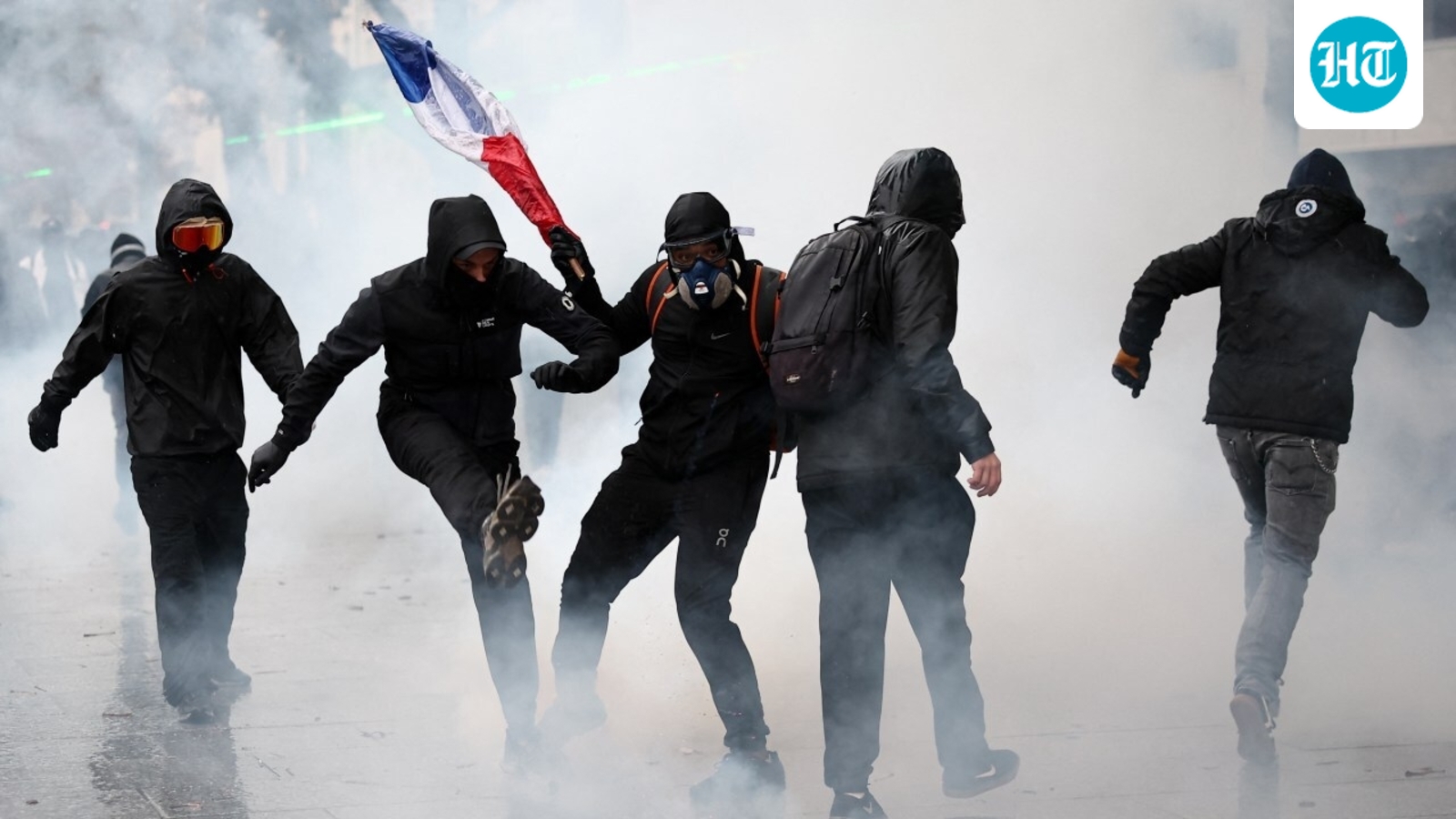
An uncomfortable question has loomed over France ever since student protests against school conditions morphed into riots and looting led by masked perpetrators dressed in black: Who was behind them?In France, it is illegal for the state to collect statistics on race, ethnicity and religion.Far-right leader Marine Le Pen says the rioters came from neighborhoods with large immigrant populations. Far-left firebrand Jean-Luc Mélenchon says the real problem was law enforcement, accusing authorities of brutal and chaotic tactics that fueled the violence.
The French government, meanwhile, blames “ultraleft” agitators.Any attempt to get to the heart of the matter, however, immediately runs into a uniquely French form of resistance: a longstanding, deeply rooted practice of colorblindness.In France, it is illegal for the state to collect statistics on race, ethnicity and religion. That means law enforcement can’t document whether French citizens detained in the rioting are descendants of immigrants or not.
Corporations, academics and others outside the state are also heavily restricted from gathering such data and are subject to five years in prison and a €300,000 fine for breaking the rules. It’s therefore hard to factor ethnicity or creed into public discussions of the riots because, in the eyes of the French state, these factors don’t exist.To Americans, reared on multiculturalism, hyphenated identities and entrenched racial politics, it might seem impossible to not talk about race and cultural difference.
But in France, these concepts carry deep stigma, as they run counter to the country’s founding principles.France considers its republic a model of Enlightenment universalism. What makes someone French isn’t ethnicity but their allegiance to universalist values—liberty, the rule of law, democracy.
There is a French word for efforts to divide France along ethnic lines—communautarisme. And it is widely regarded as a precursor to ethno-religious separatism and even civil war.The recent unrest, however, shows that these fractures already exist, regardless of whether France’s colorblind republic sees them.
The protests began in the Paris banlieues, the poor outskirts where much of the country’s Muslim population resides. The public school system there has for decades been a fulcrum of France’s struggle to assimilate immigrant communities.
Fights over Muslim headscarves and French secularism have spilled far beyond the classroom, dividing the country’s electorate, often along cultural and ethnic lines.Polls show Le Pen and Mélenchon—the candidates who embody this partition—are most likely to make the runoff in next spring’s presidential election. Candidates in the center, drowned out by the turmoil, have seen support shrink.“The politics of identity are replacing social classes in the language of political battles,” said Gilles Kepel, a prominent researcher who has studied the emergence of ethnic enclaves in France. “Those who ostensibly deplore these new fractures as abominable are in fact benefiting from them, if not outright causing them.”France’s universal republic, in other words, is producing the exact outcome it was designed to prevent.The French Revolution was fought to replace an order based on bloodlines with a national identity based on civic ideals of equality, freedom and brotherhood.To do that, revolutionary leaders aimed to overturn feudal structures and unite the mosaic of ethnicities and languages that shaped 18th century France.
More than 80% of its inhabitants at the time couldn’t speak French fluently. Local vernaculars ranged from German to Gaelic, Basque, Occitan, Flemish, Yiddish, Walloon, Norman and countless shades of Patois.
Schools and the military were the universalist crucibles in which the new French citizens would be forged.As the industrial revolution brought an influx of Belgians, Italians, Swiss and Spaniards in the 19th century, France dropped all questions regarding religious beliefs or ethnic origin from its census and class became the main dividing line within French society.In letters they sent home toward the end of World War II, Black American soldiers stationed in liberated Europe wrote about the solace they found in colorblind France. They could enter cafes, hotels, theaters and restaurants without facing any restrictions.
Romantic relations between U.S. soldiers and locals seemed almost entirely free of any racial divides.To the French, however, the War was the ultimate cautionary tale of what could happen if the state abandoned universalism. When the Vichy regime adopted its first antisemitic laws in 1940, its government actually didn’t know with certainty who fell under the statute.
Its solution was to force Jewish citizens to register with the police—which almost 90% did—leading many to be deported to Nazi death camps.Vichy was a puppet fascist regime at odds with the traditions of the Republic. Postwar governments weren’t free of contradictions either.
France’s colonial rule in North Africa also made a mockery of the universalist ideals as Algeria’s Muslim population enjoyed limited political rights compared with native French settlers. Algeria’s brutal war of independence brought a violent resolution to this contradiction in 1962—and ushered in a new wave of immigration.In the 1950s and 1960s, almost two million people—including Muslims, Christians and Sephardic Jews—moved from North Africa to France.
The newcomers joined and soon replaced blue-collar locals in the brutalist high-rise suburbs—the banlieues—that fast-growing France was building to replace urban slums in Paris and other large cities.The lines of French society were being redrawn, yet the state remained officially unaware of the country’s changing complexion. The shame of Jewish deportations had led postwar France to double down on the colorblind approach, passing a data protection act in 1978 that banned the collection and holding of records revealing racial origins or religious beliefs precisely because of the way it was weaponized.Into this information void stepped Jean-Marie Le Pen, who co-founded the far-right National Front with former SS Nazi members in 1972.
To him, being French was a matter of lineage. The Nazi gas chambers, he said, were “a point of detail in the history of the World War II.” Now, he said, France was being overrun by immigrants, particularly those from France’s former colonies in Africa.“They will be in charge.
And the French will keep their heads down, get off the sidewalks and lower their eyes,” Le Pen told Le Monde in 2003, warning that 25 million Muslims would one day live in France. A year later Le Pen told a far-right publication that people were telling him: “Monsieur Le Pen, it’s already the case right now!”Le Pen had no data to back up his figures, but neither did his opponents in the political establishment to dispute him.
The government at the time relied on researchers who estimated France’s Muslim population was between four and five million. The estimates were largely based on the number of people who emigrated from Muslim majority countries and did not precisely account for their descendants.To many mainstream politicians, engaging in debate over cultural differences—and whether such differences played a role in the socio-economic isolation of French Muslims—smacked of racism and validated Le Pen’s rhetoric.
Le Pen was fined for his comments, which French courts ruled were forms of hate speech.“It was impossible to talk about immigration, because the moment there was a problem, and we wanted to discuss it, someone would say: ‘But you sound like Jean-Marie Le Pen. You’re talking like National Front!” said Malika Sorel-Sutter, a French essayist of Algerian origins and a member of the European Parliament.The 21st century brought a wave of violence that placed new forms of pressure on France’s republican ideals.
The first major riots erupted in banlieues across the country in 2005 in response to the deaths of two teenagers who were electrocuted while hiding from police. The newsroom of satirical magazine Charlie Hebdo, which had published cartoons of the Prophet Muhammad, was the site of a massacre in 2015 by Al-Qaeda gunmen who were French citizens born of Algerian parents.
History teacher Samuel Paty was then beheaded by a Chechen refugee at his middle-school outside Paris in 2020 after he showed the Charlie Hebdo cartoons to his class as part of a lesson on free speech.Each crisis was greeted as a wake-up call that threatened the foundations of France’s universal model. But so were any attempts to understand their root causes.
A push by researchers to survey tens of thousands of people around the 2005 riots collided with the ban on collecting ethnic data. The French privacy watchdog, which vets scientific surveys before they are conducted, allowed the researchers to ask about religion, nationality and perceived discrimination but barred them from asking respondents to identify themselves by race, ethnicity or skin color.“If there’s discrimination in terms of income levels, to fight against it we have to know who’s earning a lot and who’s making less,” said Hugues Lagrange, a sociologist who took part in the study.President Emmanuel Macron proposed a law against “Islamist separatism” in an effort to confront radical forms of Islam that his government said fueled the Charlie Hebdo and Paty killings.
But the country was immediately consumed by debates about what “Islamist separatism” even meant. The government defined it as the dominance of religious rules over state authority in some Muslim communities, drafting legislation that aimed to tighten oversight of mosques and Muslim associations.
Opponents, including Mélenchon, saw it as an attempt to stigmatize French Muslims as a group and as a violation of universal values. The law eventually passed, but without any mention of Islamist separatism.Over time, politicians at the farthest ends of the political spectrum have learned how to talk around the topic of race even as they engage in identity politics.Marine Le Pen, who took over her father’s party, has called France the “least racist” country on the planet, campaigning as a law-and-order candidate who aims to unify the nation.
Her campaign’s flagship proposal, meanwhile, is a referendum that would amend the constitution to create a two-tier legal system granting different rights to citizens and noncitizens, a clear departure from universalism.Mélenchon, meanwhile, has capitalized on support among French Muslims following his refusal to condemn Hamas as a terrorist organization and attend an antisemitism march in the wake of the Oct. 7, 2023 attacks on Israel.
He won 62% of the French Muslim vote in the 2024 European elections according to exit polling.His presidential platform calls for the creation of a “Nouvelle France” that represents the “heirs of immigration.” Rather than openly embrace American-style multiculturalism, Mélenchon talks of the “creolization” of French society, a concept that recognizes cultural differences without treating them as fixed identities.In the wake of the recent riots, Mélenchon has played a lead role in policing the speech of presidential candidates in the dwindling center.Former Prime Minister Édouard Philippe, the political establishment’s leading presidential candidate, was recently asked to characterize the looters.“There were, in fact, a certain number—a significant number, probably—of young French people who I consider French from an immigrant background,” he said. For Philippe, the riots were a sign the French model was failing in its mission of cultural integration.“We have to look in the mirror and ask how do we build a nation?
How do we make it for those who arrived one, two or three generations ago?”Mélenchon swiftly wrote on X that Philippe was “dividing the country” with “racialist” rhetoric.Just days after the mid-October riots, France was confronted with the very ethnic violence it feared identity politics might produce. A gunman authorities identified as “Kevin T.” went on a shooting spree in a banlieue of Paris, killing a man of African descent and wounding seven others, including a 12-year-old girl wearing a headscarf who was shot multiple times.The banlieue he targeted, Trappes, is celebrated for producing some of the country’s most famous actors of African descent.
The shooter later told police he went there looking for “Muslim, African, North African types.” When police raided his residence they found a copy of Mein Kampf and stickers that read “100% French,” which the shooter said he had designed himself.“This is a turning point,” Macron told reporters as he visited Trappes in the aftermath, warning the public to “not fall into the trap of one camp against another.”Write to Stacy Meichtry at Stacy.Meichtry@wsj.com and Bertrand Benoit at bertrand.benoit@wsj.com