


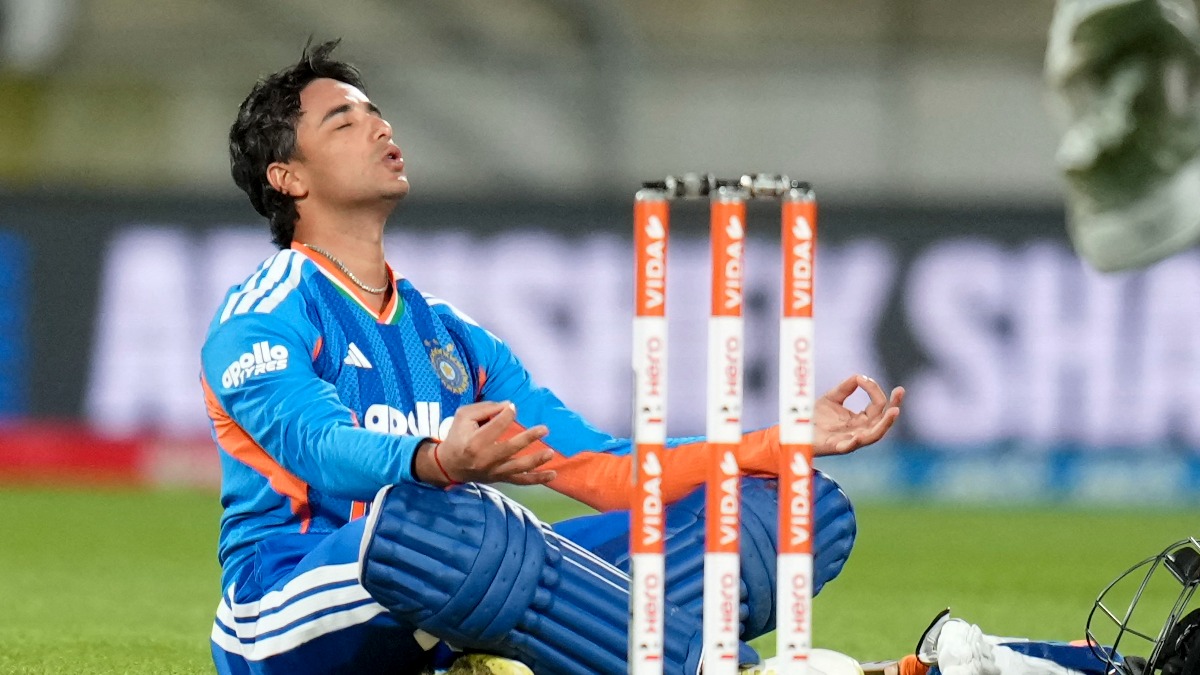
The first ball disappeared. Abhishek Sharma made room, cleared his front leg and launched Jacob Duffy over the ropes.
No sighter, no attempt to feel his way into the innings. He had seen the ball, backed his swing and gone after it.
In Wellington, the message was delivered before New Zealand had bowled a second ball.What followed was scarcely believable, even by Abhishek's standards. He smashed 113 off 38 balls, reaching his century in 35 deliveries, as India chased down 199 in 13.2 overs on Tuesday in the third of a five-match T20I series against New Zealand.
He hit 11 sixes and nine fours. His opening partnership with Vaibhav Sooryavanshi produced 133 runs in just 43 balls, and India raced to 118 without loss in the powerplay.
India got to 50 in just 14 deliveries, 100 in 30 deliveries and went all the way with 40 balls to spare.Sooryavanshi, the 15-year-old whose fearless hitting has captured the imagination of Indian cricket, made 45 off 19 balls. Sanju Samson, too, has been producing innings that demand attention.
Between the teenager's arrival and Samson's breathtaking strokeplay, there is no shortage of excitement around India's T20 batting.But Abhishek has been doing this for a while. The fireworks in Wellington was another reminder of a phenomenon.Is Abhishek the best T20I opener going around?
It is a question worth asking, particularly when his numbers are set against the noise surrounding other exciting batters. Let’s have a look at his numbers.The remarkable part is the combination.
Abhishek is the only batter to have scored more than 2,000 runs in men's T20Is while averaging above 30 and striking at over 190. Most batters are forced to make a trade-off between speed and consistency.
Abhishek's record suggests he has found a way to keep both. He has scored two T20I hundreds in 35 balls or fewer, another record no one else in the format has matched.
His 30-ball hundred against Afghanistan was the fastest by a batter from a Full Member nation in men's T20Is. In Wellington, he came close to that mark again, taking only five balls more to reach three figures.There is also a telling measure of his power: Abhishek has hit more than 10 sixes in a T20I innings three times, the most by a batter from a Full Member nation.
His hitting is not an occasional burst of boundary-clearing. It is central to the way he plays.THE POWERPLAY KINGFor most batters, the powerplay is a chance to get ahead of the game.
When Abhishek is on song, it is often where the game gets away from the opposition.Nine half-centuries in 20 balls or fewer is a record in men's T20Is. Yuvraj Singh, David Warner, Colin Munro, Finn Allen and Phil Salt have managed it three times each.
Abhishek has done it nine times.He reached his fifty in 15 balls in Wellington, barely pausing between clearing the ropes. India's 118-run powerplay was a team record, but it also captured the effect Abhishek has on an innings.
The opposition is not simply trying to prevent boundaries; it is trying to survive the opening overs without the game running away.Ravi Shastri summed up the instinct behind the first-ball six."This boy is just all belief, isn't he? To play that shot, the first ball of the innings for six—he announces himself,” he told Sony Sports Network on Tuesday.That belief is backed by a clear method.
Abhishek likes to give himself room, backing away to free his arms and hit through the off-side. Bowlers have tried to counter that movement by following him and attacking the stumps, looking to cramp him for space.
But he has added another answer: the ability to punish them on the leg-side.Dinesh Karthik has noticed the change."We all know he's so good on the off-side. Bowlers used to try to come straight at him, but now he's able to hook on the leg-side as well.
He has added that to his game over the last 12 months. You can't tuck him up on the leg-side anymore or he hits you over mid-wicket,” Kathik told Cricbuzz.The adjustment matters.
If a bowler gives him width, Abhishek can free his arms through the off-side. If the bowler comes straighter, he can clear his front leg and swing over mid-wicket.
Karthik has also pointed to the power of that swing and Abhishek's wrists, which can send even mistimed shots beyond the boundary.There is a reason the approach looks so simple when it works: he has made it difficult for bowlers to find a safe option.THE WORK BEHIND THE SWINGAbhishek's batting can look like a series of instinctive decisions, but his development has involved plenty of technical work. His father, Rajkumar Sharma, has spoken about how golf, introduced to him by Yuvraj Singh and Brian Lara, helped improve his bat swing and made it cleaner.It is an unusual detail in the story of a power-hitter, but a revealing one.
The same principle that makes a golf swing effective, a clean arc through the ball, has helped Abhishek refine the movement that allows him to generate such force. The sixes are the visible result; the work lies in making the swing repeatable.Yuvraj's role in that process has been significant.
He began working with Abhishek during the Covid lockdown, focusing on his stance, shoulder position and swing arc. The ambition was never limited to securing an IPL contract.
Yuvraj wanted to prepare him to play for India.Abhishek has since become one of India's most aggressive top-order batters, and his numbers suggest the work has translated into results.A BEAST IN T20 CRICKET?The numbers hold up across T20 cricket, too. Abhishek has scored 6,606 runs in 220 matches at a strike rate of 179.26, with 11 hundreds.
Among batters with at least 2,000 runs, that is the highest strike rate in the figures available. Strike rate of batters with minimum 2,000 runs in T20 cricket.
The gap is significant. Finn Allen, another batter known for attacking from the start, is next at 175.57.
Andre Russell, whose reputation has been built on explosive hitting across leagues, is at 166.57. Abhishek has maintained a higher scoring rate while also building a substantial run tally.In international T20Is, no one has come close.
Strike rate of batters in T20I cricket with minimum 2,000 runs. His teams' scoring patterns offer another measure of the impact.
Abhishek has featured in 58 T20 matches in which his side scored more than 200.Team totals cannot be credited to one batter alone, but the frequency is striking. Abhishek is often part of the surge, and his own scoring rate helps explain why he has become such a potent presence at the top.
Abhishek Sharma vs Jos Buttler, who tops the list for most appearances in 200-plus T20s Abhishek’s greatest strength is not simply how quickly he scores, but how consistently he does it. His numbers suggest a batter who has made extreme scoring rates look routine, rather than one who needs the perfect conditions or a particular kind of attack to thrive.
There are other explosive openers in world cricket, and several have built formidable records. But few combine Abhishek’s volume of runs with such relentless scoring.That is what makes the question worth asking.
Is Abhishek Sharma the best T20I opener in the world? On current evidence, he has a compelling case.- Ends