


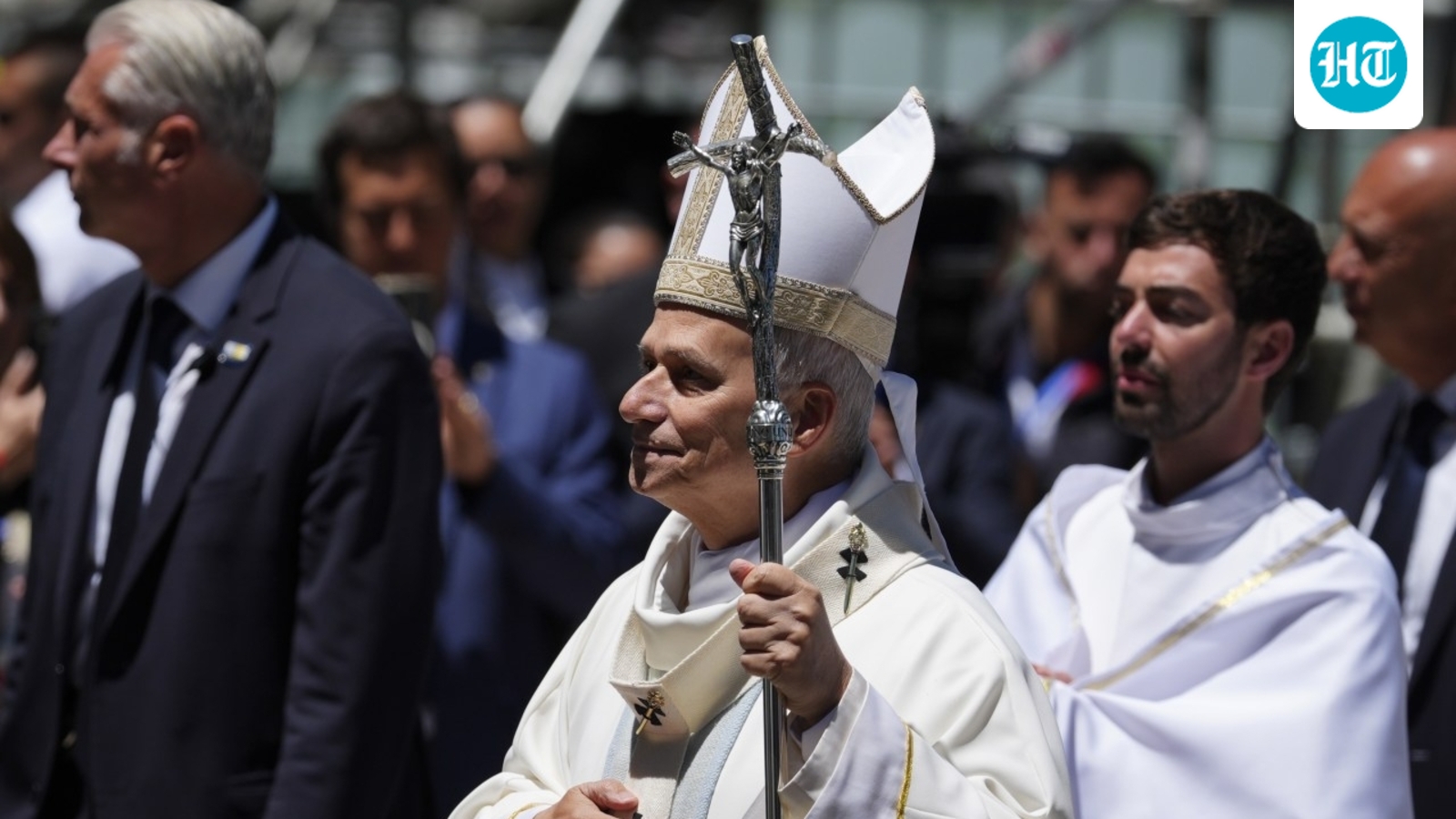
BUENOS AIRES—Pope Leo XIV is a soft-spoken missionary who rode horseback to minister to the poor in remote corners. President Javier Milei is a populist who brandished a chain saw on the campaign trail to symbolize his promise to slash government spending, champions unfettered capitalism and calls social welfare “an aberration” akin to robbery.Pope Leo XIV celebrated Mass in Uruguay on Sunday before traveling to Argentina.The two men will come face-to-face Sunday as the pontiff, born in Chicago but with 20 years of experience ministering in Peru, arrives for a four-day visit in a country where the Catholic Church and the libertarian president are increasingly at odds over how to deal with society’s most vulnerable.Neither man wants a public quarrel.
Milei has said the pope’s visit is a blessing that will bring Argentines “immense joy and spiritual enrichment.” But in a country where Catholic priests and prelates have emerged as some of the president’s toughest critics, Leo’s message of compassion for the poor and vulnerable is expected to have political ramifications for an increasingly unpopular president who is also Trump’s closest ally in South America.The two men also differ sharply on artificial intelligence. Leo has warned of its dangers, while Milei, an Elon Musk ally, wants to make Argentina a haven for unregulated AI development.“Whatever the pope says, it will be interpreted as a deep criticism of Milei and his government’s ideological attitude,” said Loris Zanatta, a historian at Italy’s University of Bologna who has closely studied Argentina’s Catholic Church. “Since Milei is unpopular, it won’t be good for him.”Milei, who grew up Catholic but has talked about converting to Judaism, has long had a confrontational relationship with the church.
He once called Leo’s predecessor, Pope Francis, an Argentine who never visited his homeland in 12 years as pope, “the representative of evil on earth.”A 56-year-old economist, Milei has attracted followers from Washington to Europe for slashing state spending, closing government ministries and dismantling state programs in an effort to rescue a country battered by decades of economic trauma. His shock therapy has sharply reduced inflation and lowered poverty, but unemployment is high and patience with his policies is wearing thin.In Buenos Aires, a well-known priest who works in the city’s slums and who urged Catholics not to vote for Milei in 2023 has called his policies “inhumane.” Recently, some priests have joined protests against budget cuts affecting retirees and the disabled in Plaza de Mayo, the square that fronts the presidential palace.
Bishops opposed lowering the age of criminal responsibility to 14, while the Catholic charity Caritas proposes legislation to revive mothballed public works projects in poor neighborhoods.“There is a certain state and institutional sadism,” Cardinal Ángel Rossi, the archbishop of Córdoba and Argentina’s second-highest-ranking Roman Catholic official, said at Mass earlier this year.Milei’s allies have called the criticism unfair, especially coming from priests who they say are closely aligned with a left-wing Peronist movement whose free-spending and protectionist economic policies generated the financial crises that drove Argentines into poverty and led voters to cast ballots for him.“Some of those in cassocks are campaigning for the return of Peronism,” said Alberto Benegas Lynch, a member of congress. He has urged Catholics to stop attending Mass and giving donations, saying that politicized clerics influenced by socialism are to blame for the decline in church attendance.“The permanent demonization of the individual and of wealth, along with the romanticization of poverty, always makes them look bad,” he said.Milei has increasingly depicted himself as defending Judeo-Christian values under threat in the West.His libertarian movement calls itself “The Forces of heaven.” He cites biblical scripture to argue that morality and justice are at the center of his government policies.
He’s not shy about framing economic issues in religious terms.“In hell, the interest rate is infinite and credit does not exist in any form,” he said in a speech last month at an Evangelical church.When he took office in late 2023, Milei inherited an economic calamity from his Peronist predecessor, which left a central bank without reserves and a fast-depreciating currency. His policies brought annual inflation down to 30% from nearly 300%.
Today, about 30% of Argentines live in poverty, down from more than 40% when he took office.But Milei has struggled to kick-start a stagnant economy by attracting private investment needed to create jobs as his policies closed construction projects and drove some factories to close, leaving tens of thousands of people out of work. Nearly 70% of Argentines say the economic situation is negative, according to pollster Aurelio.In a Buenos Aires slum called Villa 21-24, a neighborhood of cramped dwellings on the edge of a railroad track, the Rev.
Lorenzo De Vedia, a Catholic priest, says Argentina’s neediest have been left out of Milei’s free-market revolution.“If inflation has been stopped and poverty has been reduced, it’s not noticeable here in any way, quite the opposite,” said the priest, known as Father Toto. His parish has eight soup kitchens that serve about 200 people a day, but they are under strain as more people seek meals.“People don’t have the money they need in order to live,” he said. “Everything is broken.”Beatriz Maidana, 50 years old, who lost her job as a maid in August, now does odd jobs and helps to cook at one of the church’s soup kitchens.
The church provides clothes and medicine for her eight children and 14 grandchildren. Maidana said she hopes Pope Leo’s message of caring for the poor will rub off on Milei.“I hope Milei can come to his senses,” she said.The Catholic Church has long played a pivotal role in Argentine politics.In the 1940s, it initially supported the rise of Juan Perón, the populist former army officer who drew on Catholic social doctrine to galvanize labor unions for political support.
A decade later, Perón clashed with the church.In the 1960s and 1970s, Argentine priests formed a group called the Priests Movement for the Third World, which rejected capitalism and worked to alleviate poverty in Argentina’s slums. The most militant clerics backed left-wing, Cuban-inspired revolutionaries here, the Montoneros, historians say.Today, Argentina’s church is closely shaped by Francis, who many recall fondly as the former Buenos Aires archbishop, Jorge Mario Bergoglio.
An openly political Jesuit, Bergoglio prioritized social and economic justice over traditional moral teachings, profoundly shaping the nation’s clergy.“Every single position in Argentina’s Catholic Church today is the result of Bergoglio’s decisions—it’s his church,” said José María Ghio, author of the book, “The Catholic Church in Argentine Politics.”One of Francis’ disciples, Jorge Ignacio García Cuerva, a priest who worked in the shantytowns before Francis appointed him Buenos Aires archbishop, lamented what he called a lack of social solidarity and selfishness in a service in May that Milei and other government officials attended.“There are so many Argentines lying on a blanket in the cold on the sidewalks of major cities,” he said in words the political class viewed as an affront to the government. “No one can wash their hands of the social situation we are living through.”The austerity cuts have hit organizations such as Andar, which offers job training and educational workshops to people with disabilities. Andar has since struggled to pay workers and had to cut back on a vehicle service that transported people to its center on the outskirts of Buenos Aires.“He’s coming at a critical time,” said Martin Lucero, a representative of Andar and son of the founder. “But it’s hard to believe the pope’s visit could change such a cruel, unjust and aggressive course.”Write to Ryan Dubé at ryan.dube@wsj.com