


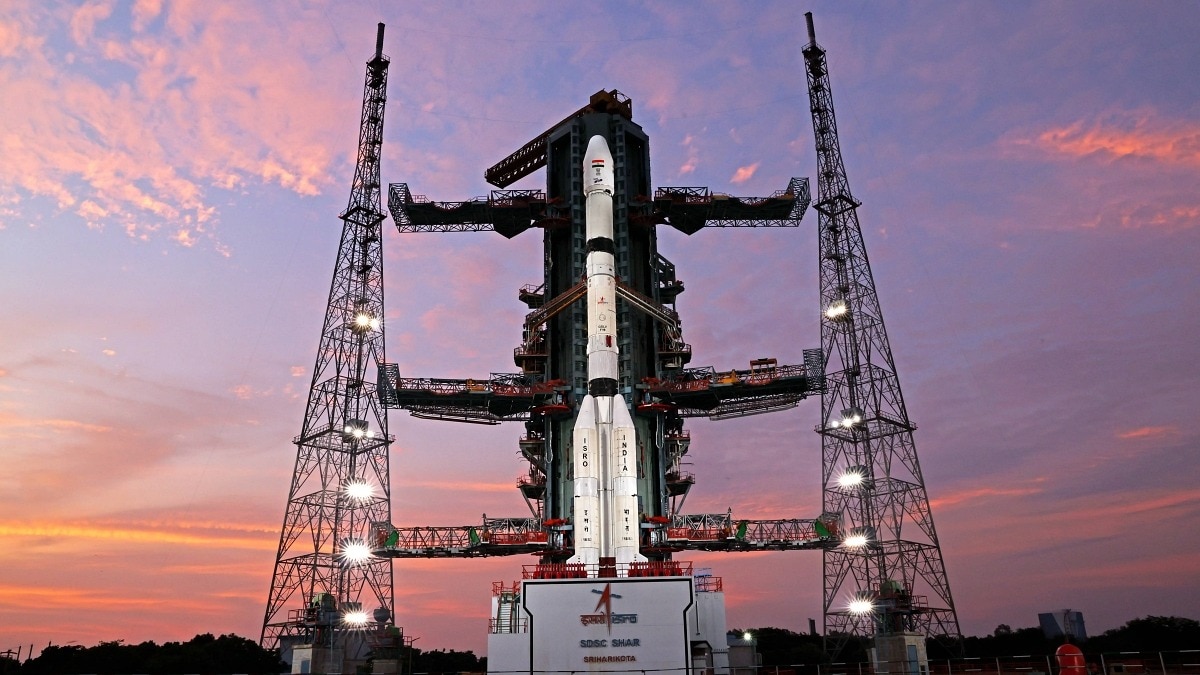
Isro will launch NVS-03 aboard GSLV-F18 from Sriharikota at 11:51 pm on Friday. Its crucial orbit-raising manoeuvres will test changes made after the NVS-02 propulsion failure.NVS-03 will have to perform a series of critical orbit-raising manoeuvres to reach its designated operational orbit.
The Indian Space Research Organisation (Isro) is preparing for a crucial night-time launch of its next-generation navigation satellite, NVS-03, aboard the Geosynchronous Satellite Launch Vehicle (GSLV-F18), with mission control at Sriharikota gearing up for the scheduled liftoff at 11:51 pm on Friday.The 24-hour countdown has commenced at the Satish Dhawan Space Centre, with the launch scheduled from the Second Launch Pad. GSLV-F18 will mark the 20th flight of India's Geosynchronous Satellite Launch Vehicle and will carry NVS-03 into a Geosynchronous Transfer Orbit (GTO).While the successful launch and separation of the satellite will mark a major milestone, the mission's real test will come after it leaves the rocket.NVS-03 will have to perform a series of critical orbit-raising manoeuvres to reach its designated operational orbit.
The mission will be judged not just by how successfully GSLV-F18 lifts off, but by whether NVS-03 completes every critical orbital manoeuvre. These manoeuvres are essential because the GSLV will only inject the satellite into an initial elliptical transfer orbit.
Its onboard propulsion system must then raise and adjust the orbit to place it in the required geosynchronous orbit.WHY THE FINAL ORBIT MANOEUVRE MATTERSThe satellite's onboard Liquid Apogee Motor (LAM) will play a crucial role in this process. By firing at the appropriate point in its orbit, the engine will help raise the satellite's orbit and bring it closer to its intended operational position.
This is particularly important because a successful rocket launch does not automatically translate into a successful satellite mission. The spacecraft must also be able to fire its propulsion system, execute the planned manoeuvres and stabilise itself in the designated orbit.Isro has a painful memory of what can go wrong during this stage.In January 2025, Isro successfully launched the NVS-02 navigation satellite aboard GSLV-F15.
The satellite was injected into GTO, but it failed to reach its intended geostationary orbit because its propulsion system could not execute the orbit-raising manoeuvres.An investigation found that the electrical drive signal failed to reach the pyrotechnic valve controlling the oxidiser flow to the engine. As a result, the Liquid Apogee Motor could not fire, leaving the satellite stranded in its transfer orbit.WHAT HAS ISRO CHANGED FOR NVS-03?In a significant departure from its established practice, Isro is flying NVS-03 with its pyrotechnic valves already activated and open.
The move is intended to avoid a repeat of the electrical activation problem that affected NVS-02.The configuration is a major change in the satellite's propulsion-system operations and reflects the lessons learnt from the previous mission.NVS-03 is the third satellite in Isro's next-generation navigation satellite series, designed to ensure continuity of services under the Indian Regional Navigation Satellite System, or NavIC.The satellite carries an indigenous atomic clock alongside procured atomic clocks. It will also introduce the L1 frequency signal in addition to the existing L5 and S-band signals, expanding compatibility with navigation receivers.
NavIC is designed to provide positioning, navigation and timing services. NavIC is designed to provide positioning, navigation and timing services across India's landmass and approximately 1,500 km beyond its geopolitical boundaries.With ageing satellites and limitations in the existing constellation, NVS-03 is an important addition to India's independent navigation infrastructure.However, tonight's mission will be judged not just by how successfully GSLV-F18 lifts off, but by whether NVS-03 completes every critical orbital manoeuvre and reaches its designated orbit.For Isro, ensuring that the NVS-02 experience is not repeated will be one of the biggest tests of this mission.- Ends