


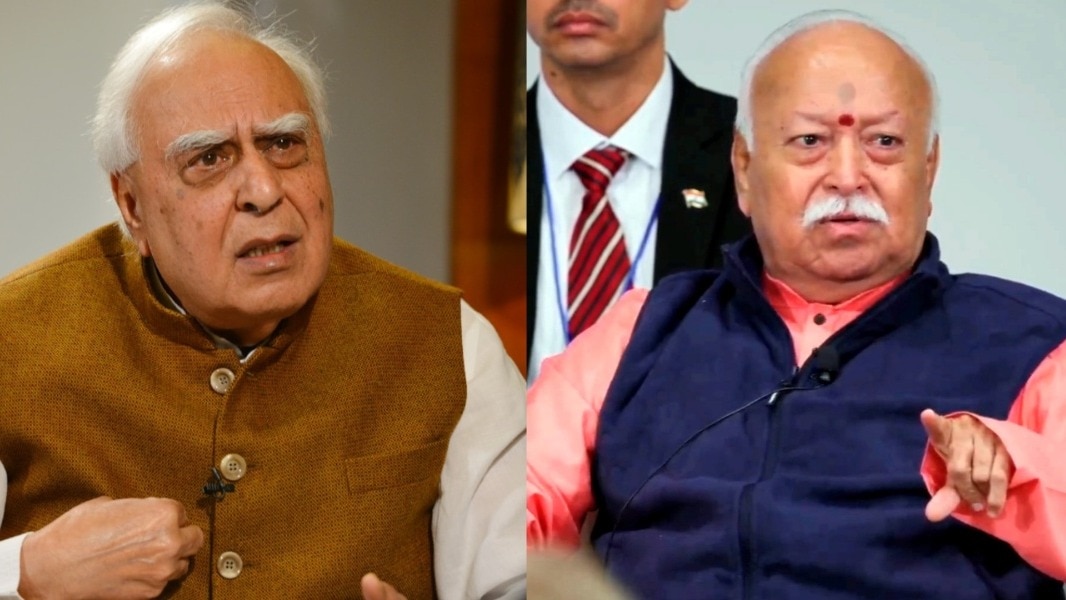
Kapil Sibal challenged Mohan Bhagwat's warning on regime change, insisting Indians seek it democratically. The exchange sharpened debate over peaceful protests, elections and claims of foreign destabilisation.Kapil Sibal counters Mohan Bhagwat, backs democratic government change. (File image) Rajya Sabha MP Kapil Sibal on Saturday criticised RSS chief Mohan Bhagwat's recent remarks on "regime change", saying India wanted a change of government through democratic means, news agency Press Trust of India reported.Sibal said the country needed change and that the people had decided there would be one. "When, how, and most peacefully it will happen, only time will tell," he said at a press conference in New Delhi.According to PTI, Sibal expressed surprise at Bhagwat's comparison of calls for regime change in India with recent developments in Nepal, Bangladesh, Albania and France."I am surprised that he even made that comparison, because as far as those kinds of open revolts are concerned, ultimately they brought about a kind of violence which none of us support," Sibal said. "What India wants is a change of government through democratic means, and I think that Mohan Bhagwat understands that, but yet is not willing to acknowledge it," he added.Sibal said the young people who had gathered at Jantar Mantar held peaceful protests and did not carry weapons or stones.
He said they had also gone on a hunger strike. He alleged that any violence during the protest was caused by outside agencies and questioned the circumstances in which a truck carrying stones was found at the site."Nobody has yet inquired as to where that truck came from or how that truck came, because the police and law and order are under the control of the Union through the Lieutenant Governor," the Independent MP said, according to PTI.Sibal said the regime change being sought was a change of government and the existing political dispensation through democratic means.He also accused the RSS of having participated in an earlier "regime change" by supporting Arvind Kejriwal.
He claimed this had contributed to the fall of the Congress-led United Progressive Alliance government."It was through the legal process — in other words, there was an election, (Narendra) Modi ji came to power, and we have suffered 12 years of power under Modi ji, and RSS has benefited greatly," he said.Questioning Bhagwat's assertion that regime change would not bring fundamental change, Sibal asked why the RSS had supported Kejriwal in the past.Calling Bhagwat's remarks about regime change in countries such as Bangladesh and Nepal a "bogey", Sibal accused the RSS chief of avoiding issues confronting India.He referred to the Cockroach Janata Party's protests over the state of school education and alleged that Bhagwat had remained silent on the issue because the RSS benefited from the BJP-led government.Sibal also accused Bhagwat of ignoring alleged manipulation of voter lists, incursions in Arunachal Pradesh and eastern Ladakh, and the detention of young people, academics and opposition leaders.He questioned Bhagwat's remarks about foreign forces trying to destabilise India, saying unemployment and inadequate educational opportunities were among the country's pressing concerns."It is the middle-class children out there who don't get employment; it is the poor people who don't get any opportunities in education," Sibal said.Bhagwat, speaking at the RSS's annual Vijayadashami Utsav in Nagpur on Tuesday, had said agitations seeking regime change did not resolve fundamental problems and could become instruments of political interests, deepening social divisions.Citing recent developments in Bangladesh, Nepal, France and Albania, Bhagwat said forces pursuing their own interests used regime change to alter political circumstances but rarely achieved the intended results."They claim that changing a regime will change the situation, but that has never really happened," Bhagwat had said.He also said a stronger India would constrain such forces, making the country a target of attempts to weaken and divide it. Bhagwat said some global powers wanted India to develop but did not want it to become too powerful as it could challenge their dominance.Bhagwat said protests were inevitable in a democracy but should aim to resolve problems rather than deepen social divisions. "Problems will remain, and protests are inevitable in a democracy.
But what should the purpose of protests be? They should be aimed at finding solutions," he had said.Sibal's response centred on his assertion that Indians were seeking political change through elections and other democratic means, while Bhagwat maintained that protests should focus on solutions and warned against forces using regime change to pursue their own interests.- EndsWith PTI inputs