


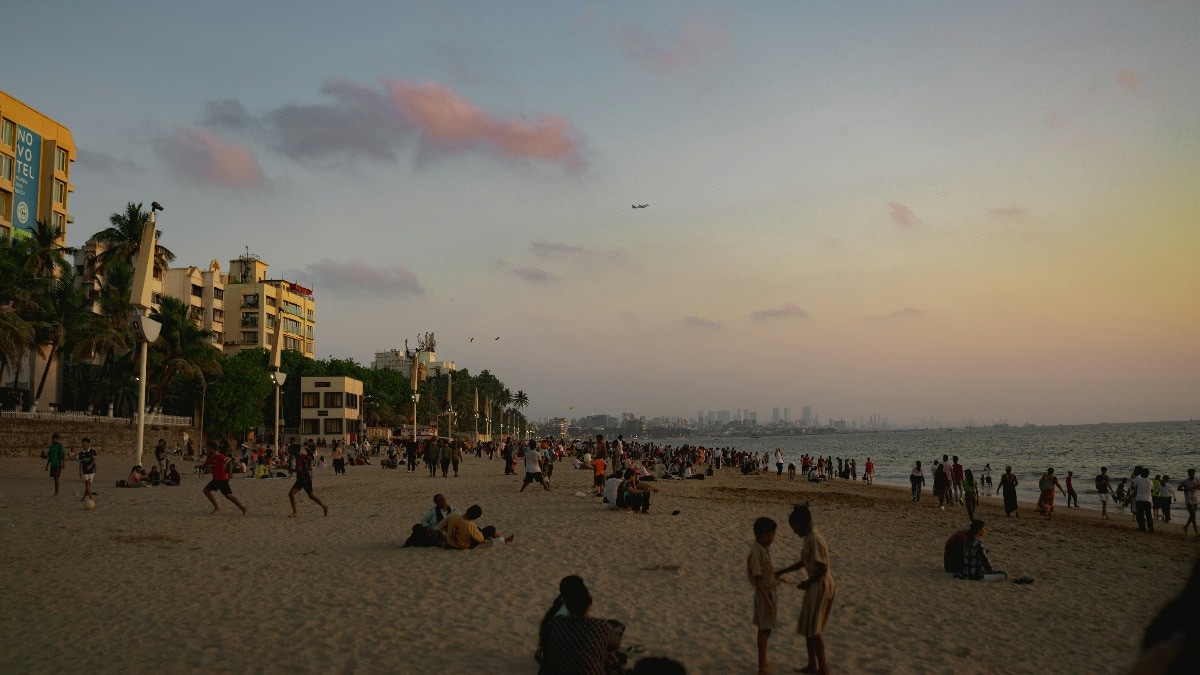
Writer and the quintessential "Bombay boy", Salman Rushdie, wrote in his novel The Ground Beneath Her Feet, "Touch the sea and at once you're joined to its farthest shore" That is how poetic a visit to one of Mumbai's most popular beaches, Juhu, can be. But Mumbai's shore might soon connect you not to another world, but to a floating LED advertisement selling you something, just as you settle down to watch the sunset.It is particularly galling for those who bought homes along Mumbai's coastline, pouring in their life savings and committing to decades of EMIs to own an apartment worth crores, partly for the promise of an uninterrupted view of the sea.
That view could now come with floating LED ads.Mumbai's beaches and seafronts offer Mumbaikars a rare escape from the city's hustle and bustle, its divisions, and its power struggles. The sea belongs to everyone, and offers the same simple pleasures regardless of who they are or where they come from.
An open view, a cool breeze, and the smell of salt in the air.The plan is to turn even the sea into commercial space, taking away the few unobstructed natural sights left in the city. The Maharashtra Maritime Board's (MMB) decision to permit floating advertisements at prominent waterfront locations has drawn criticism from both residents living along the coastline and Mumbaikars who visit the seafronts for a respite from the concrete jungle behind them.
The MMB has floated tenders for advertising installations across the Mumbai Metropolitan Region. Proposed locations reportedly include Juhu Beach, Lotus Jetty, the Bandra-Worli Sea Link jetty in Worli, Carter Road, and Marve Jetty.
Mumbai Mirror reported on Saturday (October 31) that MMB issued 19 tenders in September – 10 for floating advertising barges and nine for illuminated hoardings.According to Mumbai Mirror, the tenders cover structures across Mumbai, Navi Mumbai and the surrounding region. These include 15 illuminated barges and 14 double-sided hoardings, with the standard advertising display measuring around 40 ft by 40 ft.
However, after the public furore, Minister for Ports and Chairman of MMB, Nitesh Rane took to X, saying, "There appears to be considerable misunderstanding and misinterpretation surrounding the hoarding tender floated by the MMB. Let me clarify the facts.
Of the four floating hoardings proposed, two are existing structures near the Sea Link, and only two are new proposed installations."Residents say that regardless of how many floating advertisements are installed along Mumbai's coastline, even a single LED-lit hoarding would be enough to spoil the seafront.Citizens' groups and environmental organisations have also questioned whether any revenue generated from these ads justifies the visual and ecological costs.PEOPLE PAY CRORES TO LIVE BY THE SEA IN MUMBAI. THE VIEW IS THE REAL DEALApartments along Mumbai's coastline, sometimes barely 400 square feet in size, can command prices running into crores of rupees.
Why? It is the view.
An uninterrupted stretch of the Arabian Sea, and the sun sinking into the illuminating expanse every evening is not something you get in the rest of the city.After sunset, the experience changes. Silver clouds drift towards the city in slow motion, silhouetted against the pitch black sea.
The absence of any artificial light on the water is nothing to complain about in a city that never switches off. The darkness is broken only by a handful of distant lights, sometimes from Coast Guard vessels patrolling the coastline.
For anyone who has spent time at Marine Drive, Worli, Dadar, Santacruz, Juhu or one of the rocky and sandy beaches further north, the sea can be almost meditative.And during the monsoons, the clouds gather over the horizon and roll towards the city, also a rare view.A resident from Versova's Bayview building, Nikunj Khosla, told India Today Digital, "The upcoming Versova link's view in the sea is fine because it is an infrastructural project. The city is expanding and there needs to be better connectivity because travelling from Versova to Bandra in peak hours can take over an hour because of the choked Juhu Tara road and the Western Express Highway.
But the floating ads are going to be an eyesore."Khosla added that in Versova, a 3BHK apartment in a building with a nearly unobstructed sea view, with only a small stretch of mangroves in front, can cost up to Rs 18 crore. "Imagine buying an apartment for that view, only to have floating advertisements staring back at you from your balcony. That would be bad," he said.A Bandra resident, who stays in a building called Vastu near Pali Hill, told India Today requesting anonymity, "My building offered me an unobstructed view of the sea with the bandstand in front of it.
But now there are piers poking out of the sea for the new sea link. That's fine, because that's an infrastructural project, and seeing how good the Coastal Road looks, I don't mind a sea link in front of my building because that's also going to make my apartment more expensive from a real estate point of view because the connectivity would be amazing to both north and south Mumbai."The Bandra resident added that the proximity of his home to the sea would make the LED advertisements difficult to live with. "If they put up LED ads here, I'll have to draw the curtains even to sleep because of how close my house is to the sea.
It would be a terrible sight," he said.Khosla, who previously lived in Juhu's JVPD Scheme, explained why an open view matters so much to Mumbai homebuyers."We were initially planning to buy a house in Rustomjee Elements, an uber-luxury apartment complex right at Juhu Circle. At the time, the building offered an open view of a large stretch of land owned by the Airport Authority of India (AAI).
An open expanse, even of land, is a luxury in Mumbai. But then a metro rail project came up on Link Road right in front of the building.
During one of our visits to the property, we learnt that a few apartments up to the fourth floor had remained unsold because the project was blocking the view of the airport land's open green expanse," he said.That is how much an open view can matter in Mumbai, where the sight from most apartment windows is often little more than a neighbouring building. The vast expanse of the sea offers Mumbaikars a refreshing escape from the city's concrete jungle.
AADITYA THACKERAY HAS WRITTEN TO CM FADNAVIS TO STOP FLOATING ADSShiv Sena (UBT) leader Aaditya Thackeray has written to Chief Minister Devendra Fadnavis urging him to stop the proposal.In a letter shared on X, Thackeray called the arrangement with the contractor a "disgusting deal" and said the decision was "highly irresponsible, possibly corrupt, and surely one that ruins the aesthetics of Mumbai". He argued that pollution has already made the sea difficult to see from several parts of the city and that floating advertisements would further obstruct whatever views remain."Sadly, with this absurd decision to support a cartel of hoarding contractors, whatever can be seen, will be advertisements pasted in the faces of citizens, who are already bearing the brunt of the rampant pollution on land," he wrote.
Thackeray also called for a policy to regulate LED hoardings, arguing that their brightness at night should be controlled and their numbers limited.Filmmaker Zoya Akhtar has described Mumbai as already "an assault on the senses" and said residents need "respite, not sponsored sunsets". She urged authorities to restrict commercial signage to designated zones and ensure citizens have a say before such installations are approved.Award-winning environmentalist Sumaira Abdulali of the Awaaz Foundation has repeatedly flagged the threat of light pollution that might occur due to the floating ads.
She said, "Our sea is not a screen. These floating billboards must not come up.
Light pollution is as dangerous as noise pollution, and now it's heading into our sea. The Maharashtra Maritime Board plans to put floating billboards in the sea off Worli, the Sea Link and Bandra's Carter Road."Abdulali added, "The LED glare from these screens can reach 40 metres below the surface.
That disrupts marine life, and with it the entire marine food chain...""Even a single billboard on the water is one too many Scientists and experts say floating billboards would bring 'concentrated, high-radiance beacons right at the waterline, completely erasing natural marine dark corridors.'"Mumbai has spent decades reclaiming land from the sea and is still doing so for infrastructural projects that it desperately needs. But in the process, the city has also surrendered its open spaces.
Land has become real estate, forests and mangroves have made way for construction, and hills in the Sahyadris around the city have been quarried and reduced to rubble to feed the city's appetite for buildings.Its coastline has constantly seeing piers poking out since the 2000s, for promenades and sea links. In a city where almost every patch of open land carries a price tag, the sea has remained one of the few places that people could look at without being sold something.
But now, even that is seemingly up for grabs.- Ends