


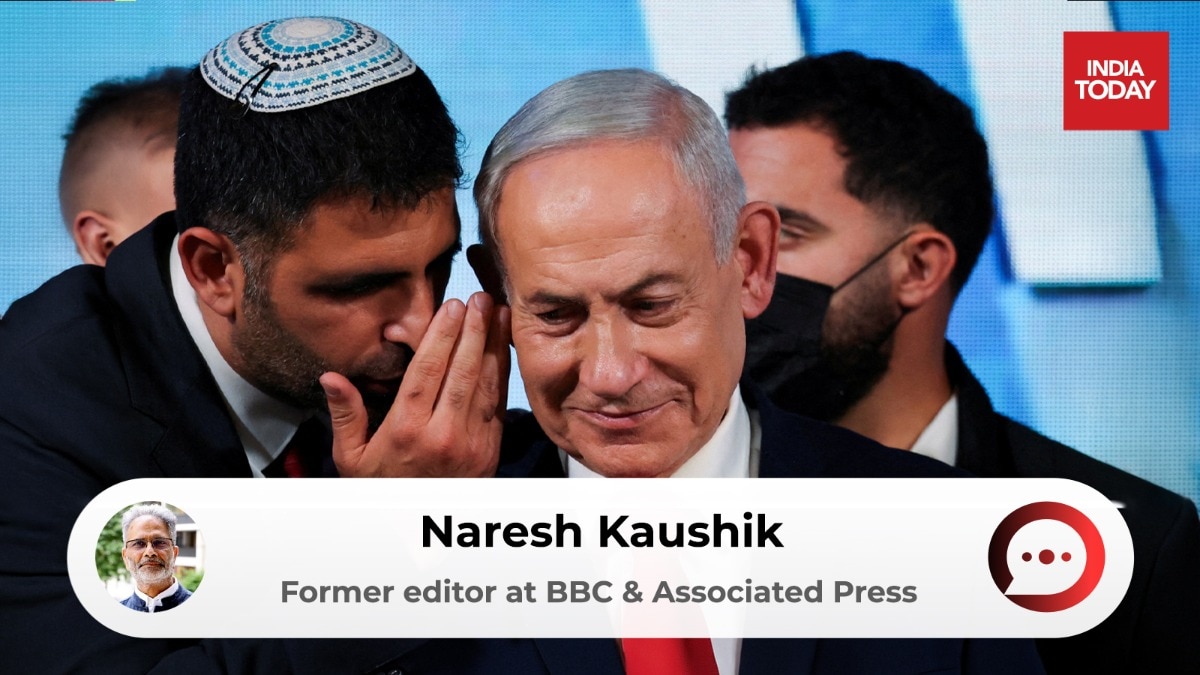
Israelis woke up on Wednesday morning to an election result that differed sharply from what pollsters had led them to expect just the night before.They expected a strong showing for the Gadi Eisenkot-led opposition alliance, the so-called change bloc. Instead, they found the Likud-led bloc of Prime Minister Benjamin Netanyahu on top.
It lost its majority but still won more seats than the change bloc, defying expectations.The final results have confirmed a deadlock: 53 seats for the Netanyahu-led bloc and 48 for Eisenkot’s bloc. Both are short of the 61-seat majority.The only political groups that have done particularly well — again, unexpectedly — are the Arab parties, which represent just over a fifth of Israel’s population.
They won 19 seats in Israel's Knesset, the highest ever. Most analysts have declared them potential kingmakers.
But can the Arab parties really play that role in a Jewish nation where most political leaders, including Eisenkot, want a Zionist government?Arab Israelis have supported governments from outside in the past, but the country has changed significantly under Netanyahu, who formed the most right-wing government in the country’s history in 2024. He assigned the national security and defence portfolios to Jewish supremacists Itamar Ben-Gvir and Bezalel Smotrich.
They have incited violence against Palestinians and have pressed for more Jewish settlements in the West Bank. Arab Israelis went to the polls in droves, hoping to remove Netanyahu and these two ministers from power.
Eisenkot also campaigned to oust Netanyahu. He could do so if he formed a government with help from Arab lawmakers.However, in current Israeli society, Eisenkot can do that only at great political risk.
Except for the small left-wing Democratic Party, no member of his alliance has supported such a move. But nothing is impossible in politics.MASTER OF POLITICAL MANOEUVRINGNetanyahu, a veteran of political manipulations, has already moved to counter that prospect.
His party has accused Arab parties of irregularities and even of stealing the election. Israel’s security agency, Shin Bet, is investigating alleged illegal funding from Qatar and Turkey.
Both Arab parties strongly rejected the claim, and Qatar dismissed the allegations as "ridiculous and dangerous."Accusing Qatar of interfering in Israel is interesting. Successive Israeli governments supported Qatar’s funding of Hamas.
Reports in Israeli and US media say it was under Netanyahu that Qatar’s funding of Hamas was regularised — he allegedly supported funding Hamas to weaken the Palestinian Authority, a divide-and-rule tactic. But the move only made Hamas more powerful and more dangerous to the Jewish state.Israel’s opposition has accused Netanyahu of failing to protect Israelis from Hamas attacks.
That was a major campaign issue in Tuesday’s election. Netanyahu has never expressed regret for his government’s failure to prevent the October 7 attack in 2023.FEAR CAMPAIGNSensing public anger towards him, Netanyahu launched a publicity blitz in the final days of the campaign, seeking to instil fear about security among voters.
Just two days before polling, he posted an AI-generated image depicting a nuclear explosion in Tel Aviv, accompanied by a warning of a “second Holocaust” and a message urging Israelis concerned about their physical survival to vote with “trembling hands”. He also tried to scare Israel’s many Jewish voters into believing that large crowds of Arab voters at the polls could pose a security threat.The outcome shows Netanyahu’s scare tactics worked; more voters than expected backed him.
Even some of Ben-Gvir and Smotrich's far-right supporters have decided to go with Netanyahu because of the fear factor.Fear also influenced the opposition vote: fear of Netanyahu’s return to power. Tens of thousands of Israelis returned from overseas to vote, many of them against Netanyahu.
Arabs also voted in record numbers for the same reason.But the overall feeling against Arabs, as a result of Netanyahu’s policies, has only helped him politically. Such feelings have increased since the October 7 attack.
The attack may have happened under his watch, but he and his far-right supporters have exploited it to create racial division in Israeli society. For that reason, most Zionist political parties are uncomfortable seeking the support of Arab parties in forming a government, a factor that only suits Netanyahu.MESSY OUTCOME SUITS NETANYAHUThe focus will now shift to Israel’s president, Isaac Herzog, who will receive the final results by November 4.
But as the leader of the largest party in the new Knesset, Netanyahu is likely to be invited first to try to form the new government. That has happened before.
That could be enough for the master of the art of dark politics to manipulate and outsmart the opposition leaders and even try to split their parties.He will have 28 days to negotiate with other factions to try to join his governing coalition. He can also request a 14-day extension to the deadline.
If he fails, Eisenkot, the leader of the second-largest party, will be invited.Even if he doesn’t succeed, he will try to form a government of national unity, as has happened numerous times in the past. Although Eisenkot has ruled that out for now, he will have no choice but to join such a government because the president has indicated he doesn’t want fresh elections.
That would suit Netanyahu, as he would most likely lead that government.There could be a deal to replace him after half the term, but in the past, Netanyahu hasn’t honoured such a deal. In any case, he will remain the caretaker head of government during this process, which could last months.Even fresh elections in the wake of parties failing to agree to form a government would suit him, as many voters who were mobilised to vote against him this time are unlikely to repeat that at that scale next time.NETANYAHU’S LASTING FOOTPRINTOn Thursday, there were small demonstrations in Israel, with people demanding a coalition between the Zionist and Arab parties to remove Netanyahu.
So, there is still a remote possibility that the opposition decides ousting Netanyahu is a bigger priority and takes the support of Arab parties from outside.But that will not bring major changes in the way Israel is governed. The nation, under Netanyahu, has become more right-wing.
A new government could bring some changes domestically, but it’s unlikely it will make any concessions to Palestinians.Most Jewish parties and the Israeli public now oppose Palestinian autonomy. They are also in favour of continuing the policy of expanding Jewish settlements in the occupied West Bank.
The only change will be a reduction in violence by settlers against Palestinians.Israel has tried to portray itself as the only democracy in the Middle East. But it is also a country where Arabs, the country’s largest minority, live largely segregated lives, face daily discrimination, and have a lower standard of living -- despite having equal voting rights.
They are separate from Palestinians living in Gaza, the West Bank, and Jerusalem, who don’t have such rights and suffer far greater discrimination and daily violence. Arab Israelis may press for better conditions for themselves in return for their support, but little change is expected.Netanyahu’s main legacy has been to end support among Israelis for Palestinian national aspirations and to secure mainstream backing for a permanent war footing to confront Iran.
He has reshaped how Israelis think about their country’s security and has institutionalised his own compromising positions. No new government after that is likely to change that position.HOW THE RESULTS AFFECT INDIAA new government in Israel is unlikely to end its conflict with Iran.
Under Netanyahu, Israel has favoured military over diplomatic solutions.It’s worth remembering that it was after Netanyahu’s persuasion that Donald Trump decided to pull out of the 2015 Iran nuclear deal, even though Iran was complying with it. It was Netanyahu who persuaded Trump to go to war against Iran last summer and again this year in February.Trump has already threatened to resume bombing Iran after next week’s mid-term elections, and preparations are reported to be underway for a “short but intense” military campaign.
Although Trump would prefer Netanyahu at the helm in Israel, he will be able to take any Israeli leader along for the resumption of war.That will have devastating consequences for global oil prices, already very high and hurting most countries' economies. India has already taken a big hit.
New bombing will adversely affect us because India still relies heavily on Gulf oil.But India’s relations with Israel are unlikely to be affected by political change there. Modi and Netanyahu call each other friends, and the countries are strong strategic allies.
However, the bilateral ties are unlikely to be affected even if Netanyahu is gone.Naresh Kaushik is a former editor at the BBC and Associated Press. He is based in London.- Ends