


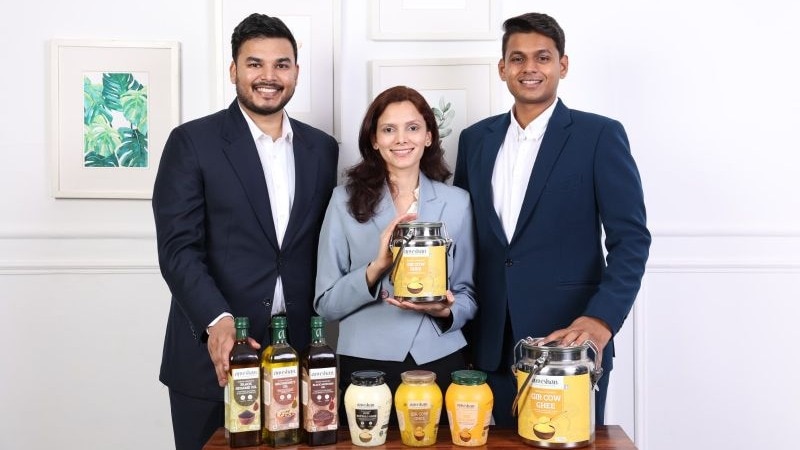
Three IIT Guwahati graduates left conventional career paths to build a business around India's farmers. What began with packing oil cans on the floor of a Bengaluru apartment has grown into a venture with 20-plus processing facilities and a team of over 150 people.Three IIT Guwahati graduates left conventional career paths to build a business around India's farmers.
In 2020, three graduates of IIT, Guwahati, were doing something far removed from what one might expect after an engineering degree. They were sitting on the floor of a two-bedroom apartment in Bengaluru, packing cans of mustard oil and ghee, stacking inventory against the walls and preparing orders for delivery.Their first office had no warehouse, no packing machines and no dedicated storage space.
One bedroom held the stock, the living room became the packing area, and the drawing room was turned into an inventory space.The three founders were Kuldeep Parewa, Akhil Kansal and Aayushi Khandelwal. They were not preparing for another corporate job or building a conventional technology startup.
They were trying to solve a problem they had seen closely: farmers doing the hard work of producing agricultural goods but struggling to earn enough from it.Their venture, Anveshan, is a farm-to-fork food startup that works with farmers and rural producers to make and sell traditional Indian food products, including bilona ghee, cold-pressed oils, raw honey and other staples. Its model combines traditional processing methods, quality testing and direct sourcing to connect agricultural producers with consumers.
FROM IIT GUWAHATI TO AN UNUSUAL STARTUP IDEAThe three founders came from different academic and professional experiences, but shared an IIT Guwahati connection.Kuldeep Parewa studied at the institute between 2014 and 2018. Akhil Kansal graduated in 2017 after studying Electronics and Communication Engineering, while Aayushi Khandelwal was also at IIT Guwahati from 2014 to 2018.
Parewa's decision to enter entrepreneurship was rooted in his agricultural family background. He had seen farmers in his family and village struggle to earn a reasonable income despite the physical effort involved in their work.In his LinkedIn post recalling the company's early days, Parewa said he had seen farmers earn just Rs 150-200 a day.
That experience made him question how agricultural producers could get better returns for what they grew.Even after working at Goldman Sachs, he decided to take a different route. Along with Kansal and Khandelwal, he began building Anveshan around the idea of helping farmers move beyond selling raw produce and participate in processing and value addition.
WHEN THE LIVING ROOM BECAME A PACKING UNITThe founders' first challenge was getting the business running with very limited resources.Parewa recalled that his Indiranagar apartment in Bengaluru became their workplace. His co-founders stayed with him, and the three handled almost every part of the operation themselves.The work was physically demanding.
Some days, they packed around 200 orders by hand. They also delivered products to local sellers on scooters, carrying the cans themselves.
The apartment, meanwhile, was filled with the smell of mustard oil and ghee.But the early setup also reflected the business they wanted to build. Instead of simply sourcing finished products and selling them under a brand name, Anveshan wanted to create a supply chain that could work more closely with farmers.It was not the typical beginning one associates with graduates of a premier engineering institute.
But the founders were willing to do the groundwork to understand the business, build customer relationships and establish a supply chain.It also uses QR-code-based traceability, allowing customers to understand where their products come from and how they are made.This approach is intended to address two sides of the same problem: farmers need better market access and returns, while consumers want greater transparency about the food they buy. FROM A TWO-BEDROOM FLAT TO FARMER ENTREPRENEURSThe business eventually moved beyond the apartment setup.In the LinkedIn post, Parewa shared that Anveshan had grown to work with more than 250 farmers, established over 20 processing facilities across India and built a team of more than 150 people.One of the changes he highlighted was the evolving role of farmers associated with the venture.
Instead of remaining suppliers of raw agricultural produce, they were increasingly participating in processing and creating value-added products.The company's wider model is built around small processing units, traditional food-making methods and quality checks. Its aim is to give farmers better access to markets while offering consumers products with greater sourcing transparency.For the three IIT Guwahati graduates, the journey has involved much more than setting up a food brand.
It has meant moving from engineering classrooms and corporate careers into the everyday realities of agriculture, production, packaging and distribution.Parewa said he still thinks about the apartment where the business began, particularly the drawing room that once served as an inventory space. He credited the farmers who trusted the founders in their early days for being an important part of the company's growth.What started with three graduates packing orders on a Bengaluru apartment floor had become a business with a wider network of farmers and processing facilities.
Their journey shows how an engineering education can lead to an unexpected entrepreneurial path when graduates choose to build a business around a problem they have seen first-hand.- Ends