


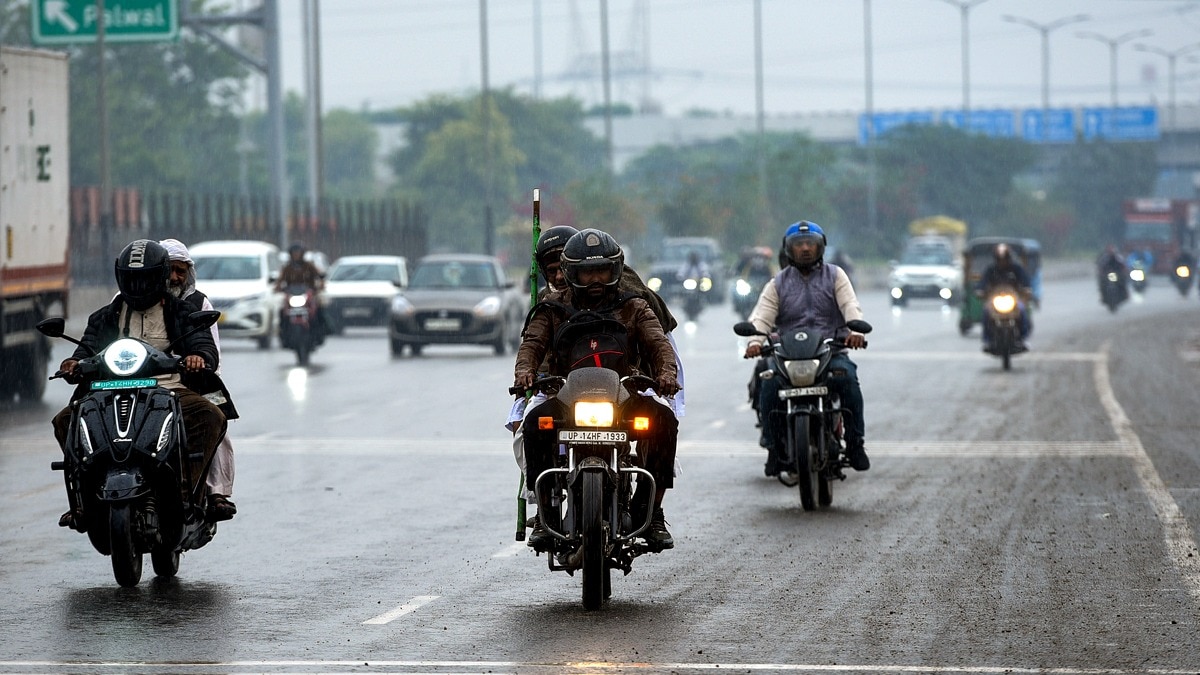
Delhi recorded its coldest October day in four years on Thursday as the maximum temperature at the Safdarjung weather station plunged to 25.4 degrees Celsius, 5.6 degrees below normal, following the weakening of Cyclone Arnab.The maximum temperature was the lowest recorded for an October day since October 8, 2022, when the mercury had settled at 23.4 degrees Celsius. Dark clouds covered the national capital through the morning, although Delhi received only trace rainfall in the 24 hours preceding Thursday.The impact of the weather system extended across northern India, with Haryana and Punjab witnessing a sharp fall in daytime temperatures.
The India Meteorological Department (IMD) issued red and orange alerts for thunderstorms in Delhi-NCR, Uttar Pradesh and several other parts of northern India over the next two days.TEMPERATURES PLUNGE ACROSS HARYANA, PUNJABKarnal in Haryana recorded a maximum temperature of 20.6 degrees Celsius, nine degrees below normal, while Ambala registered 23.8 degrees Celsius, six degrees below average. Narnaul, Rohtak and Bhiwani recorded maximum temperatures of 25.5, 24.6 and 28 degrees Celsius, respectively, with departures of up to six degrees below normal.In Punjab, Patiala recorded a maximum of 27.4 degrees Celsius, three degrees below normal.
Ludhiana and Amritsar registered 30.4 and 30.6 degrees Celsius, respectively, while Pathankot recorded 29 degrees Celsius, Bathinda 31 degrees Celsius and Faridkot 34.9 degrees Celsius.UP BRACES FOR MORE RAIN, THUNDERSTORMS The weather office in Lucknow forecast a fall of around five to eight degrees Celsius in maximum temperatures across Uttar Pradesh on October 29 and 30.Several districts, including Lucknow, Unnao, Rae Bareli, Sultanpur and Amethi, were likely to experience thunderstorms and strong winds.Parts of western Uttar Pradesh could also witness hailstorms on Friday, after which rainfall activity is expected to decrease.CYCLONE ARNAB WEAKENS, RAINS CONTINUE ACROSS STATESThe IMD said Cyclone Arnab's remnant weather system weakened into a depression over south Chhattisgarh and adjoining south Odisha on Thursday morning.It was expected to move northwards and weaken further into a well-marked low-pressure area by the evening.In Himachal Pradesh, light rain was recorded at isolated places, while thunderstorms and lightning were reported in Shimla, Jubberhatti, Sundernagar, Kangra, Murari Devi and Palampur.The meteorological centre issued a yellow warning for thunderstorms and lightning in parts of Kangra, Mandi, Shimla and Sirmaur districts on Friday. Kukumseri in Lahaul and Spiti recorded the state's lowest minimum temperature at minus 1.2 degrees Celsius.In Rajasthan, a fresh western disturbance changed weather conditions across several areas.
A circulation over Punjab and adjoining regions was likely to bring rain and strong winds to parts of eastern Rajasthan.Moderate to heavy rain and isolated hailstorms were forecast in northern parts of the Jaipur and Bharatpur divisions, with maximum temperatures expected to fall by three to five degrees Celsius over the next 24 hours.Jharkhand also witnessed heavy rainfall, with Gudabanda in East Singhbhum district recording 71.4 mm since Wednesday evening. Manjhari in West Singhbhum received 64 mm, while Chaibasa recorded 60 mm and Ranchi 26.2 mm.
Schools in several districts, including Ranchi, West Singhbhum, East Singhbhum and Simdega, remained closed on October 28 and 29 due to the cyclone.Parts of West Bengal also experienced rain and strong winds as the weather system moved over south Chhattisgarh and adjoining south Odisha.ODISHA DEPLOYS 79 TEAMS FOR RESCUE OPSIn Odisha, the Indian Coast Guard began airlifting people stranded in flood- and landslide-hit Ganjam district. The state government deployed 79 teams from various disaster response agencies for rescue and relief operations in two districts.Chief Secretary Anu Garg said around 300 villages in Ganjam had been affected by floods, with 70 of them cut off.
The state government was coordinating with the Union Home Ministry to arrange air evacuations.- Ends