


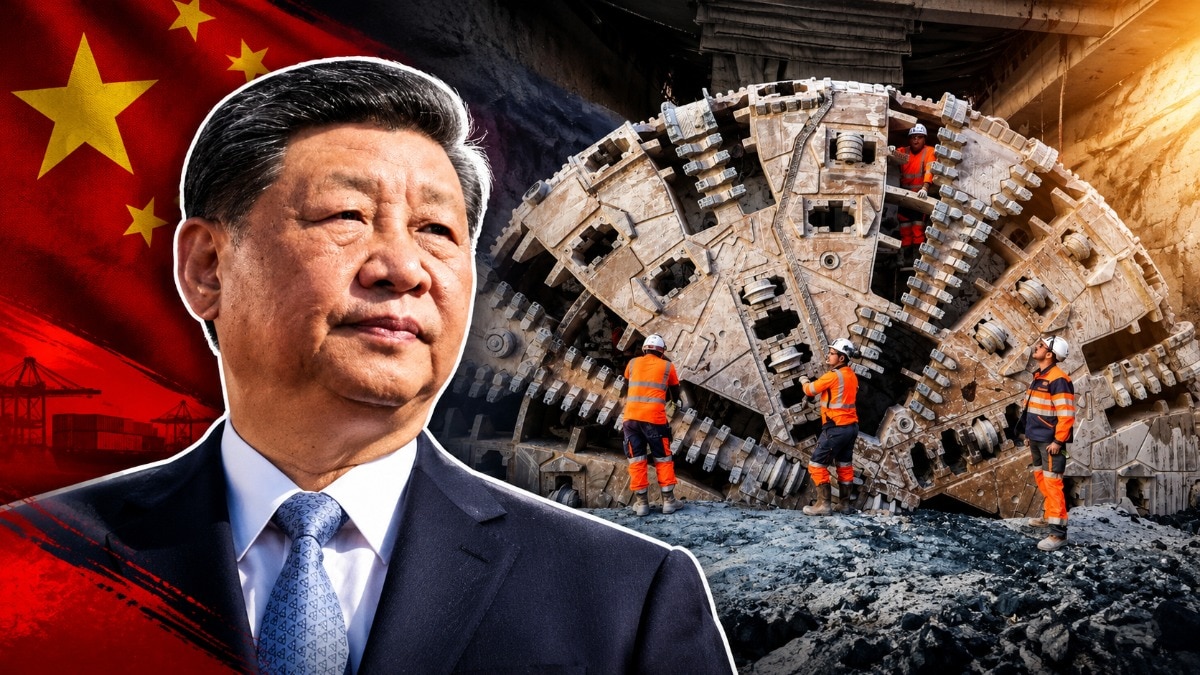
China's decision to tighten export controls on tunnel-boring machines (TBMs) has exposed a vulnerability in India's infrastructure ambitions, with implications for everything from urban transport to connectivity in the Himalayas. As Beijing tightens its grip on this technology that is essential for metro networks, highways and high-speed rail, India faces the prospect of renewed supply disruptions.
The curbs have also raised longer-term concerns about India's ability to build critical infrastructure without being dependent on foreign technology.Although the Chinese restrictions are unlikely to halt the construction of major border road tunnels that rely on conventional excavation, they still highlight the need for New Delhi to develop a resilient domestic manufacturing base as it expands infrastructure in strategically sensitive regions.The Chinese Commerce Ministry on October 19 announced that export controls on tunnel-boring machines (TBMs) and related equipment would take effect on November 18. Beijing, while making the announcement, cited "national security" and "non-proliferation" obligations.TBM manufacturing is concentrated in a handful of industrial nations, including Germany, the US, Japan and France, with China emerging as the dominant global producer.
Currently, China accounts for an estimated 70% of the global TBM market and manufactures around 95% of the machines used domestically. The move gives Beijing a formal lever to potentially disrupt India's major infrastructure projects, following supply difficulties in 2024, when China delayed shipments of tunnelling machinery manufactured at its facilities, including TBMs made by German engineering major Herrenknecht.For India, the immediate challenge is to protect project timelines and diversify supplies.
The bigger question, however, is that can New Delhi turn the latest restrictions into an opportunity to develop its own capabilities in machinery that will become increasingly important to its infrastructure and strategic connectivity? More importantly, can India wean itself off China when it comes to TBMs?
China dominates the global tunnel-boring machine (TBM) market, producing about 70% of the world's machines and 95% of its own domestic units. (AI Illustration/Sushim Mukul) CHINA'S CURBS AND INDIA'S BORDER INFRASTRUCTUREIndia's concerns extend beyond metro railways and urban road tunnels. Since the 2020 Galwan clashes, a major India-China border confrontation which resulted in the deaths of 20 Indian soldiers, New Delhi has accelerated the construction of roads, bridges, tunnels and other infrastructure to improve access to forward areas along the Line of Actual Control (LAC).These projects are strategically and militarily essential, particularly in eastern Ladakh and Arunachal Pradesh.
Without a proper network of all-weather roads and tunnels, India's ability to respond swiftly to any fresh border crisis would be severely constrained."There's no doubt that China's TBM sanctions are aimed at India's strategic infrastructure projects along the 4,056-km Line of Actual Control (LAC)," senior journalist and defence expert Sandeep Unnithan told India Today Digital.But while TBMs are important for infrastructure development, it must be noted that a significant portion of tunnels built by India near its border with China relied more on conventional excavation methods, such as using explosives.Take for instance, the Zojila Tunnel, a critical all-weather link supporting access to Ladakh. The project achieved its final breakthrough in June 2026 through use of the New Austrian Tunnelling Method (NATM), which uses sequential excavation, drilling and blasting, rock bolting, shotcrete and continuous geological monitoring.Similarly, the Sela Tunnel in Arunachal Pradesh, which improves all-weather connectivity to the strategically important Tawang sector, was constructed using NATM.
The Shyok Tunnel in eastern Ladakh, on a route supporting access to forward areas, uses a cut-and-cover approach.These examples show why China's export controls should not automatically be interpreted as a direct threat to every border tunnel. Extreme altitude, variable rock formations, water ingress, geological faults, short working seasons and the difficulty of transporting and maintaining heavy machinery make conventional methods more practical for such projects.However, that does not make the Chinese restrictions strategically irrelevant.
TBMs are increasingly used in longer railway and hydropower tunnels across the Himalayas, improving regional connectivity and potentially strengthening the wider logistics network that supports military operations in border areas.The Rishikesh-Karnaprayag railway project in Uttarakhand is an important example. Two large Herrenknecht TBMs, named Shiv and Shakti, excavated a major twin-tube section through challenging Himalayan geology.There is also the Arjuna TBM, built by Megha Engineering and Infrastructures Limited in collaboration with Germany's Herrenknecht in August 2026.
This TBM was designed to bore through the basalt formations beneath Sanjay Gandhi National Park for Mumbai's Thane-Borivali Twin Tunnel project.Such projects demonstrate that TBM technology can have an important role in difficult mountain terrain and highly populated regions, even if its deployment on primary LAC-adjacent road tunnels remains limited.So, the risk for India is disruption to projects that directly depend on imported TBMs from China and continued dependence on foreign machinery as the country expands its wider railway, hydropower and underground infrastructure network. Any future shift towards greater TBM use in strategic mountain projects would make domestic capability even more important.
India has maintained a heavy reliance on foreign-made Tunnel Boring Machines (TBMs) to drive its massive urban and border infrastructure boom. (AI Illustration/Sushim Mukul) INDIA'S DEPENDENCE OF TBMs THAT HAS ALREADY CAUSED DELAYS BY CHINAIndia's vulnerability to TBMs became evident in 2024, when Union Commerce Minister Piyush Goyal raised concerns with then German Vice Chancellor Robert Habeck about delays in the supply of TBMs manufactured by Herrenknecht in China.The episode revealed a problem that is beyond buying equipment from Chinese companies. Even though the machine was ordered from a German manufacturer, it can still become vulnerable to Chinese export restrictions if it is produced at a facility in China or depends on components subject to export controls.However, an important point to note here is that India's imports of tunnelling machinery from China fell from $18 million in 2022-23 to $3 million in 2023-24, before dropping to $500,000 in 2024-25 and rising marginally to $800,000 in 2025-26, according to figures cited by Reuters.India received delayed TBMs from China in March 2026 as bilateral tensions somewhat eased between the two countries.
Now, the new licencing requirements by Beijing introduce another layer of uncertainty for India.The immediate exposure is particularly significant for projects such as the Mumbai-Ahmedabad High-Speed Rail Corridor, which includes a seven-kilometre undersea tunnel, and major urban road tunnels. TBMs allow excavation in densely populated areas with less surface disruption and can improve safety compared with conventional blasting in suitable conditions.
Rather than a sudden drop, the steep decline of India's Chinese TBMs import is the result of a deliberate, multi-phased decoupling strategy that began after the 2020 border clashes. (AI Illustration/Sushim Mukul) INDIA'S TBM MANUFACTURING PUSH GAINS URGENCYIndia is stepping up efforts to reduce its dependence on imported tunnel-boring machines (TBMs) through domestic manufacturing, local assembly by foreign companies and indigenous design. German engineering major Herrenknecht, which established an assembly facility in Chennai in 2007, manufactured 10 TBMs for Chennai Metro Phase 2 at the facility between July 2022 and July 2023.
According to an official disclosure by Herrenknecht, 60% of the components used in the TBMs came from Indian suppliers, with the rest 40% sourced from the firm's facilities in Germany. In 2025, it acquired 12.4 acres in North Chennai for a planned manufacturing plant, signalling confidence in India's growing tunnelling demand.However, local assembly does not guarantee self-reliance, as critical components, precision-engineered systems and advanced controls might still depend on overseas suppliers.
State-owned Bharat Earth Movers Limited (BEML) is pursuing indigenous TBM development, with plans for machines ranging from around six metres to 16.5 metres in diameter, beginning with a prototype of approximately 6.5 metres.The Centre's proposed $1.2 billion incentive scheme for construction and infrastructure equipment manufacturing could accelerate this transition, attracting an estimated $1.8 billion in fresh investment over seven years. The challenge for New Delhi is to ensure that these incentives translate into domestic production of critical components, technology development and a robust supplier ecosystem, rather than merely expanding assembly operations using components sourced abroad.
A crane lifts a tunnel boring machine measuring 16.07 meters in diameter for the reconstruction project of Beijing's East Sixth Ring Road in Beijing, China. (Getty Images) Public policy researcher Pranay Kotasthane, in a post on X, argued that the latest restrictions could create short-term project delays but encourage manufacturers to expand outside China in the longer term."The larger lesson is that China is no longer a reliable business partner. India's job is to make the move easy: predictable approvals, reliable power, and quick customs clearance for components," said Kotasthane, Deputy Director of the Bengaluru-based Takshshila Institution.Therefore, amid the latest curbs by China, India, over the longer term, must develop domestic capabilities that span design, component manufacturing and complete machine production.
BEML's plans, foreign manufacturers' investments and the proposed incentive scheme offer a foundation, but their success will depend on sustained execution.But should it succeed in building a domestic TBM manufacturing base, as senior journalist and defence expert Sandeep Unnithan told India Today Digital, "The India of 20–30 years hence will thank us."China has given India another reason to question the reliability of supply chains exposed to geopolitical decisions.- Ends