


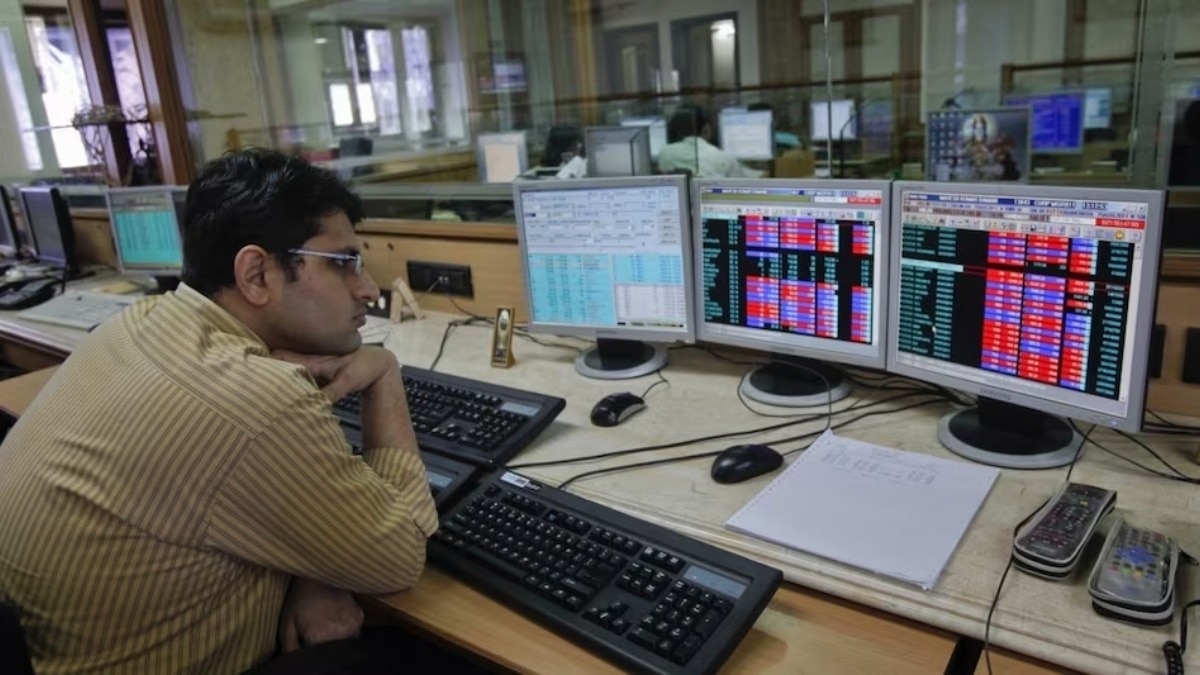
Dalal Street is struggling to find its footing on Thursday, with the Sensex falling nearly 600 points and the Nifty slipping below 22,650 as rising crude oil prices, escalating Middle East tensions and persistent selling pressure weigh on investor sentiment. The decline has spread across sectors, with auto, metal, FMCG and financial stocks among the biggest drags, while investors also reassess valuations in the broader market.The BSE Sensex was trading at 73,119.48, down 590.21 points or 0.80%, at 9:38 am.
The NSE Nifty 50 fell 197.30 points, or 0.86%, to 22,614.05.The latest decline extends the market's losses over recent sessions. While the benchmarks have faced pressure, the weakness in mid- and small-cap stocks has been more pronounced, pointing to a broader shift towards caution among investors.Here are four reasons why the stock market is falling today.
CRUDE OIL ABOVE $110 ADDS TO INFLATION CONCERNSThe biggest external concern is the continued rise in crude oil prices. Brent crude was trading at $110.68 a barrel, up 1.71%, while US West Texas Intermediate crude rose 1.42% to $98.53 in the latest snapshot.Oil prices have remained elevated amid escalating tensions in the Middle East, including attacks in Saudi Arabia by Yemen's Houthi forces.
The situation has raised concerns about energy supplies and shipping disruptions. For India, which imports most of its crude oil requirements, higher prices can increase the import bill, put pressure on the rupee and add to inflation.
They can also raise fuel and transportation costs for companies, squeezing profit margins.Persistent oil price increases could complicate the Reserve Bank of India's policy outlook. Minutes of the central bank's latest monetary policy meeting indicated that some rate-setting panel members believed further rate hikes might be needed to contain inflation, although they stopped short of endorsing aggressive tightening because of risks to economic growth.With crude remaining above $110 a barrel, investors are wary of the impact on India's macroeconomic outlook and corporate earnings.MID- AND SMALL-CAP STOCKS FACE A VALUATION RESETThe sell-off is not limited to heavyweight stocks.
The broader market is also under pressure, with mid- and small-cap indices falling more sharply than the benchmarks.The Nifty 100 declined 1.01%, the Nifty 200 fell 1.09% and the Nifty 500 dropped 1.12%. The Nifty Midcap 50 slipped 1.36%, the Nifty Midcap 100 fell 1.39% and the Nifty Smallcap 100 declined 1.45%.Dr V K Vijayakumar, Chief Investment Strategist at Geojit Investments Limited, said the recent market trend had been characterised by large-caps outperforming mid- and small-cap stocks.He noted that the resilience of the broader market in recent months had been driven more by liquidity than earnings.
September data from the Association of Mutual Funds in India (AMFI), he added, showed an increasing preference for mid- and small-cap stocks over large-caps."This has created a paradox of over-valued mid-and small-caps, particularly the latter, coexisting with attractively valued large-caps," Vijayakumar said, adding that this divergence could not continue indefinitely and appeared to be correcting.The current decline could therefore reflect not only concerns about global risks but also a reassessment of valuations in segments of the market that had attracted substantial investor money.SELLING SPREADS ACROSS SECTORSThe breadth of the decline is another sign of caution. Most sectoral indices were trading lower in the latest snapshot, indicating that the pressure was not confined to a few heavyweight stocks.The Nifty Auto index fell 1.53%, while the Nifty Metal index dropped 1.91%.
The Nifty FMCG index declined 1.47%, the Nifty Pharma index slipped 1.24% and the Nifty Financial Services 25/50 index fell 1.04%.The Nifty Realty index was down 0.81%, while the Nifty PSU Bank index declined 0.78%. The Nifty Private Bank index fell 0.74%.Among Sensex stocks, Power Grid was the biggest loser in the supplied snapshot, falling 2.58%.
Maruti Suzuki declined 1.81%, Bajaj Finserv fell 1.73%, Asian Paints dropped 1.69% and Mahindra & Mahindra lost 1.67%. Adani Ports, Bharat Electronics and Tata Steel were also under pressure.IT stocks were relatively more resilient, with the Nifty IT index down just 0.11%.
Infosys edged up 0.16%, while Eternal gained 2.21%. However, gains in a handful of stocks were not enough to offset the widespread weakness.India VIX, a gauge of expected market volatility, rose 5.51% to 16.54, indicating increased nervousness among investors.HIGH US BOND YIELDS AND INSTITUTIONAL FLOWS ADD TO PRESSUREElevated US bond yields are another external headwind for Indian equities.
Higher yields can make US assets more attractive relative to emerging-market investments, potentially putting pressure on foreign fund flows and valuations.Vijayakumar said elevated crude prices and high US bond yields were encouraging bearish investors to build short positions in the market. He pointed out that Indian equities had declined even on sessions when foreign and domestic institutional investors were net buyers.This suggests that daily institutional flows alone may not be enough to support the market when broader macroeconomic concerns remain unresolved.Vijayakumar said a shift towards fairly valued large-cap stocks could be an appropriate strategy in the current environment, although it may take time for the benefits to emerge.Investors will track crude oil prices, developments in the Middle East, US bond yields, currency movements and upcoming corporate earnings for direction.The immediate concern is whether oil prices remain above $110 a barrel and continue to fuel inflation worries.
At the same time, the performance of mid- and small-cap stocks will be important in determining whether the current weakness is a short-term correction or a more sustained adjustment in valuations.For now, the combination of external headwinds and pressure on broader-market valuations is keeping sentiment fragile. Vijayakumar expects the trend of large-caps outperforming mid- and small-caps to continue, with investors potentially shifting towards companies whose valuations are better supported by earnings.- Ends