


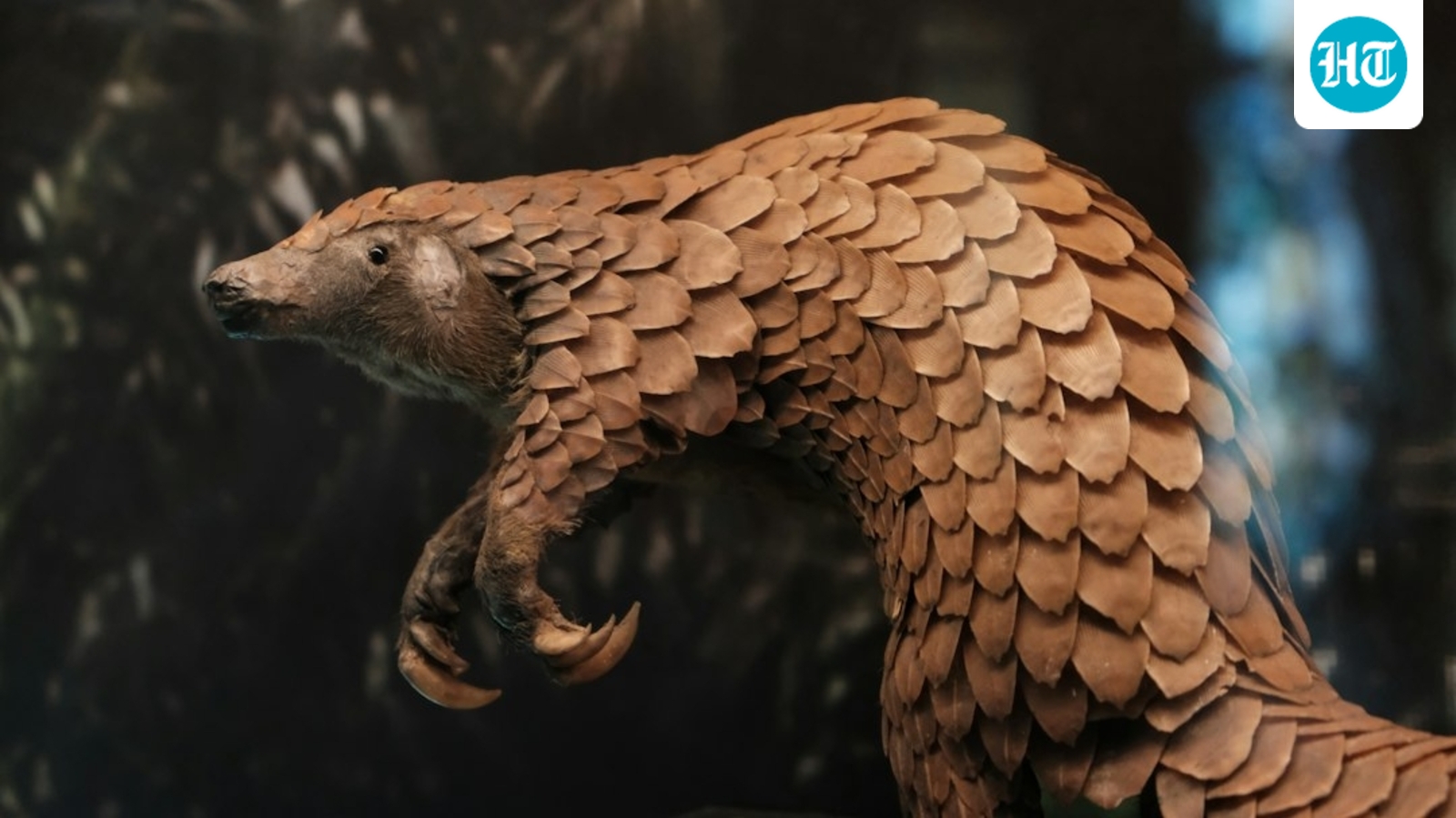
According to the Communications Biology study, researchers used DNA from that nearly 190-year-old specimen to confirm the Himalayan pangolin, Manis aurita, as its own species. It is found in Nepal and northern India.
Many scientists had believed it was a subspecies of the Chinese pangolin.Armored in pinecone-like scales, pangolins are poached more than any other mammal. (Representational/Unsplash)A mammal under heavy pressurePangolins are medium-sized mammals native to Africa and Asia. Long, thick tails, huge curling claws, and armored bodies covered in overlapping, pinecone-like scales are their trademarks.
According to the Field Museum, pangolins are poached for those scales, making them the most trafficked mammals in the world. This makes them highly vulnerable to extinction.
The scales are thought to be a potent aphrodisiac in traditional Chinese medicine, and illegal poaching is a huge threat. Anderson Feijó, an assistant curator of mammals at the Field Museum and co-corresponding author of the study, says markets sell mostly scales, not whole animals.
So it’s hard to know what species is being hunted.A name that was nearly lostThe name Manis aurita goes back to 1836, when it was described as a pangolin species. Later, it was downgraded to a subspecies of the Chinese pangolin.
Then, in 2025, another group of scientists showed that Chinese pangolins were in fact two species. One lives mainly in China.
The other lives in the foothills of the Himalayas, across parts of Nepal, India, Bhutan, and Myanmar. That group named the mountain species Manis indoburmanica, the Indo-Burmese pangolin.
In science, the first name a species gets is the one that sticks. Feijó and his colleagues had been working on the pangolin family tree for a decade, analyzing physical traits and DNA.
Kai He of Guangzhou University, a co-corresponding author, says this left a core riddle. Were indoburmanica and aurita the same species or different ones?Meet Manis aurita, the Himalayan pangolin, sitting in the Smithsonian National Museum of Natural History, now confirmed as its own species. (Wikimedia Commons)The answer was in the ancient DNAThe Natural History Museum’s team sequenced DNA from the historical type specimen of aurita, the Nepalese subspecies.
The DNA matched modern pangolins from the Himalayas. The species described as Manis indoburmanica in 2025 should be called Manis aurita, the Field Museum noted.
In a few small but distinct ways, the Himalayan pangolin is different from the Chinese pangolin. It has a larger body, a longer tail, and smaller ears.
The name aurita refers to its distinct ears. The two species also occupy separate areas that do not overlap.
Narayan Koju of the Nepal Engineering College at Pokhara University, the study’s first author, says the finding caps more than five years of research that began in Nepal.Why this is important for conservationNew DNA analyses are helping conservation scientists identify which pangolin species are being poached. They can trace samples back to high-risk regions in illegal markets.
The findings could also aid efforts to reintroduce pangolins to former ranges. Feijó notes that before, someone might have introduced Chinese pangolins into Nepal without knowing the difference.
The clarification provides a basis for the conservation of this cryptic, endangered species, says co-corresponding author Yan Hua of the Guangdong Academy of Forestry. Museums were important as well.
Because wild pangolins are so rare, collections give researchers access to more animals across the species’ range, says Feijó. The study involved scientists from institutions including Guangzhou University and the Smithsonian National Museum of Natural History.
As Feijó put it, “we can’t protect what we do not know.”The Hindustan Times US Desk brings you the latest news and developments from across the United States. The team covers everything from breaking news and politics to sports, business, entertainment and stories that are trending across the country.
Our coverage includes the White House, Congress, US elections, immigration and visa updates, H-1B, green cards, Social Security, education, jobs, layoffs, the economy, technology and major policy changes. We also closely follow stories that matter to Indian and South Asian communities in the US.
The desk covers major US sports, including the NFL, NBA, MLB and NHL, along with player news, injuries, schedules, results and major events. Entertainment coverage includes Hollywood, celebrities, television, streaming, music and pop culture.
We also report on breaking developments, major incidents, weather, public safety, court cases and other stories making headlines across the country. When a major policy or news development affects people's everyday lives, the team works to explain what happened, what it means and what readers need to know.
Alongside breaking news, the US Desk produces explainers and practical stories on topics such as immigration, Social Security, taxes, education, employment and government programmes. The team also works on science, tech, business and AI stories analyzing the impact they may have on people.
The team follows developments throughout the day, keeping an eye on official announcements, public records, reliable news sources and what people are talking about across the US.Read MorePangolinDnaUs Local NewsGet the latest World News, breaking headlines and global updates from the US, UK, Pakistan, Bangladesh, Russia and other countries. Follow major international events on Hindustan Times.