


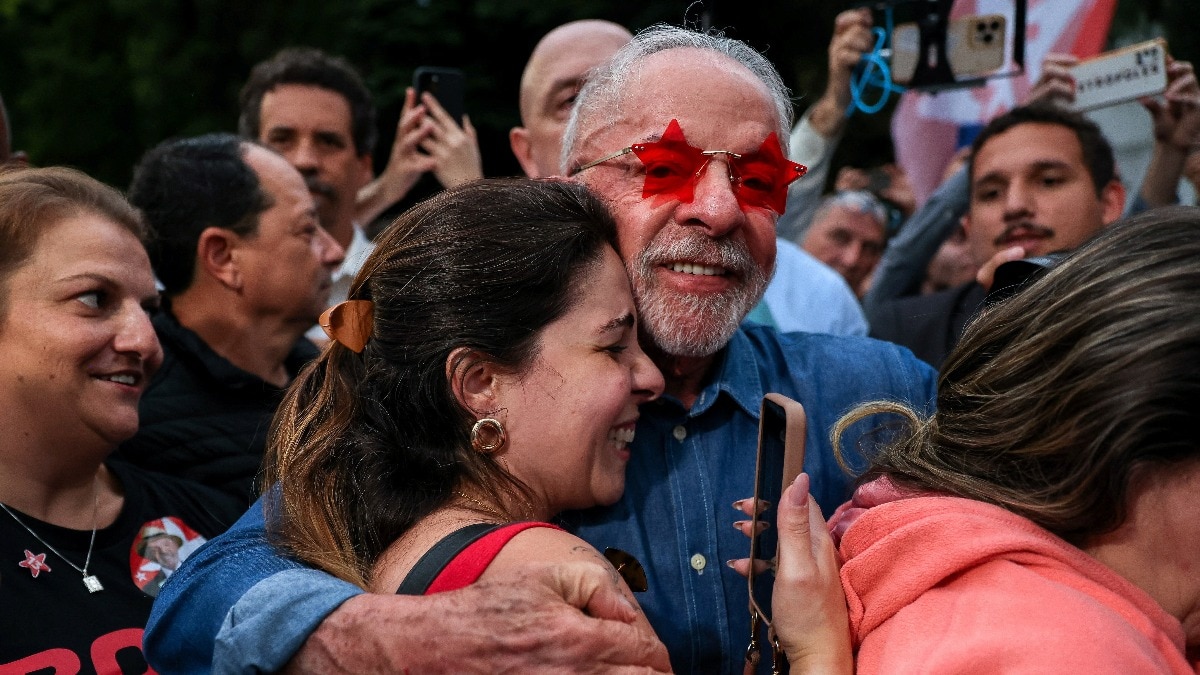
Lula defeated Flavio Bolsonaro to win an unprecedented fourth presidential term in Brazil. The result defied polls but leaves him facing a conservative Congress and economic strain.Brazilian President Luiz Inacio Lula da Silva, the Workers' Party (PT) candidate for presidential re-election, embraces a supporter outside his residence (Photo- Reuters)Brazilian President Luiz Inacio Lula da Silva won an unprecedented fourth term on Sunday, defeating Senator Flavio Bolsonaro, the eldest son of former president Jair Bolsonaro, in a shock election result that defied opinion polls and bucked a broader right-wing surge across Latin America.The victory marks another remarkable comeback for the 80-year-old leftist leader, who has dominated Brazilian politics for decades.
Lula, who served as president from 2003 to 2011 and returned to power after defeating Jair Bolsonaro in 2022, overcame concerns over rising prices, corruption scandals and questions about his government's performance to secure another term.Flavio Bolsonaro, who finished first in the election's opening round, had sought to revive his father's far-right political movement. However, better-than-expected voter turnout helped Lula prevail, according to pollsters.Leonardo Barreto, co-founder of consultancy Think Policy, said voters had opted for familiarity over an uncertain alternative. "People today are choosing between change, with some apprehension, and a known path, which guarantees certain rights," he said.
Lula's reelection appeared uncertain at several points during the campaign, as sections of the electorate grew dissatisfied with his Workers' Party amid rising prices and past corruption scandals. Societal changes and the expansion of app-based work also raised questions about his connection with younger voters and Brazil's growing informal workforce.COMEBACK FOR BRAZIL'S LEFTDuring the campaign, Lula highlighted his government's record on poverty, inequality, unemployment, illiteracy and deforestation.
He also warned that a Bolsonaro presidency could lead to cuts in welfare spending, a rollback of social advances and greater dependence on the United States under President Donald Trump. Lula's victory is a setback for Trump, whose administration had backed the return of the Bolsonaro family to power.
The result also denies Washington another major addition to the growing bloc of right-wing governments in Latin America that have aligned themselves with its policies on security and migration.Celso Amorim, a former foreign minister under Lula, described the president as a potential counterweight to the region's rightward shift."He would be very important for establishing a point of balance in Latin America. Lula is that balance," Amorim told Reuters.Lula's political career has been marked by repeated comebacks.
He was jailed between 2018 and 2019 on corruption charges that were later overturned, allowing him to contest the 2022 election and defeat Jair Bolsonaro.He also becomes the first candidate since Brazil's return to democracy in the 1980s to win the presidency after finishing second in the first round.CHALLENGE OF A CONSERVATIVE CONGRESSDespite his victory, Lula faces a difficult legislative landscape, with Brazil electing its most conservative Congress since the country's return to democracy.Bolsonaro's Liberal Party and its allies could control more than 280 seats in the lower house and up to 50 seats in the Senate, potentially giving the right-wing bloc comfortable majorities in both chambers.Oliver Stuenkel, a professor of international relations at the Getulio Vargas Foundation in Sao Paulo, said Lula could struggle to advance his agenda."He is likely to be a lame duck from the start," Stuenkel said.The conservative legislature could limit Lula's influence over policy decisions, complicate the formation of governing coalitions and weaken his leverage over Supreme Court nominations. Experts have also warned of a possible impeachment threat, adding to the political uncertainty surrounding his fourth term.Lula campaigned on a combination of populist promises and policy reforms aimed at improving living standards for workers and low-income Brazilians.
His pledges included free nationwide public transport on weekends, subject to approval by Congress, and a 15 per cent increase in his flagship welfare programme.He also backed a constitutional amendment that became Brazil's biggest labour reform in decades and passed with broad congressional support.ECONOMIC HEADWINDSLula's fourth term will also begin amid economic challenges, including high interest rates, rising public debt and concerns over household borrowing.The Brazilian government forecasts economic growth of just 2.3 per cent next year, while public debt has climbed beyond 82 per cent of gross domestic product, its highest level since the Covid-19 pandemic.Critics have blamed government spending for the deterioration in public finances, although interest payments have accounted for most of the increase in debt.Goldman Sachs expects Lula to make only modest progress in controlling spending during his next term, given his continued commitment to a state-led growth model.Surging household debt has emerged as another concern. In response, Lula introduced a provisional ban on online betting and announced a new debt relief programme during the campaign.Meanwhile, the incoming right-wing Congress is expected to push for structural reforms favouring businesses, potentially putting pressure on government spending and welfare programmes.Such measures could create fresh tensions over social spending and living standards, making Lula's fourth term a difficult balancing act between delivering on campaign promises, managing public finances and negotiating with a conservative legislature.- Ends