


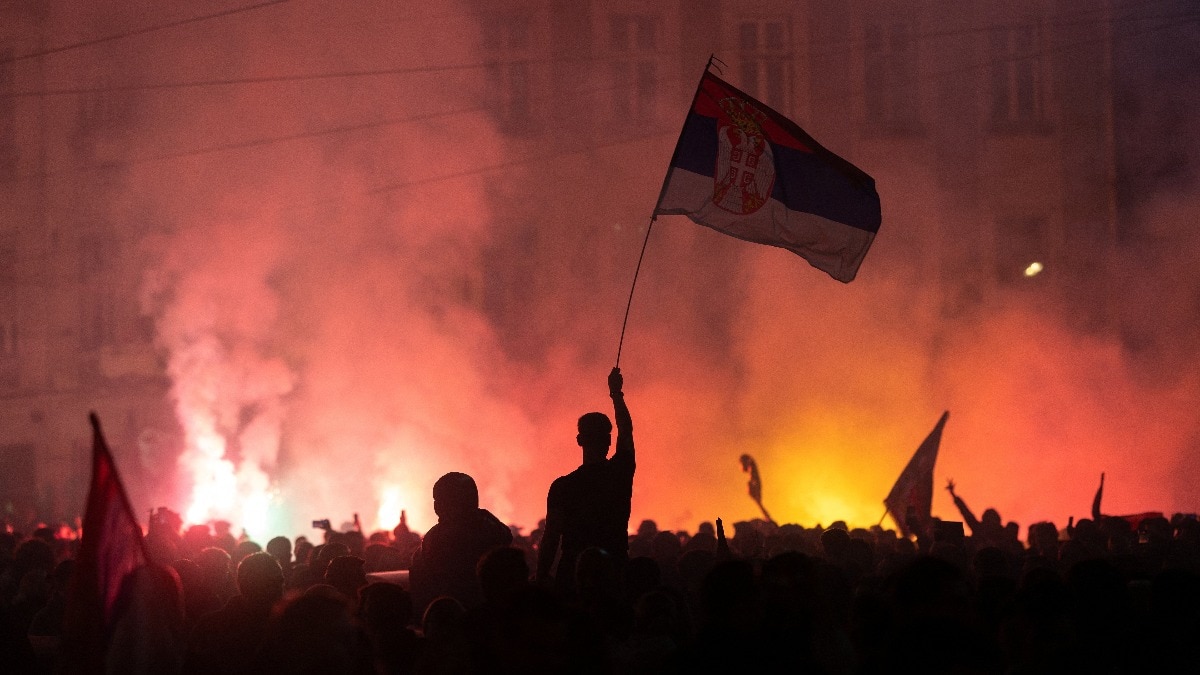
Aleksandar Vucic conceded Serbia's election after the Student List secured a historic victory. The result leaves the student-backed movement facing the challenge of forming a government.Political analysts expect the new administration to face pressure to reform state institutions, including the police, security services and ministries. (Credits: Reuters)Serbia's Aleksandar Vucic has conceded defeat to a student-led protest movement in a historic election, ending his decade-long dominance of the country's politics and opening the door to a new political era in the Balkan nation.Vucic acknowledged the defeat on Sunday after preliminary results indicated a victory for the Student List, a movement that emerged from nearly two years of protests against corruption and what demonstrators described as growing authoritarianism.“It is clear that we have lost these elections, the Student List has won,” Vucic said in a televised address. (Credits: Reuters) His announcement triggered celebrations across Belgrade, where tens of thousands of people gathered along major boulevards.
Cars honked, crowds danced and students chanted slogans celebrating the victory. Vucic said preliminary results suggested the student-backed candidates would secure between 135 and 140 seats in the 250-member parliament, while his Serbian Progressive Party (SNS) would win 105 seats.STUDENT PROTESTS DRIVE POLITICAL SHIFTThe election followed nearly two years of student-led demonstrations that erupted after 16 people died when a canopy collapsed at a railway station in Novi Sad in 2024.
The disaster fuelled public anger over alleged corruption, government accountability and safety standards.The protests gradually grew into one of Serbia's largest protest movements in a generation, with demonstrators demanding political change and calling for Vucic to step down. (Credits: Reuters) Vucic, a populist and nationalist politician who has dominated Serbian politics as prime minister or president since 2014, called the snap election in September amid mounting pressure from the movement.His supporters credit him with economic development and infrastructure projects, including new highways, railways, schools and hospitals.However, critics have accused his government of undermining democratic institutions and suppressing opponents, allegations repeatedly denied by Vucic and his party.Election turnout approached 70%, according to pollsters and the election commission, marking the highest participation since the breakup of Yugoslavia in 1992. (Credits: Reuters) STUDENT LEADERS FACE CHALLENGE OF GOVERNINGDespite the victory, questions remain over who will lead the next government and how the student-backed candidates will implement their agenda.The Student List comprises 250 candidates, many of whom are relatively unknown nationally. They include university professors, actors and farmers, and are led by cardiologist Ilija Srdanovic.The movement has pledged to tackle corruption, strengthen the rule of law and improve education.
However, the composition of the future cabinet and the leadership of the government remain uncertain.Political analysts expect the new administration to face pressure to reform state institutions, including the police, security services and ministries.Foreign policy will also present challenges. Serbia must balance its relations with China, a major investor, Russia, a traditional ally and key natural gas supplier, and the European Union, its largest trading partner.EUROPEAN LEADERS CONGRATULATE STUDENT MOVEMENTEuropean leaders and officials congratulated the Student List on its victory.European Commission President Ursula von der Leyen said the bloc was ready to work with Serbia to advance its path towards European Union membership.
European Commissioner for Enlargement Marta Kos also welcomed the result.The victory could have implications beyond Serbia, as student movements in several European countries have staged demonstrations over education standards, economic prospects and governance.For now, the immediate challenge for the student-backed movement will be to translate its electoral victory into a functioning government and deliver on its promises to tackle corruption and restore public confidence in state institutions.- Ends