


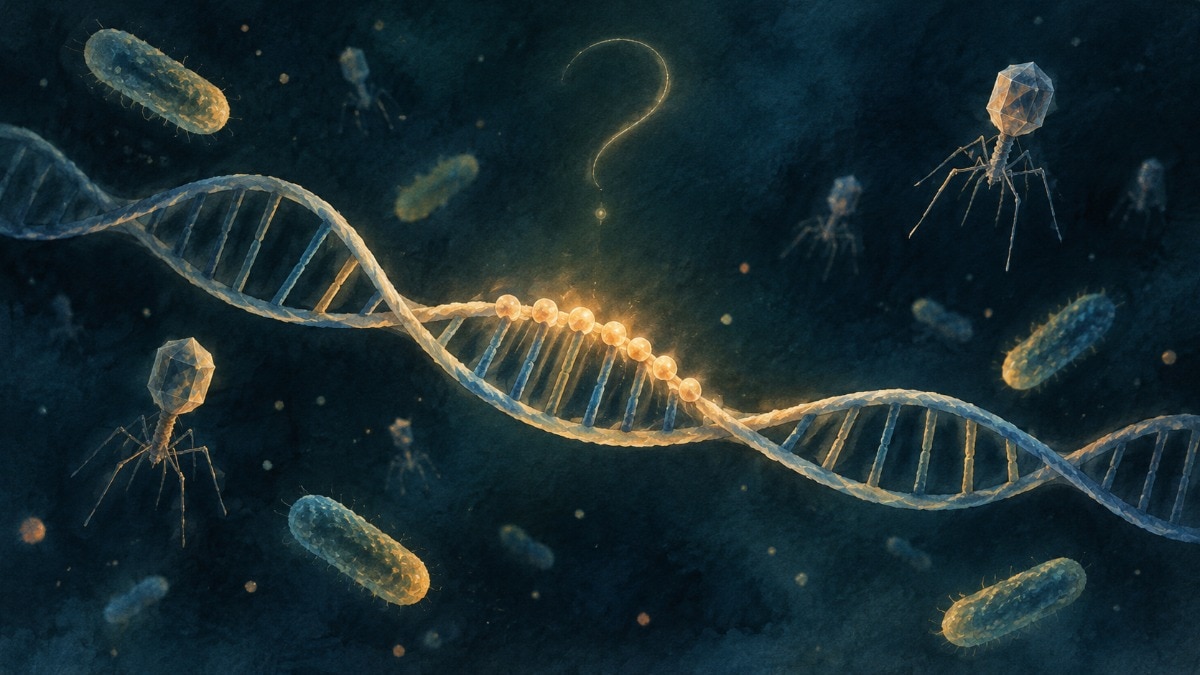
A teaspoon of seawater holds millions of viruses. Many of them are bacteriophages, or phages, and each has a single ambition: to find a bacterium, break into the organism and turn it into a factory for more phages.
Bacteria are single-celled living beings, and they have spent billions of years learning to fight back. Their defences are written into their DNA, which is the long chemical instruction book found inside every living organism, spelt out in four letters: A, T, G and C.Some of the most powerful tools in modern medicine began as strange scribbles in that war.Restriction enzymes, which cut DNA at chosen spots, come from bacterial defences.
So does CRISPR, which started as nothing more than an odd repeating pattern in bacterial DNA and is now the gene editing tool behind a Nobel Prize and the first medicines that edit human genes.This September, a machine joined the search. In the 21st hour of reading through a public library of DNA, one of about 950 AI agents, each a copy of Anthropic's AI model Claude, wrote this: "I can see by eye a tandem repeat array that's a CRISPR-like repeat array?!" A tandem repeat array is a stretch of DNA where the same short pattern repeats again and again, side by side.
The question mark and the exclamation mark were the machine's own. So, has AI just handed us the next CRISPR?
The scientists we asked say not yet, and quite possibly not at all. The reason is more interesting than the hype.WHAT, EXACTLY, IS ART?Anthropic announced the find on September 23 and calls it ART, short for array-associated reverse transcriptase.
Start with the name. A protein is a tiny machine built by living cells, and an enzyme is a protein that does one particular chemical job.
A reverse transcriptase, or RT, is an enzyme that reads a strand of RNA, a single-stranded chemical cousin of DNA, and writes out a matching strand of DNA. Cells usually copy the other way, from DNA to RNA, which is why this one is called "reverse." HIV relies on it, and many bacteria use RTs as part of their immune systems.
The "array" is what turned heads. Next to the gene for the RT (a gene is a stretch of DNA holding the instructions for one protein) sits a long run of near-identical DNA pieces, repeated between 3 and 21 times at even spacing, like beads on a string.
ART lives in phages. Inside the architecture of ART: Breaking down the phage-derived reverse transcriptase system, its CRISPR-like repeat array, and the biological mysteries that remain unsolved.
That layout echoes CRISPR. In bacteria, CRISPR is a memory system: it stores snippets of the DNA of viruses the bacterium has met before.
Those snippets are copied into short RNAs called guides, and each guide steers a cutting enzyme to a matching stretch of DNA, much as a postcode steers a courier to the right house. Anthropic's first experiments show that ART's array is also copied into distinct short RNAs.
But the company says what the system actually does is not yet known.ART has a third part: a partner protein beside the RT, whose job is also unknown.HOW DID AN AI FIND IT?Anthropic's scientists gave Claude a prompt to search a huge database of DNA for new RTs, then stayed out of the way until the laboratory stage. This kind of hunt is called genome mining: combing through the full DNA records of organisms, called genomes, for genes nobody has explained yet.
The agents gathered more than 200,000 RTs, picked out 3,500 candidate systems and narrowed those to the 20 most promising. They spent 21 hours and 210 million tokens on the job.
A token is a small chunk of text, roughly a word or part of one, that an AI model reads or writes. Anthropic says an expert scientist would need weeks to months for the same analysis.The RT itself had been described before, in a very large phage.
What Claude appears to have been first to notice is the company it keeps: the array and the partner protein.Then comes the twist, which sits in Anthropic's pre-print, a paper shared publicly before other independent experts have checked it. The company repeated the same search ten more times, and none of the repeats found the array.
When the AI models were handed the relevant DNA directly, they described the repeats at least 90 per cent of the time. With the fuller task, which mirrors how the original discovery happened, success fell as low as 32 per cent.
That is not a method you can simply switch on. It is closer to a lucky glance at exactly the right page of a very large book.IS IT A GENE EDITING TOOL?No, and the experts are united on this.
Editing a gene needs a cut, or a precise rewrite, at a chosen spot in the DNA. CRISPR makes its cut with an enzyme called Cas9, which is a nuclease, a protein that cuts DNA.
The genes that build this cutting machinery are called cas genes. ART has none nearby, and an RT cannot cut DNA."A reverse transcriptase only does the writing part," says Dr Debojyoti Chakraborty, a scientist at CSIR-IGIB, a Delhi research institute.
His lab has engineered a more flexible version of FnCas9, a Cas9 taken from the bacterium Francisella novicida, and is using it to correct the mutation that causes sickle cell disease, an inherited blood disorder."It's a scribe, not a surgeon." Dr Kutubuddin Ali Molla, a senior scientist at the ICAR-National Rice Research Institute in Cuttack, Odisha, who adapted an AI-designed enzyme into a gene editor for rice, agrees: an RT alone cannot edit genomes, even if guide RNAs steer it. In his view, the real achievement is that an AI model helped humans discover a potentially new biological system.That does not make ART a dead end.
In a technique called prime editing, an RT is attached to a modified Cas9 that makes a nick, a cut through just one of DNA's two strands. The RT then writes new letters into that spot.
So RTs can be valuable partners. But "could one day be part of a tool" is a very different sentence from "is a new tool".GUIDE OR TEMPLATE: WHAT ARE THOSE RNAs FOR?In CRISPR, the array's RNAs are guides, which tell an enzyme where to go.
In several RT-based bacterial defence systems, the RNA is instead a template, the master copy from which the enzyme builds new DNA. One points the way; the other supplies the words to be written.Dr Alex Gao of Stanford University, whose lab studies these systems, thinks ART is in the second camp.
Scientists draw family trees of enzymes to show how closely they are related, and that is what he means by "phylogenetic". ART's RT sits on a different branch from the UG family, which includes a group of defence enzymes called DRTs and is the subject of recent work he is part of.
It more closely resembles retrons, he says: small bacterial elements that make DNA copies of their own RNA. "The phylogenetic and genomic signatures suggest that these RNAs are likely to be templates for DNA synthesis rather than guides," Gao says. "Genomic" here means the layout of the genes along the DNA. His proposed test is to look for cDNA, which is DNA copied from RNA, made from the array's RNAs.
That "would help establish whether that is the case".Chakraborty reads the array in a similar way. The stretches between ART's repeats are long and stay in the same order across related phages. "That looks less like a record of past infections and more like a stored set of templates," he says.
He adds that the RT was first reported in 2021, in very large phages that infect Staphylococcus, a common bacterium, and that Claude's contribution was noticing the repeats beside it.Molla proposes a different first test. Put ART and the array together inside bacteria, then run a pull-down assay.
That means fishing the protein out of a mix of cell contents, with a hook, and checking whether any RNA comes out stuck to it. If the array's RNA is bound to ART, then ART uses it.None of the experts claims the matter is settled.
Gao calls the finding "striking" and worth "further investigation". Feng Zhang of MIT and the Broad Institute, who helped turn CRISPR into a gene editing tool, called it "genuinely intriguing" and one that "merits further investigation".
Anthropic's chief executive, Dario Amodei, wrote that its function and significance are "not yet clear". He noted that a Stanford team had independently described a different RT system with a non-coding array, meaning an array of DNA that does not carry instructions for a protein.WHAT DOES IT MEAN FOR INDIA?Chakraborty says Indian labs should search microbial DNA with AI. "Our hot springs, cold deserts, mangroves and crater lakes are barely catalogued," he says, "and the viruses living in them even less so." What slows India down is mostly unglamorous: DNA data that is well assembled and shared instead of sitting on one person's hard disk, more hands for the slow bench work that follows a promising hit, and young scientists at ease with both a computer terminal and a pipette, the lab's precision dropper.
Computing power, he says, is the least of the worries.Molla would welcome both routes, finding tools in nature and designing them with AI, but warns that whoever has the stronger in-house AI tool will win the race to be first.IS THIS AI DOING SCIENCE ALONE?Not yet, and Anthropic does not claim it is. Its scientists wrote the prompt, did all the laboratory work and chose which candidates to test.
Most of Claude's ideas are thrown out at review. Amodei argues that AI has gone from weak to strong in new fields within a few years, and that biology will follow.
Sceptics reply that one success in eleven runs, on a system with no known function, is thin ground for a prediction of runaway progress. Only the laboratory will tell.What we can say is narrower, and still exciting.
A machine read raw DNA, noticed what humans had walked past, and was right that it deserved a look. If those little RNAs turn out to be guides, the question in the headline will deserve a second look.
If they turn out to be templates, we will have learnt something about how bacteria defend themselves instead. In the war between phage and bacterium, there is a new pair of eyes, and the first thing they noticed was a question mark.- Ends