


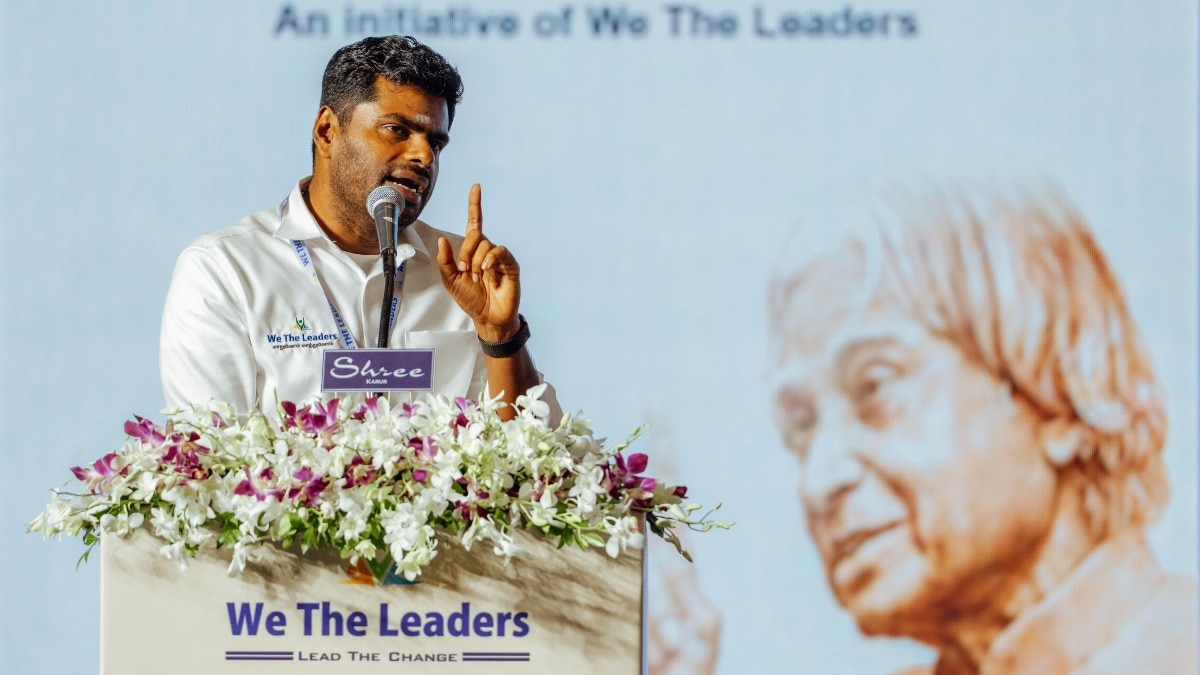
For the past three days, it is the founder and chief servant of We The Leaders foundation, K Annamalai, who has been making the most noise in Tamil Nadu politics. The former Bharatiya Janata Party (BJP) state president has turned his guns on the party that gave him a political platform, questioning the central government's handling of protests, its attitude towards dissent and its repeated invocation of nationalism.
For a politician once identified with the BJP's combative politics against the Dravidian parties, the change of target and the tone are striking.The former Tamil Nadu BJP chief is attacking the BJP more than any other leader from the state. What's behind the relentless attacks?
Is it a rush to establish himself as a serious contender? Is it some strategy or a pure sign of desperation?Annamalai's latest criticism of the BJP-led Centre came over the handling of protests by the Cockroach Janta Party (CJP).
Annamalai argued that the democratic rights of the protesters and the principles of due process could not be dismissed simply because of their political methods. His comments were interpreted by some as an endorsement of the CJP, forcing him to clarify that he did not support the outfit but would question "any wrongdoing" regardless of whether it involved the BJP or the Congress.Aspire K Swaminathan, general secretary of Annamalai's We The Leaders movement, who handles its media operations, rejected the suggestion that the former BJP Tamil Nadu chief was singularly targeting his old party. "To interpret every independent political opinion as either loyalty, rebellion or desperation would be to miss the substance of the issues he has raised," Swaminathan told India Today Digital.He added that Annamalai's reference to PM Modi's position on protest rights in 2011 was meant to underline that democratic principles should remain consistent regardless of who holds power.
But the timing of the intervention by the founder of We The Leaders is difficult to separate from Annamalai's own political predicament.After leaving the BJP, he had planned to spend at least a year building We The Leaders, establish a political party and prepare for the 2031 Assembly election. Four months into the experiment, however, he seems to have stepped on the pedal.According to Tamil Nadu-based political analyst Suman C Raman, the need to shed the BJP B-team tag is central to Annamalai's strategy."Anything Annamalai would do, he had a tag attached to him that he is a B-Team of the BJP.
By attacking the BJP or questioning the BJP-led Centre, Annamalai is trying to rid himself of that tag," Raman told India Today Digital.The political analyst said Annamalai is seeing his earlier association with the BJP as an obstacle to expanding his political appeal across Tamil Nadu.IS ANNAMALAI PUSHING HIS POLITICAL PROJECT EARLIER-THAN-PLANNED?The number of members that We The Leaders political campaign has managed to attract offers an explanation for the change in Annamalai's strategy.The political movement, founded with former President APJ Abdul Kalam's school of ideology, had set an ambitious target of five million members before Annamalai launched a political party. The initial momentum seems to have been lost, with the movement managing just around two million supporters.The gap matters because Annamalai's independent project depends on turning his personal visibility into an organisation capable of competing in elections.
Waiting until 2031, still five years away, could leave him with a movement that has generated enthusiasm but has not tested its electoral strength.With passing time, it also risks losing supporters to established parties or newer alternatives."Some of Annamalai's grassroots members who came from the BJP are already heading back to the saffron camp," JVC Sreeram, psephologist and a political expert on Tamil Nadu, told India Today Digital.Annamalai might have acted realising what was at stake. On October 14, he announced that We The Leaders would contest the local body elections in Tamil Nadu, expected in 2027.A day later, he inaugurated the Abdul Kalam Centre for Ethics and Politics in Coimbatore, an institution intended to train grassroots leaders.
The centre plans to offer a two-day foundation course, a four-week leadership academy and a 100-day field programme. Its first cohort comprises 100 women involved in community and civic activities, with a longer-term ambition of training at least one lakh grassroots volunteers.
Some of those trained there are likely to contest the local body elections.For political analyst Raman, the shift from a five-million-member threshold and a 2031 electoral ambition to an earlier contest suggests that Annamalai might be acting because of the lost momentum."Annamalai seems to be very confused regarding what needs to be done, and what strategy must be taken," he told India Today Digital, describing the recent remarks on the CJP and the BJP-led Centre as "signs of desperation".Raman also added that Annamalai's support remained concentrated in western Tamil Nadu, particularly Coimbatore, where people from his caste have a significant presence. On the other hand, Tamil Nadu Chief Minister C Joseph Vijay has attracted a much wider following among young voters.The assessment is contested by Annamalai's camp, which maintains that the movement is evolving on its own terms.
But the political test is becoming more immediate.CAN ANNAMALAI OUTGROW THE BJP BY ATTACKING IT?Annamalai's challenge is not simply to distinguish himself from the BJP. It is to convince voters that he has something substantial to offer beyond the political identity he built while leading the party in Tamil Nadu.A former IPS officer, he became one of the BJP's most visible faces in the state, frequently taking on the DMK, AIADMK and their Dravidian political model.
The party's national leadership helped amplify his profile, presenting him as a new-generation challenger to Tamil Nadu's established political order. Yet his individual prominence has often exceeded the organisational reach of the movement around him.Psephologist JVC Sreeram, who said he had worked closely with Annamalai during his BJP days, argued that the party invested heavily in Annamalai's political rise."It was the BJP that gave him everything.
He was platformed in politics by the BJP, and the party invested in him like it had done for no other leader in Tamil Nadu," Sreeram told India Today Digital.Sreeram also questioned Annamalai's ideological consistency but rejected the idea that his movement was, in any way, a proxy of the BJP.Annamalai has to do a fine balancing act now.If he continues to be seen as an extension of the BJP, his departure from the party will have achieved very little. But if he distances himself too sharply from the party's ideology, he risks alienating supporters who backed him precisely because of his association with Prime Minister Narendra Modi and the BJP."A majority of Annamalai's supporters are from the BJP," Sreeram said.CHIEF MINISTER C JOSPEH VIJAY: A BIGGER TEST FOR ANNAMALAI?There is another political reality Annamalai cannot avoid in the state.
Tamil Nadu's space for a new-generation leader has become more crowded since Annamalai first rose to prominence following the deaths of former Chief Ministers Jayalalithaa and M Karunanidhi.Vijay's Tamilaga Vettri Kazhagam (TVK) has now won an electoral victory and formed the government, turning the actor-turned-politician into a direct competitor for the attention of voters looking for an alternative to established parties. Speculation around the entry of actor Dhanush and others has added to the uncertainty.Annamalai could still emerge as a formidable opponent to Vijay, even with a small legislative presence. "In a long-term battle, anything is possible," political analyst Raman told India Today Digital.Annamalai's communication skills and ability to challenge the government could allow him to punch above his party's weight, according to political observers.That potential remains largely untested outside the BJP.
Annamalai has begun questioning the BJP and the Modi government, but he has yet to mount a comparable political challenge to Vijay. His movement will eventually need to explain not only what it opposes, but what it would do differently in Tamil Nadu."The charge of desperation misses the point that Annamalai's statements should be judged on their substance rather than on the political party they are directed at," Swaminathan of the We The Leaders said.However, Raman said Annamalai's statements exposed a movement that was struggling to find a viable strategy.
And according to Sreeram, an independent project of Annamalai is one weighed down by questions about ideological conviction and consistency.Tamil Nadu's political equation makes the situation even more interesting. Chief Minister Vijay, who has openly termed the BJP as his ideological enemy, has largely refrained from directly targeting the BJP-led Centre.
He appears to have chosen a more accommodating strategy towards the party in power in New Delhi while attacking the prime rival in Chennai.For Annamalai, the BJP remains an unavoidable reference point, and that is why he is targeting the BJP more than he is criticising the TVK.So, Annamalai's targeting the BJP is both desperation and a strategy. While he is rushing to contest the local body polls to retain momentum and members, he is also trying to shed the BJP B-Team tag.
But how the messaging is received is crucial. Whether it signals a confident breakaway or a hurried attempt to regain momentum will depend on how he follows up on the rhetoric.- Ends