


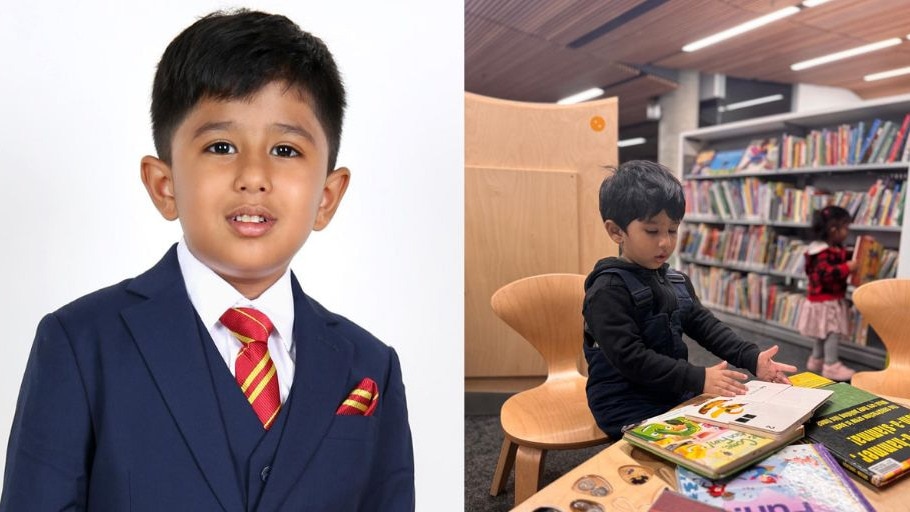
"What is infinity minus infinity?" asks five-year-old Arjun Prajapati. While most children his age are discovering the world around them, Arjun is exploring mathematical concepts, black holes, human genetics and the immune system.Born to Dr Vishal V Prajapati, a physician and clinical researcher, and Mahitha, a lawyer, Arjun has built an extraordinary learning journey around one simple impulse: curiosity.At four, he qualified for membership of Mensa and Intertel, two international high-IQ societies.
A Stanford–Binet assessment recorded his Full Scale IQ at 141, placing him at the 99.7th percentile. He has also received a congratulatory letter from Canadian Prime Minister Mark Carney.Yet, for his parents, the story goes beyond IQ scores and certificates.
Their parenting philosophy is simple: "Fostering, Not Forcing" Arjun began reading at approximately 18 months and has explored more than 3,000 books on mathematics, astronomy, human physiology, genetics, microbiology, history and other subjects.His love for books is so strong that his parents keep eight to ten of them in their family car. “Daddy, what if I get bored? I should have at least one book to read!” he once explained to his father.THE FIRST SIGN WAS A LOOK OF CURIOSITY Dr Prajapati remembers noticing something unusual immediately after Arjun's birth.
The newborn was looking around, seemingly taking in his surroundings. “I turned to my wife and said something that I still remember vividly: ‘Look at him! Above everything else, he looks so curious!’” he recalls.As Arjun grew, picture books became an early interest.
He enjoyed turning pages, listening to his mother read and anticipating what came next during nursery rhymes. Numbers and patterns also caught his attention.Soon, recognising words and remembering facts were no longer enough.
He wanted explanations. On one occasion, he wondered what would happen if someone took a giant saw and cut the Earth all the way to its centre.“His questions were not something we had taught him to ask,” says Dr Prajapati. “They emerged spontaneously from his imagination and desire to understand the world,” he adds.Mathematics, astronomy, Earth science, human physiology and genetics became recurring subjects of conversation.
Black holes and dinosaurs could interest him as much as the human immune system.WHAT THE IQ TEST REVEALEDArjun underwent a formal cognitive assessment at four years and ten months. According to a diagnostic letter dated June 11, 2026, the Stanford-Binet Intelligence Scales, Fifth Edition, recorded a Full Scale IQ of 141.Additional assessment scores included a Nonverbal IQ of 149, a Fluid Reasoning score of 144 and a Working Memory score of 146.The assessment described his intellectual functioning as gifted.
His results also supported his admission to Mensa and Intertel at four. Mensa requires a score within the top two per cent of the population on an accepted intelligence test, while Intertel requires a score within the top one per cent.“Although these achievements were incredibly meaningful to our family, they did not come as a complete surprise,” says Dr Prajapati.“What began with a tiny cloth picture book in a hospital has grown into a remarkable journey of more than 3,000 books, countless scientific questions, and an extraordinary passion for learning," Arjun's father further adds.Arjun has also received a personal letter from Canadian Prime Minister Mark Carney congratulating him on joining Mensa International and Intertel.
Ontario Premier Doug Ford has sent him congratulations as well.He has visited Harvard University and the Massachusetts Institute of Technology (MIT) and has been invited to receive special recognition at Ontario’s Legislative Assembly at Queen’s Park on October 29, 2026.But some of his parents' most memorable moments have happened at home.'MOM, THANK GOD YOU HAVE EGGS!'While learning about human reproduction and embryonic development, Arjun made an observation that astonished his parents. “Mom, thank God you have eggs! Otherwise, neither I nor my sister would have existed in this world!” he told his mother, Mahitha.Another time, during a conversation about hygiene, he reassured her: “Mommy, don’t worry!
My white blood cells are working hard to protect me from viruses and germs!”For Dr Prajapati, these exchanges show how Arjun connects what he reads with everyday life. His interests include the cardiovascular, respiratory and immune systems, genetics and microbiology.
He has also explored how HIV affects CD4 T-cells and how immune system damage can leave the body vulnerable to infections.His father, however, emphasises that the family had never expected Arjun to become a doctor.FROM WHITE BLOOD CELLS TO AN X-RAYAn incident at preschool offered another glimpse into Arjun's approach to learning. After falling on a concrete surface and injuring his left elbow, he described the accident to his father and asked to see a doctor.At the appointment, he explained his symptoms and suggested the injury might involve the bone rather than the muscle. “Can we get an X-ray?” he asked.The paediatrician ordered one, and Arjun later asked the radiology technician whether the image showed a crack.
Fortunately, there was no fracture.His parents were struck by how he described his symptoms, considered possible explanations and communicated his concerns. During other medical visits, he has asked doctors, “We don’t need antibiotics for viral infections, right, Doctor?”His parents stress that medical decisions require professional judgement.
For them, knowledge should encourage children to ask questions, not attempt independent diagnoses.“He does not simply want to know what something is,” says Dr Prajapati. “He wants to understand why it happens, how it works, and how that knowledge might apply to the world around him.”A CHILD WHO CARRIES A LIBRARY IN HIS MINDArjun's learning does not follow a fixed timetable. His parents allow his interests to shape his day, rather than prescribe study hours.
Libraries are among his favourite places, and visits to book fairs can last two to three hours.Mathematics is a particular passion. He knows multiplication tables from one to 20 and enjoys arithmetic, squares, cubes, number patterns and logical reasoning.
He also explores concepts typically introduced to older children, including material at approximately Grade 5 level.His scientific interests range from the Earth's internal structure and atmospheric layers to black holes, galaxies, dinosaurs, genetics and immunology. He has pursued enrichment coursework in human physiology and cell biology through Northwestern University's Centre for Talent Development.Arjun is also fascinated by the lives of scientists.
Albert Einstein and Sir Isaac Newton are among his favourites, with their discoveries leading him to questions about gravity, motion and the universe.His parents want him to understand that intelligence is valuable, but so are kindness, courage, compassion and service to humanity.For Arjun, a great scientist is not merely someone whose name appears in a textbook. A scientist is someone who asks difficult questions, challenges existing ideas, perseveres through obstacles and contributes something meaningful to the world.WHAT DOES ARJUN WANT TO EXPLORE NEXT?Mathematics and medical science, particularly human physiology, remain among Arjun's strongest interests.
He enjoys learning about the brain, nervous system, blood circulation and how the body responds to infections.He has explored red and white blood cells, platelets, haemoglobin, B-cells and T-cells, as well as the roles these play in the body. Astronomy remains another fascination, with black holes, white holes, galaxies and planets prompting questions about the universe.He is also interested in French and Spanish and enjoys music and painting.“Whether he eventually chooses Mathematics, Medicine, Physics, Engineering, Music, Languages, or an entirely different field, we want that decision to come from his own interests and aspirations,” says Dr Prajapati.Beyond books, Arjun pays close attention to highway signs, road names, exit numbers and route connections.
He often recognises familiar roads and follows the family's progress on navigation maps.“Daddy, look at the GPS! Can you see that blue area on the map?
That’s water. We’re travelling alongside it!” he once said while observing the geographical features displayed on the screen.Even routine car journeys become opportunities for him to observe, remember and learn.HOW DO YOU NURTURE A GIFTED CHILD WITHOUT PRESSURE?For Dr Prajapati and Mahitha, raising a gifted child means offering intellectual challenges without making achievement the centre of his identity.
They want Arjun to learn, but also to play, make friends, explore his imagination and enjoy music and painting.“Every child has unique interests, strengths, and abilities,” says Dr Prajapati.He further adds that parents should recognise their children’s interests, provide opportunities for exploration and create an environment that encourages curiosity.The family believes a high IQ should never become a burden. Children should not be constantly compared with others or judged solely by their grades, test results or public recognition.THE CHILD BEHIND THE CERTIFICATESBeyond his Mensa and Intertel memberships, Arjun remains a five-year-old who enjoys painting, music, playing with friends and spending time with his younger sister.His questions sometimes prompt his father to revisit scientific concepts and find new ways to explain them.
For Dr Prajapati, this is a reminder that learning works both ways and that education is as much about asking questions as finding answers.Arjun's IQ score of 141, early membership of two high-IQ societies and exploration of more than 3,000 books mark an unusual journey. But his parents do not see these achievements as a blueprint for his future.“Intelligence may open doors, but curiosity, perseverance, compassion, and the freedom to explore are what make the journey meaningful,” says Dr Prajapati.For now, Arjun has books to read, pictures to paint, music to enjoy and a universe of questions waiting to be explored.
His parents hope he will continue discovering the world at his own pace, one question and one happy day at a time.- Ends