


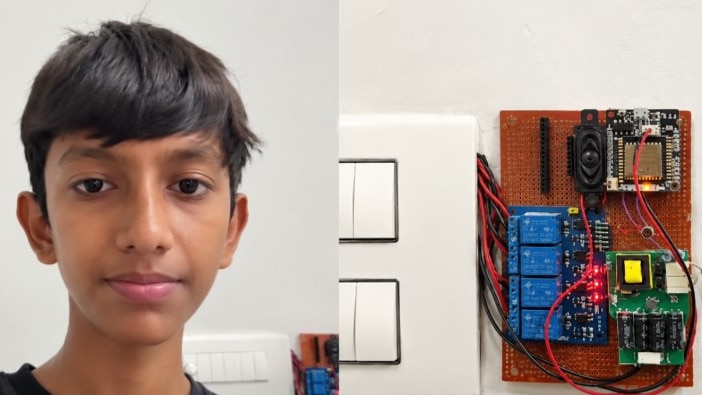
A 16-year-old Indian tech enthusiast has built an offline, voice-controlled JARVIS system to operate lights and fans. Inspired by Iron Man's fictional AI assistant, Ridit Kumawat's creation brings a touch of futuristic technology into everyday homes without relying on the internet.16-year-old Indian boy builds his own Jarvis, an offline voice-controlled smart home Every teenager who has watched Iron Man may have wondered what it would be like to have a JARVIS of their own.
Ridit Kumawat, a 16-year-old Indian tech enthusiast, has taken that curiosity a step further by building an offline, voice-controlled home automation system inspired by Tony Stark's fictional assistant.The device can control household appliances, including lights and fans, through spoken commands, without needing an internet connection. A demonstration video shared by Ridit on Instagram has caught attention online, showing the system responding to instructions such as switching off the lights.Introducing his creation in the video, Ridit describes it as one of his most exciting projects, saying the tiny device can control his entire room.INSPIRED BY IRON MAN, BUILT FOR REAL LIFEFor many technology enthusiasts, Iron Man's Jarvis represents the possibilities of a home that responds to voice commands.
Ridit appears to have taken inspiration from that concept and developed a working system for everyday use. In the video, he addresses the device by saying, “Jarvis, what can I do for you?” He then gives commands such as “All lights off” and “Fan off”, with the system responding by switching the connected appliances on or off.The demonstration offers a glimpse of how users can control household appliances without manually operating their switches.HOW DOES HIS OFFLINE JARVIS SYSTEM WORK?
The system works through a sequence of steps that allow it to recognise a voice instruction and translate it into an action.First, a microphone captures the spoken command. The system then processes the instruction and identifies the action associated with it.
A controller communicates with the switching mechanism, which activates or deactivates the connected appliance.In simple terms, the system listens to a command, processes it and carries out the corresponding action.The video shows the electronic setup and the device responding to voice instructions. One of its key features, according to Ridit, is that it does not depend on an internet connection to function.NO INTERNET, MORE PRIVACY: WHAT MAKES IT DIFFERENT?Unlike internet-dependent smart-home devices, Ridit says his system works completely offline.
This is one of the features he highlights while comparing it with popular voice assistants such as Google Home and Alexa.Explaining why he considers this a major advantage, he says, “In the craziest part, this works completely offline unlike other devices like Google Home and Alexa. So, privacy on top.”An offline system can be useful in places where internet connectivity is unreliable or unavailable.
It may also reduce the need to send voice commands to internet-based services. However, the extent of its privacy protection would depend on how the device processes and stores voice data.The project therefore raises an interesting possibility: can simple, locally operated technology make smart-home features more accessible without depending on constant internet connectivity?IS IT REALLY ARTIFICIAL INTELLIGENCE?Although the project is inspired by an AI assistant, it is important to distinguish between voice-controlled automation and advanced artificial intelligence.A basic voice-controlled system can recognise predefined commands and perform the actions assigned to them.
For instance, a particular phrase may be programmed to switch off a light or operate a fan.An advanced AI assistant, on the other hand, can understand more complex instructions, interpret context, respond to questions and perform a wider range of tasks.Ridit's project demonstrates the potential of offline voice-controlled automation. Its resemblance to Jarvis lies in the idea of interacting with technology through voice, rather than necessarily replicating the full capabilities of the fictional AI assistant.FROM IRON MAN'S JARVIS TO A REAL-WORLD PROJECTRidit has invited viewers interested in exploring his creation to follow him on GitHub, where he has shared the repository link and complete project details.“If you want the repository link or the complete project details, just follow me on GitHub,” he says in the video.At 16, Ridit's project reflects his curiosity and ability to turn an idea into a working solution.
While it may not replicate all the capabilities of Iron Man's Jarvis, it brings a glimpse of that futuristic vision into an ordinary home, demonstrating how inspiration from films can translate into real-world experiments.- Ends