


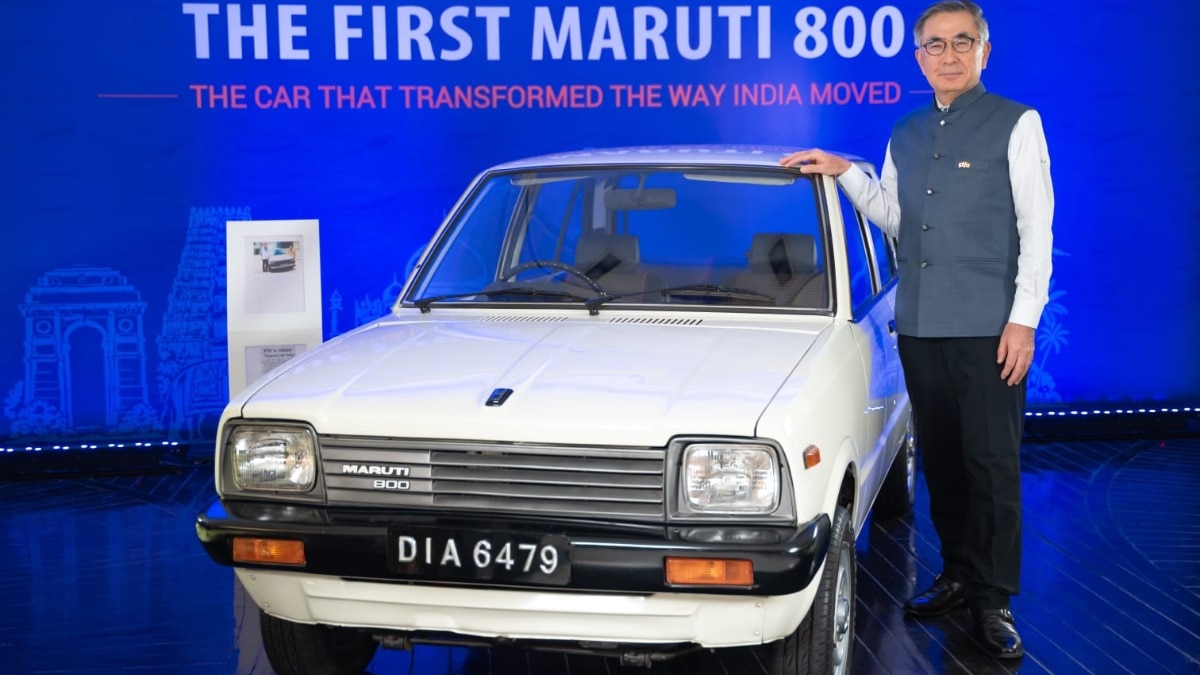
The inaugural award acknowledges the car's contribution to India's automotive heritage and its role in democratising mobility.The award, announced by FIVA on November 16, recognises vehicles that have had a lasting influence on society, industrial development and national identity. Unlike conventional automotive awards that often focus on rarity, prestige or monetary value, the FIVA World Vehicle Heritage Awards celebrate vehicles that have made a wider cultural and historical impact.The Maruti 800 was selected alongside vehicles from countries including the US, Brazil, Germany, France, Austria and Slovenia.
It is the only vehicle from India among the 21 awardees.A car that changed India's automotive landscapeIntroduced in December 1983, the Maruti 800 marked a turning point in India's passenger vehicle market. Developed through the partnership between the Government of India and Suzuki Motor Corporation, the hatchback brought modern, affordable and relatively accessible personal mobility to a much larger section of Indian households.
Before the Maruti 800, car ownership in India was largely limited by high prices, long waiting periods and a relatively narrow choice of models. The compact hatchback helped change that perception, becoming a familiar sight across Indian cities and smaller towns.Over its production life, more than 2.9 million units of the Maruti 800 were manufactured.
It also played an important role in establishing India as a manufacturing and export base for Suzuki, with exports beginning in 1987. Speaking about the recognition, Maruti Suzuki India chairman R.C.
Bhargava said the car's contribution extended well beyond the automotive industry.He highlighted how the Maruti 800 demonstrated India's ability to manufacture high-quality engineering products at a time when domestic manufacturing capabilities were questioned. He also credited the car and the wider motorisation movement with generating millions of jobs and enabling more women to participate in economic activities through access to reliable personal transport.From a domestic bestseller to an export storyThe Maruti 800's significance also extended beyond India's borders.
According to Suzuki Motor Corporation president Toshihiro Suzuki, exports of the hatchback began in 1987, with Hungary, France and Belgium among its early international markets.Suzuki said the company initially began manufacturing around 40,000 cars annually in India. However, over the following three decades, production of the Maruti 800 crossed 2.9 million units.The model also laid the groundwork for India's emergence as an important automobile manufacturing and export hub.
Maruti Suzuki now exports more than 400,000 vehicles annually to over 120 countries, reflecting the scale of the manufacturing ecosystem that developed over the decades.Recognition beyond automotive nostalgiaFIVA, an international non-profit federation for historic vehicles and a non-governmental partner of UNESCO, introduced the World Vehicle Heritage Awards to broaden the definition of automotive heritage.The inaugural awards recognise vehicles not merely for their engineering or collectability, but also for their influence on everyday life, industrial progress and cultural identity.For India, the Maruti 800's inclusion is particularly significant. The hatchback was more than an entry-level car; it became a symbol of aspiration and economic change for generations of Indian families.Its recognition by FIVA places the Maruti 800 among a select group of vehicles that have left a lasting mark on the societies they served, cementing its place in global automotive history.Subscribe to Auto Today Magazine - Ends