


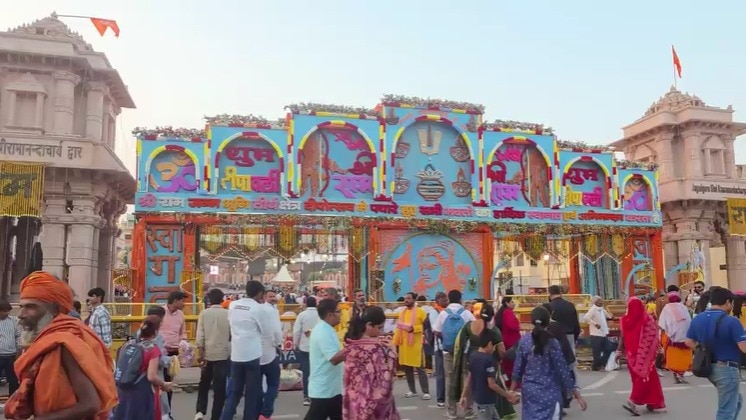
Ayodhya's traders and workers report sustained business growth following the Ram temple's construction. The year-round visitor flow has expanded livelihoods while sharply raising rents and investment interest.The commercial transformation is also attracting people looking beyond immediate business opportunities.Ayodhya,Nov 17, 2026 12:27 ISTThere was a time when traders in Ayodhya waited for festivals and religious fairs to make their money.
The crowds would arrive, shops would get busy, and business owners would try to earn enough during those few days to sustain themselves through the quieter months.That rhythm of business has changed.Since the construction of the Ram temple and the consecration of Ram Lalla in January 2024, Ayodhya has witnessed a sustained flow of devotees and tourists. What was once a market dependent on a handful of religious occasions is increasingly becoming a year-round commercial destination.The change is visible in the city's shopfronts, rental agreements and property market.
Shop rents that once ranged between Rs 1,000 and Rs 2,000 a month are now reportedly fetching Rs 30,000 to Rs 50,000 in some locations. New businesses have opened, existing traders say their earnings have multiplied, and people from outside the city are exploring opportunities to invest in hotels, shops and other commercial properties.
But perhaps the most revealing account of this transformation comes from the people who have experienced it on the ground.From festival earnings to business every dayFor Lavkush Vishwakarma, who moved from Jalaun district to Ayodhya to sell pani puri from a roadside cart, the growing number of visitors has opened up a livelihood opportunity."Since the Ram temple was built, business has improved considerably. We have come here from Jalaun district and sell pani puri.
Employment opportunities have increased for everyone, not just one person. Whether someone drives a rickshaw, runs a roadside cart or applies sandalwood tilak, everyone is finding work and earning a daily wage," he said.His experience points to an important aspect of Ayodhya's changing economy.
The benefits are not confined to established traders or property owners. The growing footfall has also created opportunities for people working in the informal economy.Local resident Surya Pandey, who drives an e-rickshaw between Lata Mangeshkar Chowk and the Ram Ki Paidi market, says his earnings have increased nearly fourfold since the temple's construction.He charges passengers Rs 20 for the journey and says the expansion of commercial activity is visible across the city."Earlier, there were only a few shops scattered around.
Now, you will find shops almost everywhere. People's businesses are doing well, and employment opportunities have increased," he said.When a shop becomes more valuable than the business inside itPerhaps the most striking indicator of Ayodhya's commercial transformation is the increase in shop rentals.Local businessman Ashok Kumar Tiwari says shops that once commanded monthly rents of Rs 1,000-2,000 are now being rented out for Rs 30,000-50,000.Tiwari has rented out his own shop, Anshika Matching Centre, while his family lives in the house above it."Earlier, shop rents in Ayodhya were around Rs 1,000 to Rs 2,000.
Today, they can go up to Rs 30,000, Rs 40,000 or even Rs 50,000," he said.He also claims that his own business has grown eight to ten times, rather than merely doubling."Earlier, business was dependent on particular occasions. Now, there are crowds throughout the year.
We sometimes cannot even tell whether it is Pitru Paksha, Navratri or Diwali because there are devotees visiting the city in every season," he said.That shift is significant for a market whose fortunes were traditionally linked to religious calendars. Traders no longer have to wait exclusively for major festivals and fairs to attract customers.For established shopkeepers, however, higher rents also mean a change in the economics of running a business.
Property owners are benefiting from increased rental income, while new businesses have to contend with much higher entry costs.Women find a larger marketThe changing business environment is also being experienced by women running shops in the city.Sangeeta Singh, who operates a sindoor and bindi shop, says business has improved since the Ram temple was built.She also spoke about the sense of security she experiences while running her shop, including at night."We are doing very good business. Since the Ram temple was built, our business has grown.
We can sit at our shops without fear, even at night. We have received better security as well as respect," she said.Her experience brings another dimension to the economic story.
For small businesses, particularly those run by women, the ability to operate for longer hours and serve a steady stream of customers can make a difference to earnings.Land becomes an investment propositionThe commercial transformation is also attracting people looking beyond immediate business opportunities.Rakesh Kumar Gupta says people from outside Ayodhya are increasingly exploring property investments in the city. Some want to build hotels, while others are looking at service ashrams and projects connected with religious activities."People want to own even a small piece of land in the birthplace of Lord Ram.
Some want to build a hotel, others want to establish a service ashram or contribute to Ayodhya's development in some way. Tourists and investors from outside are coming here," he said.The growing demand for commercial space has also pushed up shop rentals, according to Gupta.The shift suggests that Ayodhya is increasingly being viewed not just as a pilgrimage destination but also as a place where businesses and investors see long-term opportunities.The old business model is changingPankaj Gupta, president of the Ayodhya Dham Trade Association, offers a glimpse into how dramatically the city's commercial calendar has changed.His family has been associated with the hospitality business for decades.
He runs a guest house that is around 40 years old and a restaurant that has been operating for approximately 35 years.He says businesses like his once depended heavily on religious fairs and festivals."Earlier, business depended on fairs. Traders would borrow money to run their businesses and repay their loans after earning during the fairs.
But now, business is growing every day. It feels like there is a fair here every day, with visitors arriving regularly," he said.According to Gupta, the consecration of Ram Lalla was followed by extensive infrastructure development.
He cited projects such as Ram Path, Bhakti Path and other road improvements, along with better rail and air connectivity, as factors making it easier for devotees to reach the city.He also referred to investments in the city's infrastructure, which he believes have helped expand its economic potential.However, Gupta says the next challenge is to encourage visitors to spend more time in Ayodhya rather than simply arrive for darshan and leave.Longer stays could mean more business for hotels, guest houses, restaurants, local transport operators and shops.The boom also brings new questionsAyodhya's changing commercial landscape has created opportunities for street vendors, shopkeepers, transport workers, hospitality businesses and property owners. But the sharp increase in rents and land prices also raises questions about affordability.For an established property owner, higher rentals can mean a substantial increase in income.
For a small trader looking to open a shop, the same increase can become a barrier.The challenge will be to ensure that the city's expanding tourism economy creates sustainable opportunities for local residents rather than making commercial space unaffordable for smaller businesses.There is also a larger question of whether the current flow of visitors can translate into stable, year-round demand across different seasons and business segments.For now, the change is hard to miss. A pani puri seller from Jalaun has found work in the city, an e-rickshaw driver says his earnings have multiplied, a shopkeeper is earning substantially more from rent, and a decades-old hospitality business is seeing a different kind of customer flow.Ayodhya's transformation is therefore not just about a temple attracting devotees.
It is about a city whose businesses once waited for the next big religious occasion and are now learning to operate in a market where, as local traders put it, every day feels like a fair.- Ends