


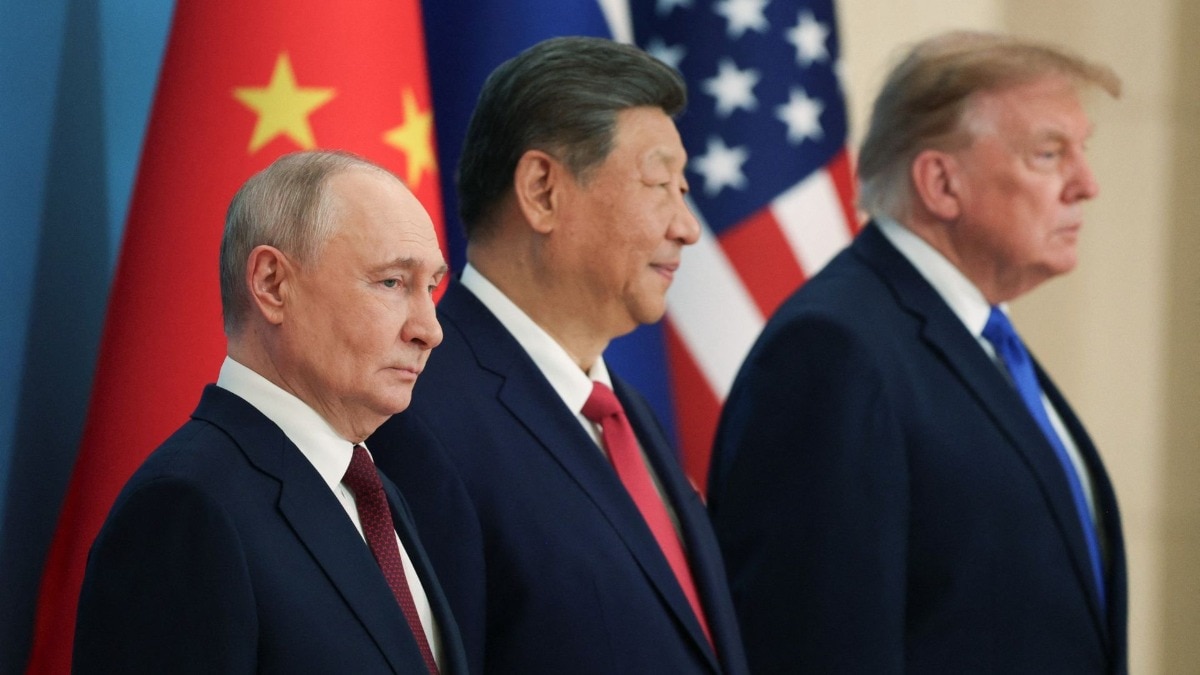
The seating arrangements, the airport welcome, the music, and even a family photograph at the Asia-Pacific Economic Cooperation (APEC) summit in China have offered a glimpse of an emerging geopolitical reality. Chinese President Xi Jinping rolled out the red carpet for US President Donald Trump, while his long-time friend Russian President Vladimir Putin received markedly different treatment.
So, is Xi's China recalibrating its priorities, and is the old Beijing-Moscow partnership giving way to a new equation with Washington? The optics that have emerged from the communist country's APEC summit signal something big.In diplomacy, gestures make sound as much as agreements do.
And at the APEC summit in Shenzhen, China, on November 18–19, Xi Jinping's contrasting treatment of Trump and Putin was difficult to ignore.When Putin arrived in Shenzhen ahead of the summit, Xi did not receive him personally. Instead, Cai Qi, a member of the Chinese Communist Party's Politburo Standing Committee and its fifth-ranking official, welcomed the Russian president at the airport.
Russia has long been a key strategic partner of China, and Xi has often personally welcomed Putin during his visits to Beijing.The reception for Trump on November 18 was totally different and striking. Xi personally went to Shenzhen Bao'an International Airport to welcome the American president, greeting him at the foot of Air Force One.
He also broke protocol and hugged him. The ceremony included a military honour guard, a children's welcome, a military flypast and the national anthems of both countries.
The gesture was particularly significant because Xi had not personally welcomed Trump during his earlier visit to China in May. This time, Beijing appeared keen to show the importance it attached to the US-China relationship.The stark differences continued at the welcome reception.
While the orchestra played the American national anthem for Trump, Putin's arrival was accompanied by Trepak, a Russian dance from the second act of Pyotr Tchaikovsky's ballet The Nutcracker. Then came the photographs.
During the Wednesday (November 18) photo opportunity ahead of the banquet, Xi and Trump stood together. When Putin approached, footage showed the Russian leader being directed towards a separate position by the Chinese president.Trump and Xi were standing together for the photo op, but Putin was positioned besides Chinese first lady, Peng Liyuan, far from the US president.
The symbolism was striking, even if the choreography alone cannot establish a deliberate diplomatic snub.Pavel Slunkin, former Belarusian diplomat argued that according to the Chinese protocol, the most prestigious position is to the right of the Chinese president."Even if Putin had stood to Trump's right, his position would still have been less prestigious in protocol terms than the position to the left of President Xi's wife," Slukin said in a post on X, adding, "When the Chinese president's wife is also present, the second most prestigious position shifts one place further to the left, placing it to the left of the First Lady."In a post on X, former Indian diplomat Kanwal Sibal argued that if Putin had been pulled by Trump to his side, it would have made it look as if Trump was the host with Xi and Putin flanking him and Putin getting precedence.Putin also missed an opportunity to speak to Trump at the gala banquet because the two were seated at different tables. Kremlin aide Yury Ushakov told the Russian news outlet Vesti that the seating arrangement had prevented a conversation between Trump and Putin.
Russian President Vladimir Putin, Chinese President Xi Jinping, and US President Donald Trump pose for a group photo during the Asia-Pacific Economic Cooperation (APEC) summit in Shenzhen, southern China's Guangdong province. (Associated Press) IS XI'S WASHINGTON CALCULUS CHANGING?The circumstances detailed above do not necessarily suggest that Xi is abandoning Putin. Instead, they point to a larger diplomatic calculation.
China has always projected itself as a power capable of engaging the US as an equal, while positioning itself as a central figure in shaping the global order.China and Russia have drawn closer since Moscow launched its full-scale invasion of Ukraine in February 2022. Western sanctions pushed Russia towards China for markets, technology and financial support, while Beijing gained access to discounted Russian energy and strengthened its strategic partnership with Moscow.The relationship between the two countries has frequently been described as a "partnership without limits".
Both countries have also advocated a multipolar world order, challenging what they see as American dominance.But this partnership has its boundaries. China does not want to be seen as a junior partner in an arrangement with Russia, nor does it want its relationship with Moscow to constrain its engagement with Washington.
It is apparent that Beijing's ambition is to establish itself as a power equal to the US, capable of competing with it across economic, technological and geopolitical arenas.The US remains central to China's trade, technology ambitions and financial interests. The two countries are locked in a contest over advanced semiconductors, artificial intelligence, tariffs, supply chains and influence across the Indo-Pacific.
Yet, despite these rivalries, neither can afford to ignore the other.For Xi, therefore, managing the American relationship is not simply another diplomatic engagement. It is an opportunity to demonstrate that China can negotiate with Washington from a position of strength, rather than be drawn into a US-led framework.There is also a larger geopolitical message in the way Beijing has brought Trump and Putin together.
By engaging both leaders, Xi is seeking to project China as a central diplomatic actor between two countries that were Cold War rivals. The optics place Beijing at the centre of a conversation involving the world's three major powers, reinforcing its claim to a leading role in shaping international affairs.
Vladimir Putin, Xi Jinping and Donald Trump held a trilateral meeting at on the sidelines of the APEC summit in Shenzhen. (Associated Press) HAS XI PUT PUTIN OUT OF SUPERPOWER PICTURE?The reading of Shenzhen optics as a Chinese shift away from Russia would be premature.Xi held bilateral talks with Putin in Shenzhen ahead of the summit, demonstrating that the relationship remains important. Putin also attended APEC for the first time in nine years, giving Moscow an opportunity to return to a prominent international diplomatic platform.The two countries continue to share interests in challenging Western sanctions, expanding non-Western institutions and reducing dependence on the US-led financial system.There is also a practical reason for Beijing to retain Moscow as a strategic partner.
Russia remains a major energy supplier, a nuclear power and an important military actor. Its geographical position and influence across Eurasia give it significance in China's wider security calculations.But the balance within the relationship is changing.
Russia's dependence on China has increased since the Ukraine war, while Beijing has retained greater room to manoeuvre in its dealings with Washington. Xi can maintain strategic cooperation with Putin without giving Moscow the same diplomatic priority he accords Trump.In other words, China might value Russia as a strategic partner while treating the US as a power with which it must negotiate.The summit itself carried ambitions beyond the three leaders' personal relationships.
On November 19, Trump, Xi and Putin began an unprecedented trilateral meeting at Kylin Villa in Shenzhen, on the sidelines of APEC.The symbolism invited comparisons with the 1945 Yalta Conference, where the leaders of the United States, Britain and the Soviet Union discussed the post-war order.The series of events that is shaping in China hint that the emerging world order might therefore not be one in which China and Russia simply stand together against the US. It could be one in which Beijing maintains its partnership with Moscow while selectively engaging Washington to protect its own interests.- Ends