


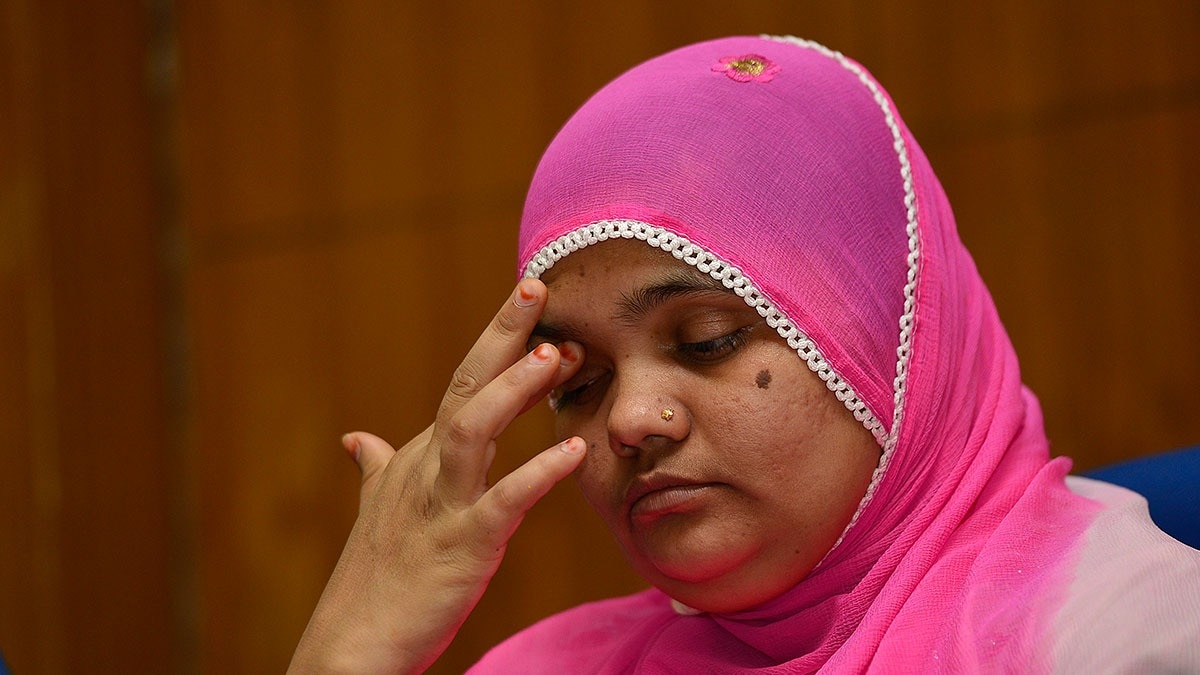
“I still cannot believe that once again, for the second time, an order has been passed by the Supreme Court without calling me up and without hearing me,” Bilkis Bano said in a statement on November 16. “I learnt of this through press reports.”The order she refers to was passed on October 28, but became public only weeks later when it was uploaded to the Supreme Court’s website. In it, a bench of Justices M.M.
Sundresh and P.B. Varale suspended the life sentences and granted bail to Bipinchand Kanaiyalal Joshi and Pradip Ramanlal Modhiya, two of the 11 men convicted of raping Bilkis and killing 14 members of her family, including her three-year-old daughter Saleha, during the 2002 Gujarat riots.The court suspended the life sentences while the convicts’ appeals challenging their 2017 conviction by a special CBI court are pending.The bench gave two reasons: the men have been in custody for more than 17 years and one of them is severely handicapped.
It added that the appeals raise questions of fact and law still to be decided. Senior advocate Siddharth Luthra, representing the convicts, argued that one of the men was not named in the original FIR.
Additional solicitor general Raja Thakre opposed bail, citing the gravity of the crimes. The conditions for bail are to be set by the trial court.The violence against Bilkis, then 19 and pregnant, and her family was part of the communal carnage that rocked Gujarat in 2002 after the burning of a Sabarmati Express coach in Godhra on February 27 killed 59 kar sevaks.
On March 3, a mob attacked Bilkis’s family at Randhikpur village in Dahod district. She was gang-raped and 14 members of the family were killed.“Familiar fears are resurfacing.
I am scared once again,” Bilkis said in her November 16 statement, issued through her lawyer, senior advocate Shobha Gupta. “How could the honourable Supreme Court simply suspend the sentence of the men who did this to me?” She vowed to challenge the order: “I will fight this order. I must.”In 2004, the Supreme Court had moved the trial from Gujarat to Maharashtra.
In 2008, a special CBI court in Mumbai convicted 11 men in the case.The case continued to make headlines from time to time. In 2022, on Independence Day, the Gujarat government released all 11 convicts under its remission policy after the Centre cleared the move.
The men were greeted with sweets and garlands, and BJP legislator C.K. Raulji even defended the release, calling the convicts Brahmins with good values.
Then, in March 2023, convict Shailesh Bhatt shared the stage with Dahod BJP MP Jaswantsinh Bhabhor and his MLA brother Shailesh Bhabhor at a government event in Limkheda.In January 2024, the Supreme Court reversed the release of the convicts. A bench of Justices B.V.
Nagarathna and Ujjal Bhuyan held that Gujarat had usurped Maharashtra’s power to grant remission. It found that the earlier order directing Gujarat to consider remission had been obtained by fraud and observed that the state had “acted in tandem and was complicit” with the convict who sought it.
All 11 men went back to Godhra jail that month.The Supreme Court’s latest order is legally separate from that verdict. Suspending a sentence does not overturn a conviction.
Bilkis’s complaint is about the process as much as the outcome. Her core contention is that the bail was granted without hearing her.
In 2022, her husband had said that the family learnt about the release of the convicts from the media. Four years on, she has come to know of the Supreme Court order the same way.What lies ahead is equally concerning.
The other nine convicts remain in jail, but the order may not hold them there for long. The main ground for bail—more than 17 years in custody—applies to all 11 men, who went back to Godhra jail together in January 2024, and their lawyers are likely to seek the same relief on grounds of parity.
The disability ground applied only to one of the two men who got bail.The court has taken this route before in 2002 cases. In December 2022, it granted bail to a Godhra train-burning convict who had served 17 years, noting that his role had been limited to throwing stones at the train.
In April 2023, it gave bail to eight more, citing that their 17-18 years in jail and their individual roles, but turned down four others because of what they were found to have done. Time served, in other words, has not been enough on its own.
The role each accused played in the crime added to the weightage in the past.The Ahmedabad-based Minority Coordination Committee (MCC) has asked that Bilkis be heard in any future hearing on custody or release, and that the pending appeals be decided quickly. MCC convener Mujahid Nafees said his group respects the court’s authority and the convicts’ legal rights, “but the victim’s rights must not disappear in the process of justice.
No victim should feel that the process of justice for a crime against her is unfolding around her, without her”.Bilkis says she will fight on, for her children and for Saleha, “whose memory demands justice”.Subscribe to India Today Magazine- Ends