


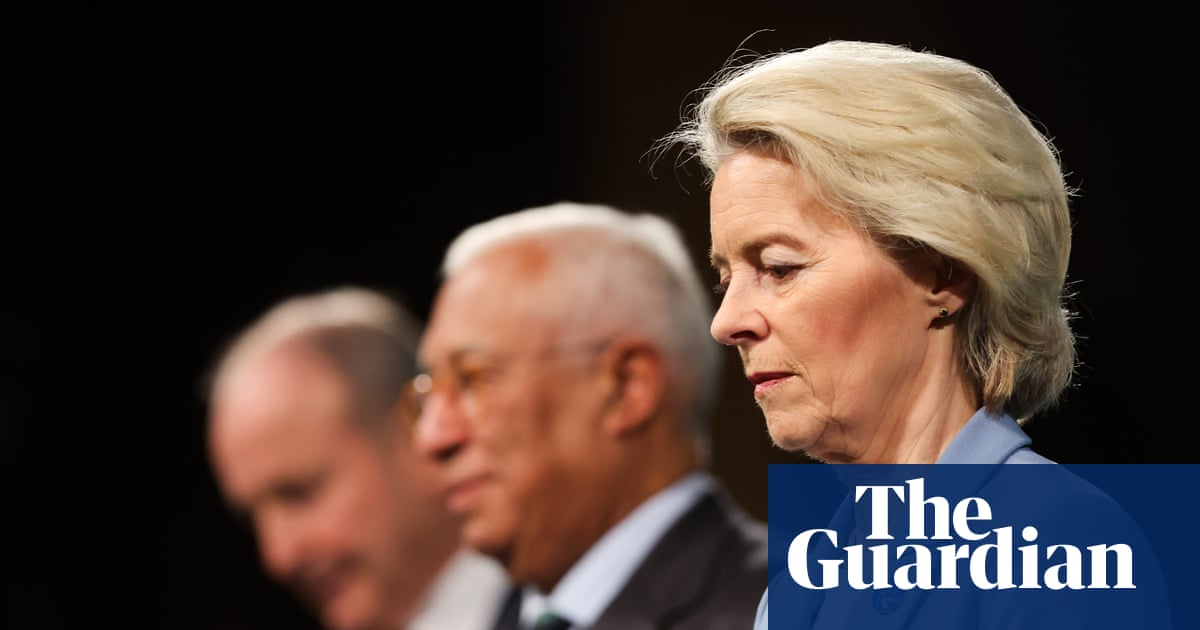
The EU, we are repeatedly told, wants (and needs) to be a global player, a geopolitical heavyweight capable of shaping its own foreign and security policies – or at the very least, speaking with one clear, unambiguous voice on the world stage.Last Friday’s summit in Dublin, when leaders debated who should represent the bloc in talks aimed at ending Russia’s war on Ukraine – the gravest security crisis the EU has faced in decades – showed once again that it is unlikely to find such a voice anytime soon.The EU has a chief diplomat: she is called Kaja Kallas, she is a former Estonian prime minister, and she was appointed the EU’s High Representative for Foreign Affairs and Security Policy, and a European Commission vice-president, in 2024.In theory, Kallas should embody this more assertive Europe. But as the US-mediated talks accelerate, EU leaders have – despite Ukrainian president Volodymyr Zelenskyy’s pleas for the bloc to field a single negotiator – locked her out of the room.Instead, alongside US negotiators Steve Witkoff and Jared Kushner, Europe is being represented by a seven-strong team: European Council president António Costa, Commission president Ursula von der Leyen, and representatives from the E5 powers: France, Germany, Britain, Poland, and Italy, working with Nato.On paper, Kallas’s job description is straightforward and twofold.
She chairs the Foreign Affairs Council, the monthly decision-making forum where national foreign ministers meet to agree on common EU foreign policy, sanctions and crisis responses.She also runs the European External Action Service (EEAS), the bloc’s permanent diplomatic corps and de facto foreign ministry, made up of civil servants and over 140 embassies around the world that carry out day-to-day EU diplomacy on the ground.In practice, being the face of EU foreign policy – a role created by the Lisbon Treaty in 2009 to answer Henry Kissinger’s famous if apocryphal question “Who do I call when I want to talk to Europe?” – is, as one commentator puts it, a “poisoned chalice”.Jennifer Rankin in Brussels tells me: “Personally, I think Kallas has an impossible job: having to represent the positions of 27 member states that often disagree on foreign policy, and don’t want to cede real decision making on it to the EU.”Relations between Kallas and von der Leyen – who critics accuse of sharing exactly the same kind of power-hoarding and centralising instincts as some EU national leaders – have been particularly difficult.That friction has been aggravated by active proposals in Brussels to overhaul the bloc’s whole diplomatic service, folding parts of the EEAS and key foreign policy powers directly into the Commission president’s remit.On Friday, when the Dublin summit convened, Kallas was unequivocal: leaders had agreed in 2024, when it was clear there would have to be talks with Russia, “that I’mthe one who is representing Europe in foreign and security policy,” she said.But when Costa announced the bloc’s negotiators in Dublin, Kallas wasn’t among them. So why did the 27 capitals bypass the person they hired for the job?Three explanations are doing the diplomatic rounds.
First, several western European capitals view the Estonian envoy as too overtly, and fiercely, anti-Russian.Second, there is a much deeper reflex at play: the EU’s big member states simply refuse to cede real foreign policy power to Brussels. Paris and Berlin in particular resist a single EU envoy, clearly preferring to protect their own seats at the table.Third, diplomats point to a wider trend for the kind of international questions once handled by foreign ministers being taken over by premiers or presidents.Whatever the reason, von der Leyen’s defence of the decision was brisk: “We decide for ourselves who will represent us, and we made that decision today,” she said.
Germany’s chancellor, Friedrich Merz, has also argued that intergovernmental formats like the E3 – France, Germany and the UK – are “a well-established format” and “I see absolutely no problem with keeping it that way.”Others, though, were less happy. Spain and Lithuania both criticised the team approach. “Europe needs one voice,” said Lithuania’s foreign minister, Kęstutis Budrys. “We cannot speak with 27 microphones.
We need one.”A damaging own goal?skip past newsletter promotionafter newsletter promotionKaja Kallas is supposed to be the face of EU foreign policy. Photograph: Cathal McNaughton/ReutersAll this may seem rather inside-the-Brussels-beltway stuff.
But beneath it lies a real, and important debate over whether the EU will ever be a global actor, or be fated to remain a disjointed collection of national voices.Defenders of the Dublin decision argue that hard security and ending the war are issues that belong to the EU’s major military and financial powers, not supranational officials: bringing the big beasts to the table provides the real geopolitical heft.One EU diplomat said the problem was that EU institutions “do not have sufficient political legitimacy in the eyes of voters. And this matters big time.
The E5 solution is an attempt to bridge that gap.”But critics see a damaging own goal, and a profound hypocrisy. Brussels commenter Dave Keating argues there is a fatal contradiction inherent in Europe’s integration.Member states “know what the right thing to do is in the abstract, so they create these positions and institutions to make a stronger EU,” he says. “But then … they undermine [them] … because they always give in to the urge not to hand over power to someone else.”By choosing to field what Keating called a “European cacophony” that would inevitably be dismissed as irrelevant by Moscow and Washington, leaders proved Kallas’s job “is not real, and the EU doesn’t actually have a foreign policy”, he said.Jennifer is slightly less damning. “I think the E5+ format could be seen as a realistic answer to represent the EU as it is, not the idealised union of the treaties,” she said. “It needn’t be a cacophony if everyone in the room has the same message.”So far, on Ukraine at least, there is a large degree of consensus.
But if, for example, Marine Le Pen becomes French president, all bets are off,” says Jennifer.For her part, Kallas has put a brave face on it, insisting she will focus on “substance” while leaders handle “format”. But the suspicion remains: Europe’s leaders want the bloc to be a global power, but won’t let anyone else speak for them.Until they do, the risk is that the EU will be stuck on the diplomatic sidelines, forever punching below its geopolitical weight.To receive the complete version of This Is Europe in your inbox every Wednesday, please subscribe here.