


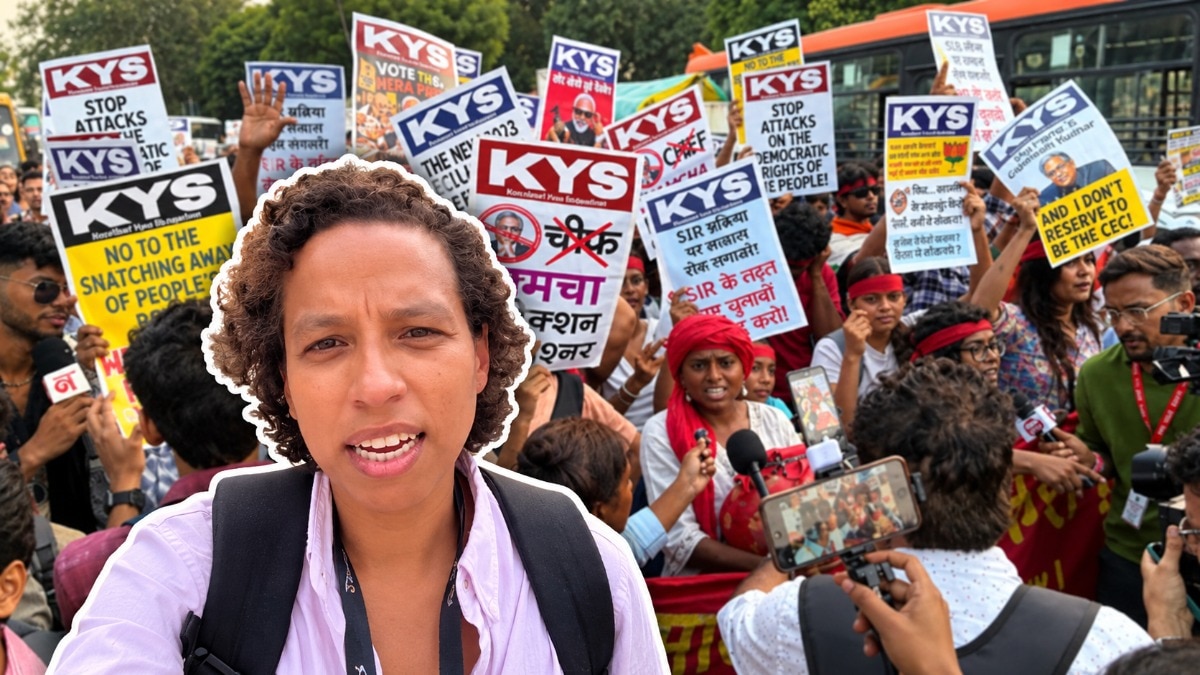
A week in New Delhi, two protest sites and a sweeping conclusion about India's political mood. US-based journalist Lydia Polgreen's opinion piece in The New York Times, arguing that protests in India should worry US President Donald Trump, has drawn sharp criticism from Indian commentators who question whether a brief visit to the national capital can capture the mood of a country of 1.4 billion people.Polgreen's column in the NYT, published on October 26 (Monday), titled 'In India, I Saw Things That Should Scare Trump', argued that young, educated Indians were increasingly willing to challenge BJP-led central government.
But critics of the column said that the demonstrations, while reflecting genuine grievances, do not necessarily point to a wider political shift.The criticism has also revived a familiar question about the coverage of India by foreign journalists: how much can a handful of conversations and observations at protest sites reveal about a country as vast and diverse as India? Critics said that while the protests and the grievances behind them were real, they did not necessarily establish a wider national mood or signal an imminent shift in India’s political landscape.The demonstrations in New Delhi on October 10 and 16, called by the Cockroach Janta Party (CJP) to demand the resignation of Chief Election Commissioner (CEC) Gyanesh Kumar, unfolded under different circumstances.
While the October 10 protest took place amid extensive restrictions across central Delhi, the October 16 gathering saw no comparable movement curbs, despite a similar deployment of security forces. Sushant Sareen, a senior fellow at the Observer Research Foundation (ORF), accused Polgreen of selecting observations that supported her argument."Classic example 'I came and saw what I wanted to see to the exclusion of everything else'.
The broader reality is just an inconvenience to the narrative that is being plugged," Sareen wrote on X.Kushal Mehra, a podcaster and entrepreneur, recalled meeting an American activist in India who opposed PM Modi because he did not speak English. Mehra said the activist's views reflected the social circle he interacted with rather than a broader understanding of Indian voters."I never got those 2 hours back," he wrote, recalling the encounter.OCTOBER 10 PROTEST HELD AMID RESTRICTIONSIn her column, Polgreen wrote about Delhi University student Mohini Majumdar and her classmates taking an early-morning taxi to central Delhi to attend the October 10 protest.However, central Delhi faced significant restrictions that day, with cab-hailing services Ola, Uber and Rapido directed by the Delhi Police not to accept rides towards the area.
Access was restricted by multiple barricades manned by Delhi Police, the CRPF, the Rapid Action Force and the BSF.Trains to New Delhi and Hazrat Nizamuddin railway stations were suspended for part of the day, shops remained shut, and prohibitory orders were in force. More than 7,000 people were detained across the National Capital Region, including protesters, activists, journalists and commuters.The circumstances raised questions about how protesters accessed the site and whether the difficulties faced by ordinary commuters and journalists were adequately reflected in accounts of the demonstration.The ability to participate in protests can also depend on whether individuals have the resources and support to deal with possible detention, police cases, legal expenses and disruption to their education or employment.
These factors can shape whose dissent becomes visible and who is deterred by the potential consequences.OCTOBER 16 TURNOUT AND LEADERSHIP QUESTIONSA second protest called by the CJP and the All India Students' Association (AISA) took place at New Delhi's Connaught Place on October 16, without the same restrictions imposed a week earlier.The gathering grew through the evening but remained scattered, with students, Left activists and other citizens raising slogans in small groups. The turnout appeared to be around 1,000 by evening.With key CJP leaders detained, the gathering lacked clear coordination to turn it into a sustained, organised march.
In Mumbai, a protest at Azad Maidan the same day drew only a few dozen people.The turnout at the two locations prompted questions about whether the demonstrations could be taken as a reliable indicator of wider public sentiment. A smaller gathering, however, does not establish that the grievances behind a protest have disappeared, just as a large turnout alone cannot establish nationwide support.Vivek Krishnan, CEO of SSS Defence, criticised what he called a recurring approach among foreign journalists."Once again, the standard foreign correspondent trope.
Fly in, interview the taxi driver or socialite friend about what the nation thinks. The driver and friend, both agree with everything the correspondent already believed," he wrote.Entrepreneur Ram Prasad recalled a similar encounter with a foreign reporter in Delhi in early 2014, before Modi became Prime Minister.
The reporter had asked, "Who the hell would vote for Modi?" Prasad said, adding that the journalist had not spoken to people beyond his acquaintances in New Delhi.A senior editor on X summed up the criticism with a line dripping in sarcasm, saying, "I spent a week in Delhi'. Enough to understand the nation, I'm sure.
As the column evidently shows."The criticism highlights a broader question about the limits of short visits and selective conversations in understanding a country as politically and socially diverse as India.While unemployment, examination-paper leaks and concerns about voter rolls remain significant issues, their political consequences require wider evidence than observations from a few demonstrations. The protests offer a glimpse of dissent, but whether they indicate a broader shift in public sentiment remains an open question.- Ends