


When Anthropic launched Claude Cowork earlier this year, it became quickly clear that this was no ordinary AI. It was able to perform tasks that were traditionally dependent on IT companies like TCS and Infosys and it was able to do those tasks at par with engineers more efficiently.
Tools that Anthropic had made generally available to anybody and everybody were so powerful, global IT lost hundreds of billions of dollars in market value. The internet called it the SaaSpocalypse.Suddenly, these companies who had mastered SaaS which is short for software as a service were facing an existential crisis.
The writing was on the wall. Zoho founder and chief scientist Sridhar Vembu had seen it coming too. “An industry that spends vastly more on sales and marketing than on engineering and product development was always vulnerable.
AI is the pin that is popping this inflated balloon,” he had tweeted at the time. But Vembu was not alone.
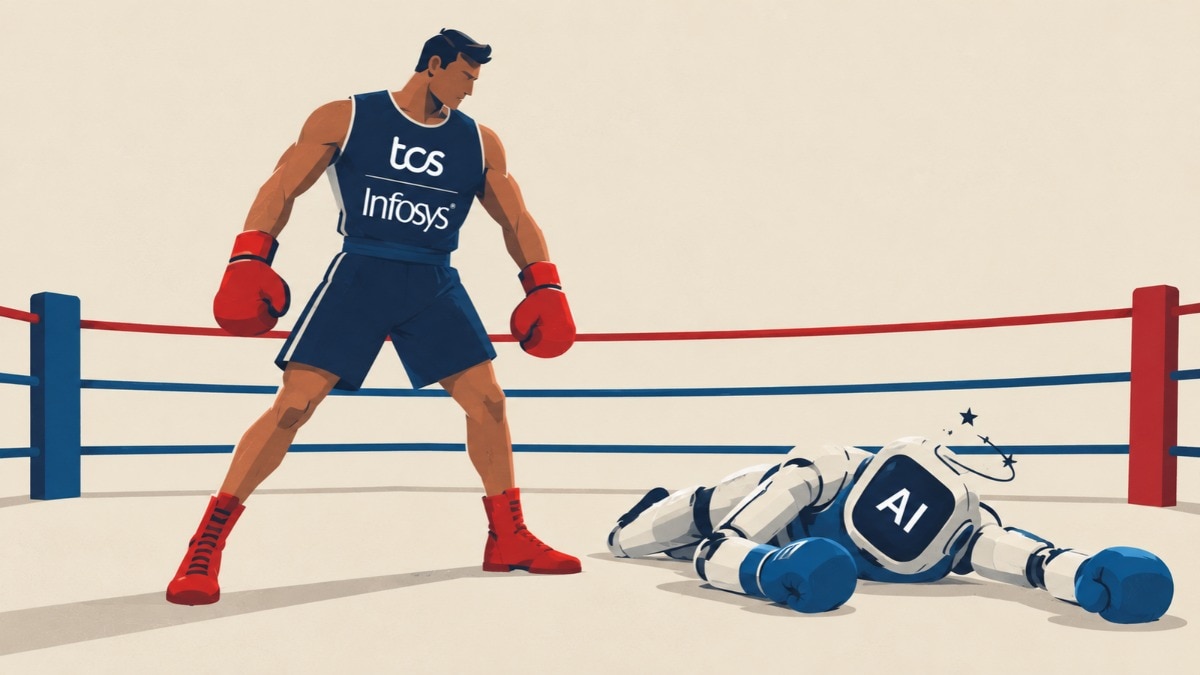
Many veterans had come forward and basically written off IT. It seemed like it was game over.But before the bell rang in this boxing match, Indian IT got up and went for another punch.Eight months later, the situation feels much different.
In TCS’ quarterly financial earnings for Q2 2027, the company reported $3.1 billion in AI annualised revenue, an increase of over 19 per cent from the previous quarter. To be more specific, its revenue related to AI now accounts for 10.1 per cent of the company’s total annualised revenue.
TCS is not alone. Infosys too, has come back better and stronger recording a quarter-on-quarter AI revenue increase of 29 per cent.
This is the first time both companies have reported double-digit revenue from their AI operations. Fighting AI with AIWhen Claude Cowork was launched, Indian IT had two options.
Either sit around and do what it had been doing or innovate. The IT industry picked the latter.In the past year, TCS has signed deals with OpenAI and Anthropic to use AI in their offerings.
Infosys too, has made similar agreements. To bring these AI tools to reality, the companies are recruiting FDEs.
FDEs, or Forward Deployed Engineers, work with clients to integrate their systems with their offerings, in this case with AI solutions. While Infosys plans to hire roughly 6,000 FDEs in the next few years, TCS is set to hire about 8,900 candidates for this new role.
And this seems to be bringing in results. During the earnings call, a TCS spokesperson mentioned demand for AI tools. “We are seeing three distinct demand patterns.
AI native solutions with business outcomes, AI transformation of enterprise systems and autonomous GBS (Global Business Services),” she said.The spokesperson cited an example where TCS came up with an “AI native approach” for a global industrial manufacturer that compressed “lead to code time from 4.7 days to under an hour.”Similarly, Infosys also has similar projects in the pipeline, some of which involve modernising current systems. “One of the areas which are growing well is where we do work on modernising a client’s environment using AI capability. That is new work,” an Infosys spokesperson said during their earnings call. “It’s not that that was something that we were doing in the past That’s the work that we share outside as this 10.5 per cent which is growing quite well.”Simply making AI-driven solutions is not enough, unless there is a demand to use it.
Anil Agarwal, CEO of InCruiter, says that a large part of this growth is the fact that businesses are less cautious of using AI today. “Businesses are no longer looking at AI as something they should experiment with; they want to see what it can actually deliver,” he tells India Today Tech. “That is where the opportunity is coming from.”Rajesh Chhabra, general manager at Acronis, says that now we are seeing clients actually use AI in their daily operations. “Over the past two years, many enterprises have experimented with AI, and now they’re putting it into real workflows – modernising old applications, getting their data in order, and using agents in support, engineering and operations,” he tells India Today Tech.OpenAI and Anthropic have also set up their own service units. But TCS and Infosys have legacy.
They have long-standing relationships with clients. “Enterprises also tend to give that work to the partners who already run their core systems, because those partners know where the data sits and what the compliance rules are,” Chhabra adds. That is, instead of working with a new partner, companies can simply stick with their existing SaaS firm and get AI integration.This has been highlighted by Infosys CEO Salil Parekh. “As enterprises adopt AI at scale, another quarter of strong growth in AI revenues is a recognition of our differentiated market positioning and client confidence,” he said during the earnings call.Tanmay Pandya, senior director at Newton School of Technology, concurs.
Pandya highlights that the fear over a SaaSpocalypse missed something important – AI tools alone aren’t enough. “A bank or a manufacturer needs more than access to a powerful model. It needs engineers who can connect it to existing systems, work with its data, test its reliability and take responsibility when something goes wrong,” he tells India Today Tech. “That creates a substantial opportunity for Indian technology talent.”A key part, however, that may have gone under your radar, is that Indian IT also learnt how to change the way it operates.A change in how Indian IT works“What we’re seeing is not Indian IT being displaced by AI, but Indian IT adapting faster than many expected,” says Gartner’s senior principal analyst Biswajit Maity.
Maity says that companies adapted to a new way of working in the age of AI. “A year ago, the dominant narrative was that AI would undermine the people-intensive delivery models on which the industry was built,” he tells India Today Tech. “Instead, leading providers are increasingly using AI to improve productivity, automate delivery, and expand the scope of transformation engagements.”At the same time, there is a focus on client-side AI models also. Infosys, for instance, is bringing more AI tools through Topaz.
According to the company, a client can access 15 different open and closed-weight AI models through Topaz, with token optimisation to reduce costs. This, Biswaji Maity says, also points towards a change in the work structure of SaaS firms like TCS and Infosys. “Indian providers are gradually moving away from a model built primarily on labour scale and toward one centred on productivity, automation, platforms, and business outcomes,” he adds.It is hard to ignore the irony though.
AI, which looked like a weapon in the hands of OpenAI and Anthropic, IT is using the same tools to write their comeback story. “The technology expected to disrupt Indian IT is also becoming a source of growth for the industry,” Anil Agarwal notes. “TCS and Infosys are showing that Indian IT firms can participate in the AI opportunity rather than simply react to it.”Does this mean that Indian IT companies have managed to get up and win this boxing match? Not quite.
While the companies have made their next move, they need to keep going to survive. “Companies that successfully combine industry and technological expertise will be able to reap the benefits,” says Path in AI Technologies CEO Kanishk Agrawal. “For continuous prosperity, companies will require upskilling employees and increasing productivity.”And a key part of the future for companies like Infosys or TCS is trust. “What happens next will come down to trust. As clients let AI agents do more on their behalf, they’ll want to know who is accountable for what those agents see and do,” Rajesh Chhabra explains, “Indian IT has the scale and the domain depth.
If it pairs that with strong data protection and cyber resilience, it can hold on to the premium work.”There has been progress in terms of AI adoption by other players too. Tech Mahindra recently signed a deal with Elon Musk’s SpaceXSI to use Grok AI models in its workflows, the first time Musk’s company had reached an agreement with an Indian IT player.
Meanwhile HCLTech has also reported gains in AI revenue.However, Indian IT will need to keep pushing aggressively if it wants to keep a chunk of the big AI pie that AI companies have promised us. As Tanmay Pandya puts it, “I would not read these developments as proof that the disruption is over.
They show that Indian IT has an opportunity to adapt.” While Indian IT companies have managed to get up from the blow they felt in February, there is a long way to go before they can really consider themselves as winners in the AI era of SaaS.- Ends