


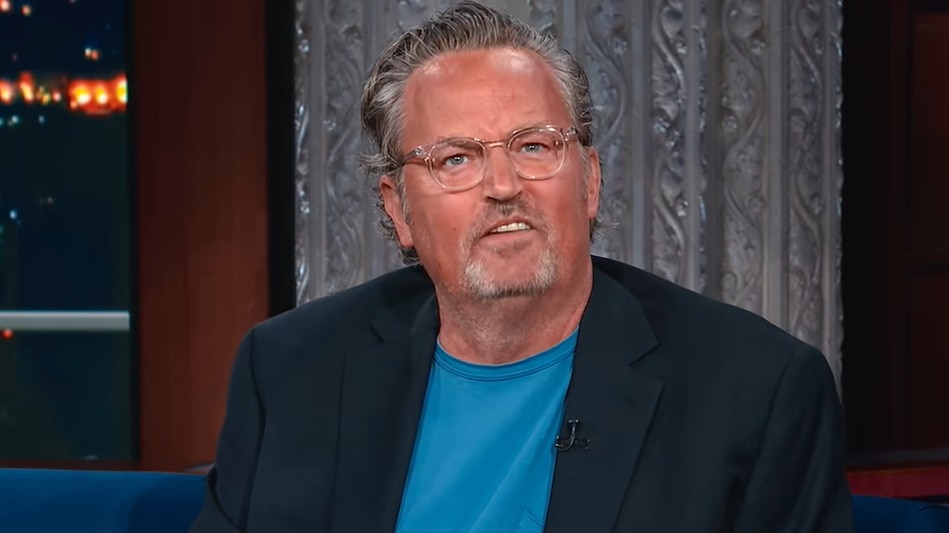
There is something particularly cruel about being remembered for making people laugh when your own life is anything but funny. Matthew Perry knew that contradiction all too well.
For 10 years, as Chandler Bing on Friends, he made awkwardness charming, sarcasm endearing and vulnerability funny. Behind the character we continue to adore, however, was a man battling demons that fame, fortune and the love of millions could not defeat.Netflix’s three-part documentary The One About Matthew Perry, directed by Mary Robertson, tells his story through the people who knew him best.
It is intimate, heartbreaking and, at times, difficult to watch. Above all, it makes you wish the man who brought so much joy to others had found a little more of it himself.If you were hoping the Friends cast would appear to reminisce about their beloved co-star...they don’t.
Jennifer Aniston, Courteney Cox, Lisa Kudrow, Matt LeBlanc and David Schwimmer are absent from the interviews. Yet Perry’s sister, Mia Perry Bowick, recalls the five friends coming together at his funeral, holding hands and crying around his casket.
It is enough to leave you teary-eyed. That is the impact Friends has had on us.
These six characters feel almost immortal, like familiar companions who will always be around, waiting for us in another rerun. Knowing what the man behind Chandler endured makes it all the more heart-rending.
Through interviews, archival footage, old conversations with Perry and recreated moments, the series traces the promise of his early years and the darkness that followed. His sister, childhood friends Roger Castillo and David Pressman, former girlfriends and industry colleagues, including former NBC Entertainment president Warren Littlefield and Friends writer-producer Jeff Strauss, piece together a life far more complicated than the sitcom’s familiar punchlines suggest.The early memories are a delight.
Castillo and Pressman recall hanging out in Los Angeles, chilling at cafes, checking out girls and dreaming big. There is a red car, youthful ambition and a charming, funny young man who seems to have the world ahead of him.
Strauss recalls Perry’s Friends audition and how naturally he inhabited Chandler. Perry had even helped friends audition for the role because he felt so connected to the character.
Littlefield revisits the making of the sitcom and the chemistry among its six leads, a combination that would make television history. But success came with a cruel catch: it did little to make Perry feel better about himself.His parents’ divorce left him struggling with insecurity and a sense of displacement.
Even after Friends became a phenomenon, he felt lonely and inadequate, constantly trying to prove he was enough. He had money, fame and relationships, including one with Julia Roberts.
He was generous, too, spending on family and friends and gifting his 15-year-old sister a Mustang. Yet none of it could fill the void.Former girlfriend Marjorie recalls how openly Perry flirted as a young man, while Ren Ashton speaks about their romance, offering a glimpse of him as a loving partner.
Rome, another former girlfriend, remembers his affection and instinct to help others.His addiction began after a jet-ski accident while filming Fools Rush In, when he was prescribed painkillers. What followed was a punishing cycle of substance abuse, rehabilitation, relapse and guilt.
His drinking and drug use affected not only his health but also those around him and the productions that depended on him. His sister’s recollections are particularly painful, capturing the helplessness of seeing their loved one caught in the cycle.The documentary’s account of his 2018 medical crisis is devastating.
Following a colon rupture, Perry spent an extended period in hospital, including time in a coma, with just a 2 per cent chance of survival. His sister recalls how dramatically he aged in just three months.
And yet, Perry was never just his addiction.His obsession with Batman, desire to save people and generosity towards those struggling with recovery reveal another side to him. He wanted to help others, perhaps because he understood their pain so intimately.
His work on Mr Sunshine, his play The End of Longing and his efforts to support people battling addiction reflected that impulse.In the play’s climax, Perry broke the fourth wall to speak about seeking help. One former collaborator’s description of seeing him in that state as the wreckage of a successful career is difficult to forget.
Perry wanted to help others escape addiction even as it continued to imprison him. He stood his ground, quite furiously, when a journalist tried to shrug off addiction as a fantasy.The series also revisits the Friends reunion in 2021 and the online trolling surrounding Perry’s appearance and speech.
Those close to him suggest the scrutiny affected him deeply. His memoir later offered an unflinchingly honest account of his struggles, which means the documentary does not always reveal much that readers won’t already know.Its final chapters, including Perry’s ketamine use and the criminal case involving people accused of supplying the drug, are particularly harrowing.
The revelation that people he trusted were implicated in the circumstances surrounding his death makes the tragedy even harder to process.At times, the three episodes revisit familiar ground and could have benefited from a tighter edit. There is also a sense of an obituary arriving late, although the legal proceedings surrounding his death may partly explain the timing.
Still, the documentary offers something the memoir could not: faces, voices and relationships that make Perry’s story painfully personal. His family and friends speak with love, grief and the unmistakable exhaustion of watching someone they cared about struggle for so long.We may never fully understand what Matthew Perry endured.
But we know what Chandler Bing gave us: laughter, comfort and the feeling that we were not alone. The One About Matthew Perry cannot change how his story ended, but it reminds us why the world is still mourning the man behind the jokes.- Ends