


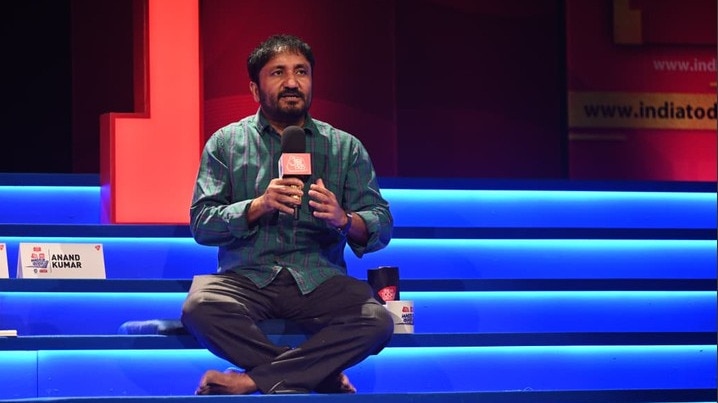
From missing out on Cambridge University due to financial hardships to building Super 30, Anand Kumar's journey reflects perseverance and a commitment to education.Speaking at the Aaj Tak Masterclass 2026 event, Super 30 founder Anand Kumar shared lessons from his personal journey, spoke about the changing nature of education, the growing influence of artificial intelligence (AI), and the importance of perseverance, hard work and good teachers.In a conversation with Aaj Tak Senior Managing Editor Sweta Singh, Kumar also reflected on the experiences that shaped his life and inspired him to establish Super 30. Addressing students from different backgrounds, Kumar said that success was not determined by the resources available to an individual but by their determination to overcome challenges.“Resources do not matter as much as your determination.
Even when circumstances are unfavourable and success does not come easily, the person who continues to fight is the real warrior,” he said. Asked what the opening scene of a film on his life would look like if he had directed it himself, Kumar recalled a deeply personal memory involving his father.He said his father would wake up early every morning, prepare two cups of tea and come to wake him up when he was a school student.
Before Kumar could touch his father's feet as a mark of respect, his father would touch his feet instead. “I used to feel embarrassed and ask him why he was doing that. He would tell me, ‘Son, I believe that one day you will become a very big person.
People may touch your feet and seek your blessings. Perhaps I may not be around to see that day,’” Kumar recalled.His father's words, he said, became a source of strength whenever he faced difficulties.
Although his father is no longer alive to witness the respect he receives today, Kumar said the memory continues to inspire him.‘NEVER THINK YOU HAVE REACHED THE END’Reflecting on his journey, Kumar spoke about the challenges that eventually led him to establish Super 30. He recalled receiving admission to Cambridge University but being unable to pursue his studies because he could not afford the airfare.His father's death during that difficult period further changed the course of his life.
Kumar said he had two options: take up a job in place of his father or work at a coaching centre to earn money. Instead, he chose to create an initiative that would give talented students from underprivileged backgrounds an opportunity to pursue their dreams.Speaking about the students who have passed through Super 30, he cited examples of young people from economically disadvantaged families who went on to build successful careers.He also explained that the selection process was not based solely on academic performance.
The institute looked at students' willingness to learn, their genuine interest in education and whether they came from underprivileged backgrounds.Kumar said the success of the film based on his life and the recognition that followed, including the Padma Shri, could have been an opportunity to commercialise his work.“People suggested that I should launch courses for Rs 200 or Rs 500 and earn millions. But I thought about what new work I could do instead,” he said.He added that the increasing number of students approaching him after the film's release motivated him to work on a free online learning platform, without hidden charges or the sale of courses.The objective, he said, was to help students overcome their fear of mathematics and develop the ability to think about the how and why behind concepts.“Never think that you have achieved everything and that your journey is over.
Whenever you reach a milestone, think about what new and meaningful work you can do next,” he told the students.AI, EDUCATION AND THE IMPORTANCE OF THINKING INDEPENDENTLYOne of the key discussions during the session centred on artificial intelligence and its impact on education and employment.Asked whether students should increasingly turn to AI instead of teachers to clear their doubts, Kumar said that AI was a useful technology but warned against becoming entirely dependent on it.He recalled how people had feared that the arrival of computers would eliminate jobs. While computers eventually transformed workplaces and made several tasks easier, he said AI was developing at a much faster pace and could not simply be compared with the computer revolution.“AI is a very useful thing, but how much we use it is extremely important.
Never become completely dependent on AI. Otherwise, your ability to think and understand will not develop,” he said.Sharing an example, Kumar recalled asking a Class 4 student to write about how he felt during Diwali.
Instead of writing independently, the child turned to ChatGPT for an answer.Kumar said that while he also used AI, students should not allow it to replace their own thinking, observation and creativity.He also shared an example of a young IIT graduate who had joined him as an assistant. The student initially showed strong abilities but gradually became dependent on AI for assignments and other tasks.“AI can take away certain jobs, particularly at the entry level.
But the bigger concern is that people may become so dependent on it that they are unable to do anything independently,” he said.Kumar urged students to develop their powers of observation, describing it as an important quality among successful leaders, poets and thinkers.“Your ability to think is your greatest strength. Never let your thinking die,” he said.‘CHOOSE A GOOD TEACHER, NOT A GOOD POSTER’Kumar advised students preparing for competitive exams not to let setbacks define their abilities, stressing that missing cut-offs by a few marks did not determine their true potential.“An examination in this world does not have the power to give a complete verdict on your talent,” he said, urging students to persevere and focus on understanding subjects rather than seeking shortcuts.On choosing coaching institutes, he said students should prioritise dedicated teachers over flashy advertisements, banners and social media popularity.He also urged parents to allow children to explore their interests and discover their strengths rather than pressuring them into conventional academic careers.‘HARD WORK AND GOOD BEHAVIOUR CAN TAKE YOU ANYWHERE’Responding to a question about balancing personal life and career ambitions, Kumar said young people should first work towards building a strong foundation for themselves.He emphasised that sustained effort, patience and good behaviour were essential to achieving long-term goals.“Whether it takes one year, two years, four years or even six years, keep working until you achieve what you have set out to do,” he said.
Asked about political and corporate offers that he had received, Kumar said he preferred to remain connected with students and continue his work in education.He said the affection and respect he received from students were more valuable to him than material success or lucrative opportunities.Kumar also reflected on the changing habits of students, saying that while distractions had always existed, the growing influence of short-form videos and social media had made many young people impatient for quick results.“Students today want to achieve everything overnight. But there is no substitute for hard work and detailed understanding of a subject,” he said.Concluding the interaction, Kumar encouraged students to remain curious and keep learning throughout their lives.
He recalled his own interest in exploring new ideas, reading books and adopting emerging technologies, including the internet, to expand his knowledge.The session was part of the Aaj Tak Masterclass 2026, an initiative that brought students and young people into conversation with prominent personalities. When asked to choose between talent and hard work, Kumar picked hard work.
Asked whether mathematics or life was more difficult to solve, he chose life.His final message to students was simple: remain committed to learning, keep faith in your abilities and never allow setbacks or limited resources to stop you from pursuing your dreams.- Ends