


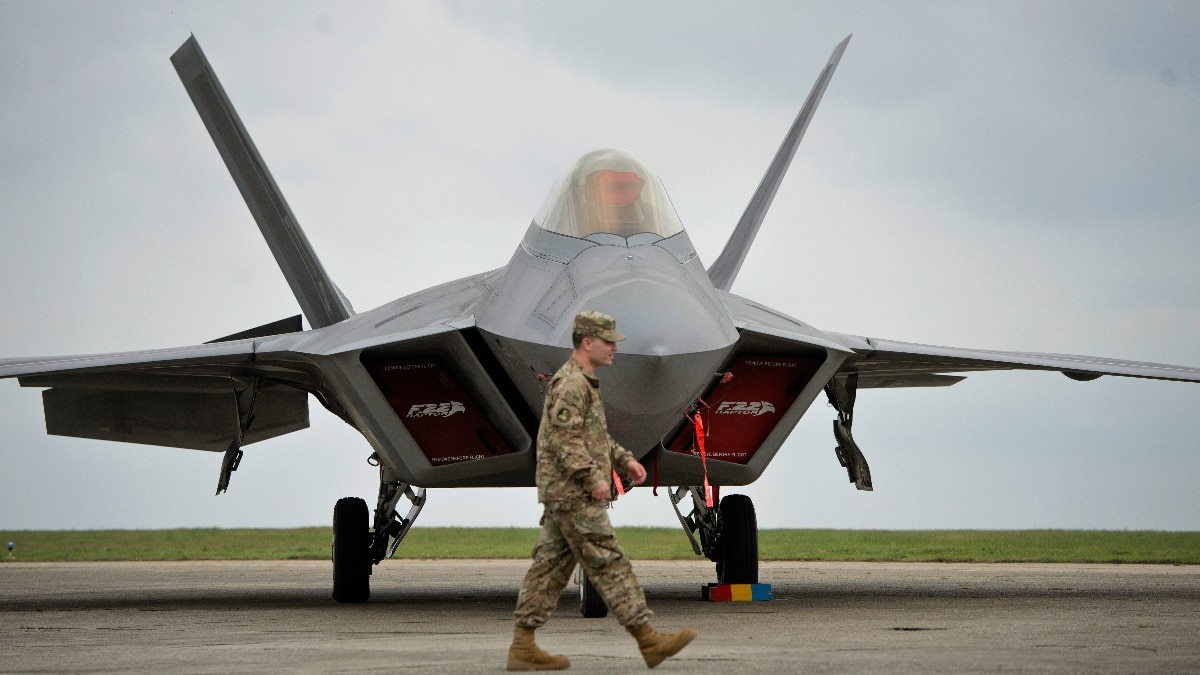
The F-22 Raptor can evade enemy radar and take on some of the world's most advanced fighters. But keeping its mission data systems running means finding memory cards from a bygone technological era.
The US Air Force is now looking for companies that can still supply them.A US Air Force F-22 Raptor fighter jet parked at the Mihail Kogalniceanu air base, near the Black Sea port of Constanta in southeast Romania. The F-22 Raptor is widely regarded as one of the world's most advanced fighter jets.
It can evade radar, supercruise without afterburners, and process an extraordinary amount of information to identify and engage threats. But there is something rather less futuristic about how its pilots load mission information before take-off: a removable flash memory card using a format that belongs to the 1990s.The US Air Force is now looking for American companies that can still supply these ageing storage devices for the F-22.
And it is not even looking for anything particularly large by today's standards. The minimum storage capacity it will accept is just 256 megabytes (MB), less than what a modern smartphone uses to store a handful of photographs.In a notice published on the US government's procurement portal on November 16, the Air Force's F-22 Division invited companies to indicate whether they could supply the memory cards used in the fighter's Data Transfer Cartridge (DTC).
Responses have been sought by December 1, 2026.The requirement offers a glimpse into an often-overlooked challenge of operating advanced military aircraft. The F-22 Raptor belongs to the fifth generation of fighter aircraft, a category characterised by stealth technology, advanced sensors, integrated avionics and the ability to share battlefield information.Developed by US defence manufacturer Lockheed Martin in partnership with Boeing, the twin-engine, single-seat fighter made its maiden flight in 1997 and became operational in 2005.
Unlike the US' other fifth-gen aircraft, the F-35 Lightning II, the F-22 has never been exported, with a US congressional restriction preventing its sale to foreign countries, making it an exclusive asset of the US Air Force.The F-22 has seen combat, making its operational debut in September 2014 when it struck Islamic State targets in Syria as part of the US-led Operation Inherent Resolve. It subsequently carried out close air support missions against IS positions in Iraq and Syria.
In February 2023, an F-22 also shot down a suspected Chinese surveillance balloon off the US coast, marking its first air-to-air kill.The F-22 Raptor was also deployed in Israel amid the US's war with Iran, which was reportedly the first time the US has sent the fifth-generation stealth fighter to the country.WHAT KIND OF MEMORY CARDS DOES THE F-22 USE?First, the F-22 does not use conventional computer processors or modern memory chips. The Air Force is looking for removable flash storage cards, similar in principle to the memory cards once commonly used in digital cameras and older computers.However, the specific formats mentioned in the notice are important.The Air Force is seeking two types of storage devices – Personal Computer (PC) Standard 95 Type II flash cards, and CompactFlash (CF) cards fitted with passive CompactFlash-to-PCMCIA Type II adapters.PCMCIA, short for Personal Computer Memory Card International Association, was a standard used for removable expansion and storage cards in laptops during the 1990s and early 2000s.
Type II cards are 5 mm thick.CompactFlash, meanwhile, was another popular flash memory format, particularly in digital cameras. It was widely used before smaller formats such as SD cards became mainstream.The distinction matters because the US Air Force is not simply asking companies to supply any old memory card.
The devices must fit the F-22's existing equipment and work with its government-provided host system.The official Sources Sought Notice (SSN) states that the requirement is for PC Standard 95 Type II flash advanced technology attachment (ATA) cards and/or CompactFlash cards with passive adapters. It specifies that the cards must have a storage capacity of at least 256 MB and be "readable and writable in a government-furnished host system".In other words, even if a company can manufacture a memory card with several gigabytes of storage, that does not automatically make it suitable for the fighter.
It must be compatible with the aircraft's existing hardware and software.WHAT DOES THE MEMORY CARD ACTUALLY DO IN AN F-22 RAPTOR?The cards are part of the F-22's Data Transfer Cartridge, or DTC, a removable storage device used to transfer mission-related information between ground systems and the aircraft.Before a mission, information such as flight routes, radio settings and threat-related data can be loaded onto the cartridge on the ground. The pilot then uses it in the aircraft to transfer the relevant information to the onboard systems.After the aircraft returns, the cartridge can be removed and used to retrieve flight-related information for analysis and maintenance.Interestingly, the US Air Force says pre-formatting the cards using FAT16, an older file system, is highly preferred.
FAT16 is a file system developed in the 1980s and commonly associated with older storage devices and computing systems.This further underlines the compatibility requirements involved. The objective is not to introduce the latest storage technology but to find something that works reliably with the F-22's existing architecture.NO CONTRACT YET, BUT A GLIMPSE INTO THE F-22'S AGEING SUPPLY CHAINThe document is an SSN, which means the US Air Force is conducting market research to identify companies capable of meeting its requirements.
It is not a formal tender or a commitment to purchase the cards.The official document explicitly states that the US government "does not presently intend to award a contract" and is seeking information for planning purposes. It also says that only US companies will be considered for a potential contract award.Companies have been asked to submit their responses by 1 pm Eastern Standard Time on December 1.Notably, the US Air Force intends to operate the F-22 into the 2030s, making the availability of replacement components and compatible equipment important.For an aircraft designed to dominate the skies of the 21st century, finding a reliable piece of 1990s-era storage technology has become a surprisingly modern maintenance headache.- Ends