


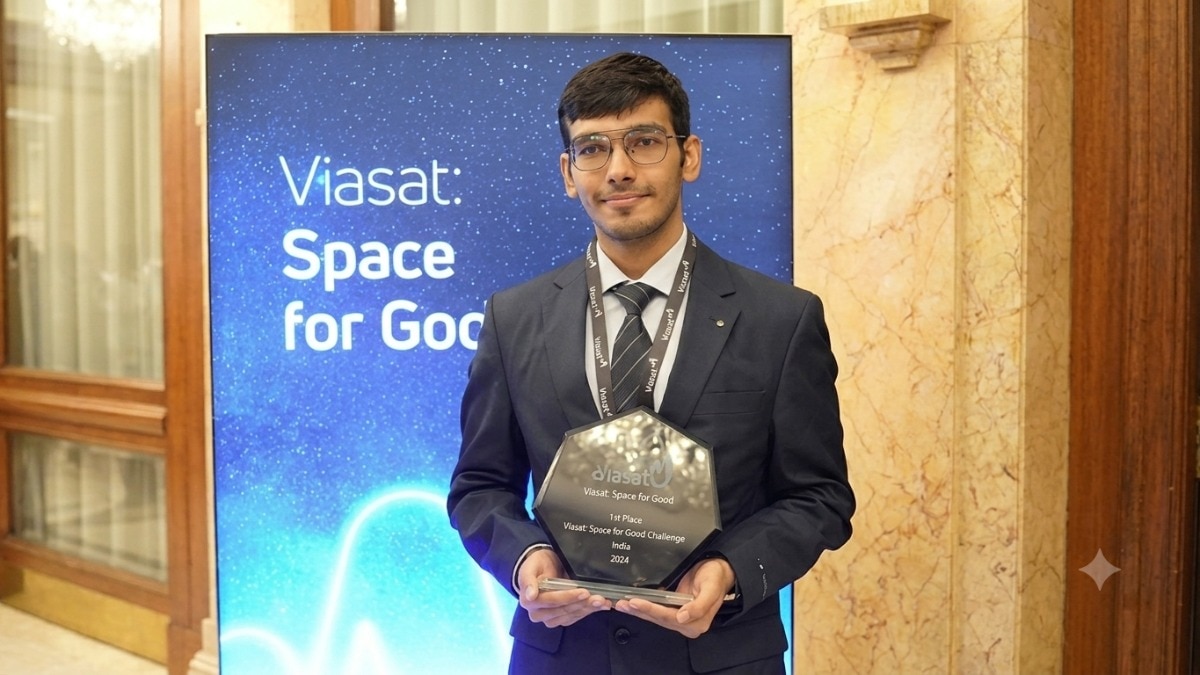
An IIT Kharagpur aerospace engineering student has won Rs 5 lakh for DRISHTI, an AI-based system designed to detect dangerous space debris and calculate satellite avoidance manoeuvres to prevent crashes. Adeetya Uppal's innovation aims to automate collision warnings and protect satellites supporting communication, navigation and disaster response.An IIT Kharagpur aerospace engineering student has won Rs 5 lakh for DRISHTI, an AI-based system designed to detect dangerous space debris and calculate satellite avoidance manoeuvres to prevent crashes.
Thousands of satellites orbit Earth, supporting everything from GPS navigation and communication to weather forecasting and disaster response. But there is a growing problem above our heads: space debris.
A collision with even a small fragment can damage or destroy an operational satellite.An IIT Kharagpur student wants artificial intelligence to help prevent that from happening.Adeetya Uppal, a fourth-year Aerospace Engineering dual-degree student pursuing BTech and MTech, has won the 2026 Viasat: Space for Good India Challenge for developing DRISHTI, an AI-based system designed to detect threatening space debris and help satellites avoid collisions.Originally from Navi Mumbai, Uppal won the competition organised by satellite communications company Viasat in partnership with the Indian National Space Promotion and Authorization Centre (IN-SPACe). He will receive Rs 5 lakh to further develop the idea.
HOW DRISHTI WANTS TO PREVENT SPACE COLLISIONSThe problem DRISHTI addresses is not simply detecting debris. Satellites must also determine whether an approaching object poses a collision risk, calculate an alternative trajectory and execute an avoidance manoeuvre.According to Viasat, conventional collision-warning protocols can take hours for human operators to respond to.
This can mean wasted fuel and increased risks for operational satellites. DRISHTI aims to automate this process.
Its proposed system uses artificial intelligence to monitor potentially dangerous debris, calculate a safe evasion trajectory and transmit avoidance commands through Viasat's satellite network.The company says the concept could reduce response times from hours to seconds, while helping preserve satellite fuel and protect orbital infrastructure.AN IDEA ROOTED IN SPACECRAFT RESEARCHUppal's interest in the problem is linked to his research on autonomous spacecraft proximity operations, Viasat noted in its profile of the six competition finalists.This area of aerospace engineering deals with spacecraft operating close to other objects, including approaching, navigating around and maintaining safe distances from them.The competition also gave him an opportunity to work with industry professionals. Viasat identified Ganesh Ramalingam as his mentor during the challenge.Speaking after his win, Uppal said his fascination with space and his earlier work on space debris led him to explore automated collision avoidance."The Viasat: Space for Good experience was really exciting.
It gave me a fresh perspective on a lot of things, including how to build and present my ideas and how to look at the problems from a different angle," he said.WHAT HAPPENS AFTER THE WIN?The Rs 5 lakh prize is intended to help Uppal develop DRISHTI further and move it towards real-world application.However, several technical details remain unclear. Viasat's public announcement does not specify the datasets used to train or operate the AI system, whether it has been tested against simulated or actual satellite trajectories, or whether a working prototype has been developed.For now, DRISHTI is a promising student-led concept rather than a demonstrated operational collision-avoidance system.
Its next challenge will be showing that it can work reliably under the complex conditions of space.- Ends