


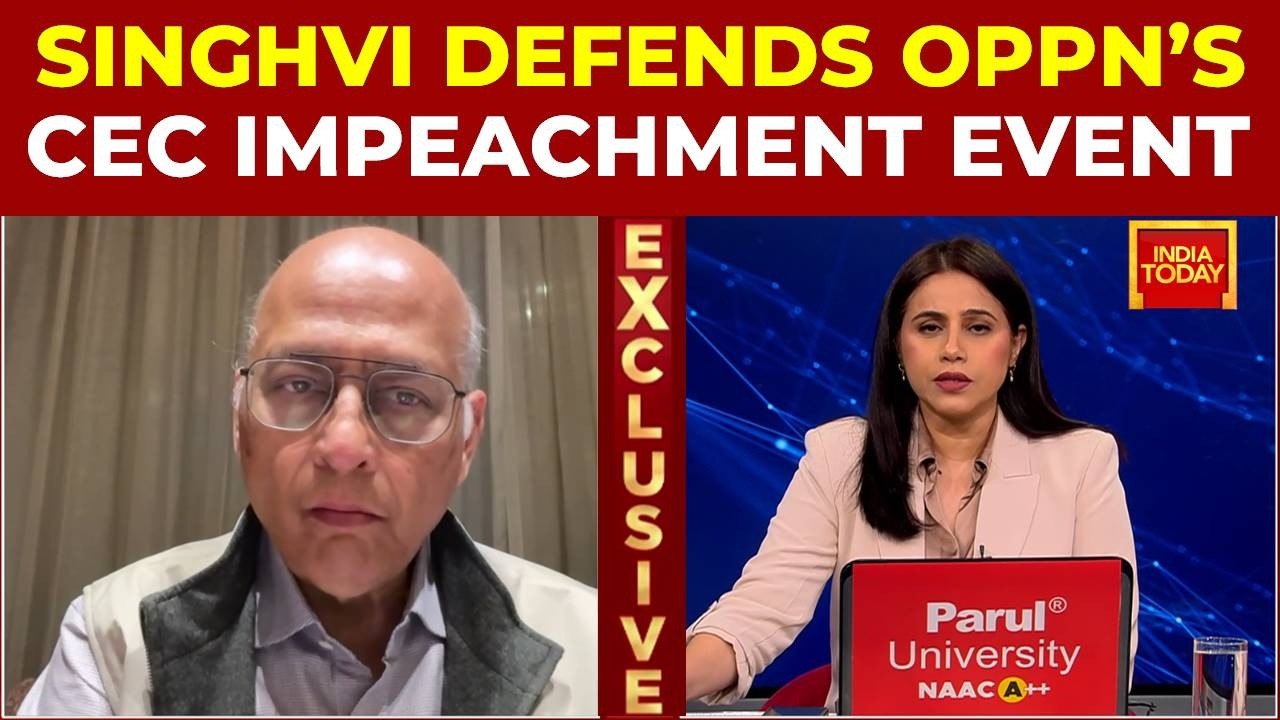
UPDATED: Oct 31, 2026 20:56 ISTSpeaking in an interview, Congress MP and senior advocate Dr. Abhishek Manu Singhvi defended the opposition's mock parliament held to highlight alleged irregularities in the electoral system.
Singhvi stated that the widespread participation across political parties and civil society showed growing public concern. Questioning the functioning of institutions, he argued that genuine grievances are not given adequate discussion time in Parliament.
Critiquing the Election Commission of India's affidavit, Singhvi asserted that the document 'conceals more than it reveals' and contains implied admissions through evasive responses regarding procedural authorizations and resolutions. Addressing legal avenues, Singhvi noted that legal processes face structural limitations and delays, emphasizing that sustained public and political movements remain paramount alongside constitutional challenges.
Read MoreVIDEOS FROM OTHER SECTIONSLATEST VIDEOSPM Modi: 'Country Has Broken the Back of Naxalism, Not a Single Affected District Left'Addressing the nation at the Statue of Unity in Ekta Nagar on the occasion of Rashtriya Ekta Diwas, marking the 151st birth anniversary of Sardar Vallabhbhai Patel, Prime Minister Narendra Modi declared that India has achieved its pledge to eliminate Naxalism and Maoist terror. Modi recalled his vow made during Patel's 150th birth anniversary and noted that while 126 districts were affected by Left-Wing Extremism in 2015, by March 2026, no district remains impacted.
He stated that formerly affected regions are now integrating into mainstream development with expanding roads, mobile connectivity, schools, and healthcare facilities. Welcoming families from Naxal-affected areas who attended as special guests, he paid homage to security forces who sacrificed their lives.
Modi emphasized that Sardar Patel forged modern India by integrating over 550 princely states and reviving cultural pride through the Somnath Temple. He urged citizens to recognise that India's diversity is the true foundation of national unity.Ekta Divas: CRPF, SSB All-Women Daredevil Formations Stun At Ekta NagarCelebrations for National Unity Day, or Rashtriya Ekta Divas, took place at Ekta Nagar in Gujarat, featuring a parade by paramilitary and police forces alongside cultural events.
A nationwide motorcycle rally covering 14,165 kilometres culminated at the venue, carrying messages of unity and a drug-free India. The event showcased daredevil bike formations by CRPF and SSB personnel, including prominent all-women formations such as Surakshit Bharat, Jungle Yoddha, and Naxalmukht Bharat missions, concluding with a flag march by 36 female riders across nine motorcycles.Patel on Princely States: 'With Their Help, Unity Achieved Was Unprecedented in Hundreds of Years'A recorded address by Sardar Vallabhbhai Patel reflects on the integration and unity of independent India.
Sardar Patel notes that after the departure of sovereign British rule, concerns arose over whether the nation would remain united or fracture. He commends the rulers of the princely states for demonstrating patriotism and backing the Indian government, stating that their cooperation fostered an unprecedented level of unity unseen in hundreds of years.
Sardar Patel stresses that if India continues on its assigned duty and follows the path shown by Mahatma Gandhi, the country will attain a revered and rightful standing across the globe.INDIA Bloc Public Impeachment: Mock Motion Passed Against Gyanesh Kumar at Kharge ResidenceThe opposition INDIA bloc convened a symbolic public impeachment proceeding against Gyanesh Kumar on the lawns of Congress President Mallikarjun Kharge's residence. The mock session, modelled on parliamentary procedures, saw the introduction of a resolution moved by Mallikarjun Kharge.
Leader of the Opposition in the Lok Sabha Rahul Gandhi delivered the concluding address, expressing strong backing for the measure and calling for Gyanesh Kumar to face trial in a court of law. Addressing attendees and viewers across the country, speakers characterised the initiative as a defence of the Constitution and the collective voice of the people, asserting that institutional barriers prevented these concerns from being voiced inside Parliament.
The symbolic proceedings concluded with the formal adoption of the resolution through a show of hands by participating opposition leaders.