


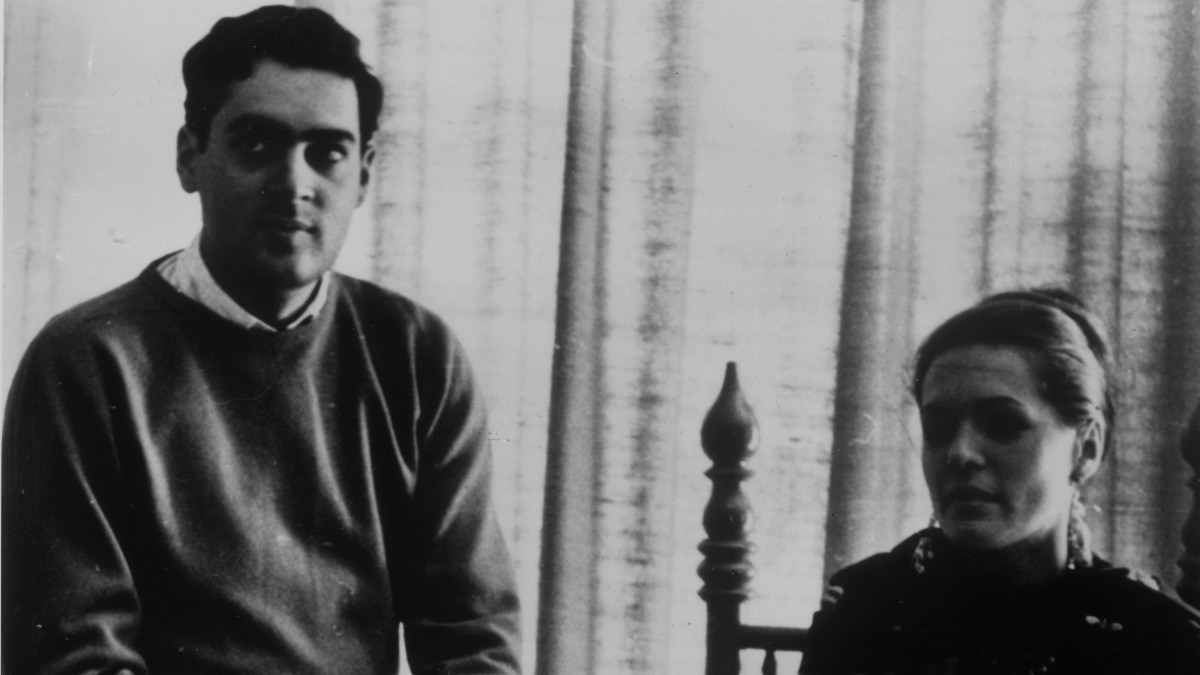
Sonia Gandhi recalls how a London dinner with Rajiv introduced her to tandoori chicken. The excerpt in her book Belonging: A Journey of Love reveals how an initially daunting cuisine gradually became a favourite.A old photo of Rajiv and Sonia Gandhi.
Sonia Gandhi's first encounters with Indian food were far from pleasant. The smell of spices was something she actively avoided, and an Indian restaurant was hardly where she would have chosen to spend an evening.
But things began to change after she met Rajiv Gandhi, who introduced her to a cuisine that would eventually become a favourite.In her newly released autobiography, Belonging: A Journey of Love, Sonia Gandhi looks back at her early relationship with the former prime minister, their courtship in London and an evening at an Indian restaurant that left a lasting impression on her. What began as a dinner with family friends turned out to be one of her first memorable encounters with North Indian food, particularly tandoori chicken.The evening also came at a time when Rajiv's relationship with Sonia was becoming serious.
In March, he had written to his mother, Indira Gandhi, sharing the news that he had met a girl whom he believed was "very special". The following month, he told her that he was quite sure he was in love.Indira, however, was concerned.
She felt her son had barely met the young woman and wondered whether she would be able to adjust to a life so different from the one she had known, and so far away from home. She also cautioned him that the first girl he met was not necessarily the right one.
Rajiv's response was to question how one could know whether someone more "right" would come along. Sonia was the girl he wanted to marry.
With few people she could trust with such a delicate matter, Indira eventually confided in old family friends P. N.
Haksar, India's Deputy High Commissioner in London at the time, and his wife. The Haksars knew Rajiv and were fond of him.
In March, they invited the couple to their official residence, Sun House, in Hampstead.After the initial introductions and small talk, the Haksars took them out for a meal at an Indian restaurant. Sonia suspected that she was being assessed as a potential match for Rajiv and admits that she ‘was on edge throughout the evening’.
But there was another reason she was uncomfortable. "I disliked the alien smell of spices," she writes.Recalling her experience, she writes, "In Cambridge I would hold my breath and walk fast each time I passed by the East Pakistani restaurant on the main street. That was the very smell that hit me as we entered the restaurant with the Haksars."Things did not get much easier when she was handed the menu and asked to choose something.
Sonia recalls that she simply stared at it "in bewilderment" until Rajiv came to her rescue.Soon, a bright red, slightly charred piece of chicken was placed in front of her. It was tandoori chicken, a North Indian speciality.
Her first taste was quite an experience. "One bite, and my mouth was on fire!" she writes.Little did she know that the same dish would become one of her favourites not long afterwards. Rajiv began taking her to a little restaurant on Charlotte Street in London that served different North-Western Indian dishes cooked in a tandoor.
It was there that she gradually developed a liking for the food she had initially found so unfamiliar.The Haksars' dinner had also introduced her to another Indian preparation, although that was a rather different experience. The only item that vaguely resembled something familiar to her came at the end of the meal, alongside kulfi.Sonia describes kulfi as "a terribly sweet half-frozen milky concoction" and recalls being served falooda with it.
She compared the vermicelli-like strands to spaghettini, though they were "transparent, viscous, and tasteless". At least, as she points out, "my mouth was not ablaze".If anything, Belonging: A Journey of Love offers a glimpse into Sonia Gandhi's life beyond politics.
It allows readers to see the person behind the public persona, offering a more intimate picture of who she was and who she is beyond the political figure we have come to know.- Ends