


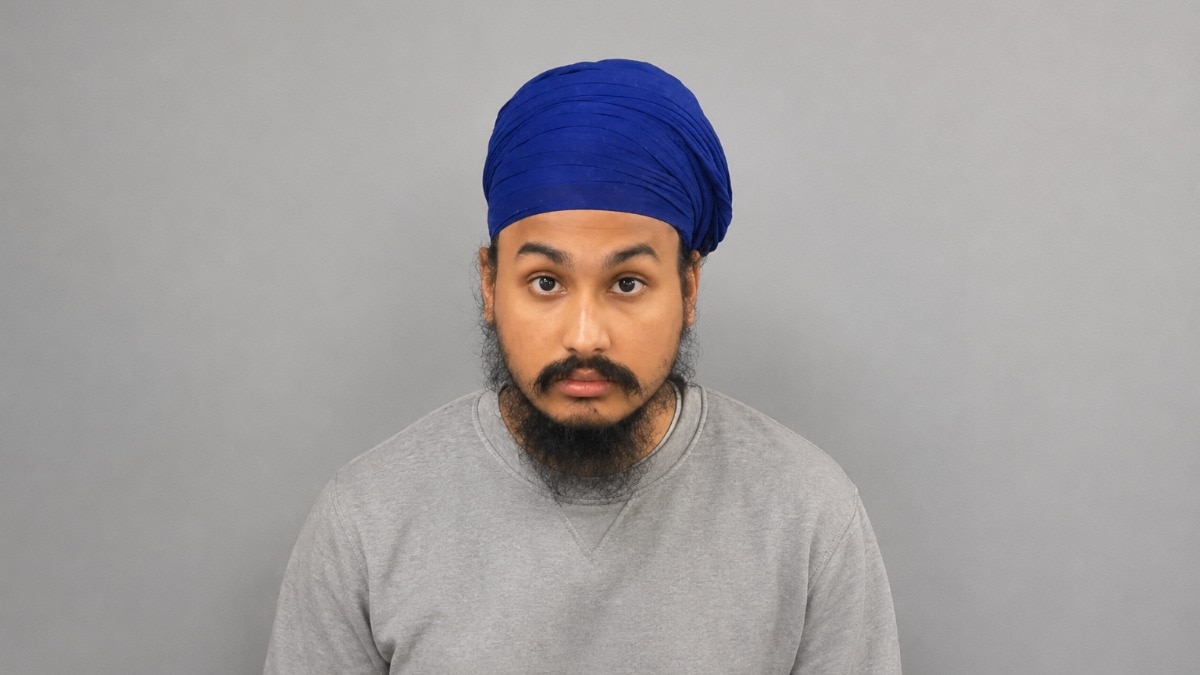
Vickrum Singh Digwa has applied to challenge his murder conviction and increased minimum prison term. The applications do not automatically mean that he will receive further hearings or that either court will agree to reconsider his case.Vickrum Digwa is challenging both his murder conviction and the decision to increase his minimum prison term. (File Photo)Vickrum Singh Digwa, who is serving a life sentence for murdering 18-year-old Henry Nowak in Southampton in December 2025, is seeking to overturn his conviction on four grounds.
His lawyers have also approached the Supreme Court seeking a review of the decision to increase his minimum jail term from 21 to 25 years.According to the BBC, Digwa is challenging both his murder conviction and the decision to increase his minimum prison term, with his lawyers, Imran Khan and Partners, pursuing separate applications for each."An application has been lodged seeking to appeal against Vickrum Singh Digwa's conviction. That application concerns the safety of the conviction and is separate from the proceedings concerning sentence."The applications do not automatically mean that Digwa will receive further hearings or that either court will agree to reconsider his case.
WHY DIGWA WANTS TO CHALLENGE HIS CONVICTIONOne of the central arguments Digwa intends to raise concerns WhatsApp messages recovered from Nowak's phone. The messages, sent when Nowak was around 13, were allegedly found during a police examination of his phone.
Digwa's defence suggested that they showed a history of racist language and should have been considered during his trial.However, the trial judge ruled that the messages were irrelevant to the case and could not be admitted as evidence. Digwa is also challenging the use of a secretly recorded confession in which he admitted stabbing Nowak.
He argues that the recording should not have been presented to the jury because it breached rules governing the admissibility of such evidence. The arguments form part of his attempt to establish that his murder conviction is unsafe.WHAT HAPPENED TO HENRY NOWAK?Nowak, who was from Chafford Hundred in Essex, was stabbed to death on Belmont Road in Southampton on December 3, 2025.
Digwa, who was 22 at the time, attacked the teenager with a 21cm (8-inch) kirpan, a religious blade that he said he carried as part of his Sikh faith.During police questioning, Digwa claimed that Nowak had attacked and racially abused him. Nowak was handcuffed while lying critically injured and dying.
However, the trial judge subsequently rejected Digwa's account of racial abuse, finding that his claims were lies. The court heard no evidence that Nowak was racist.Digwa was convicted of murder and sentenced to life imprisonment at Southampton Crown Court in June, with a minimum term of 21 years before he could be considered for release.WHY HIS MINIMUM PRISON TERM WAS INCREASEDThis follows a decision by the Court of Appeal earlier this month to increase Digwa's minimum prison term from 21 to 25 years after the Attorney General argued that the original sentence was too lenient.
On November 5, the court upheld the trial judge's decision to use 15 years as the starting point for calculating the minimum term. This was because there was no evidence that Digwa had taken the kirpan to the scene intending to use it as a weapon.Had the court established that he had deliberately brought the blade for use in an attack, the starting point under sentencing guidelines would have been 25 years.
However, Chief Justice Baroness Carr, sitting with two other senior judges, ruled that the final minimum term of 21 years did not adequately reflect the seriousness of the killing.The judges pointed to Digwa's repeated use of the blade and what they described as the "deliberate cruelty, additional suffering and obstruction" that followed the stabbing.They ordered "a very significant uplift ... to reflect the use of the large kirpan alone", raising the minimum term to 25 years.Digwa's legal team is also seeking a Supreme Court review of how the Court of Appeal arrived at the revised sentence. The UK Supreme Court does not routinely reconsider criminal convictions or sentences.
It generally takes up cases where there is a disputed point of law that has implications beyond the individual case.- Ends