


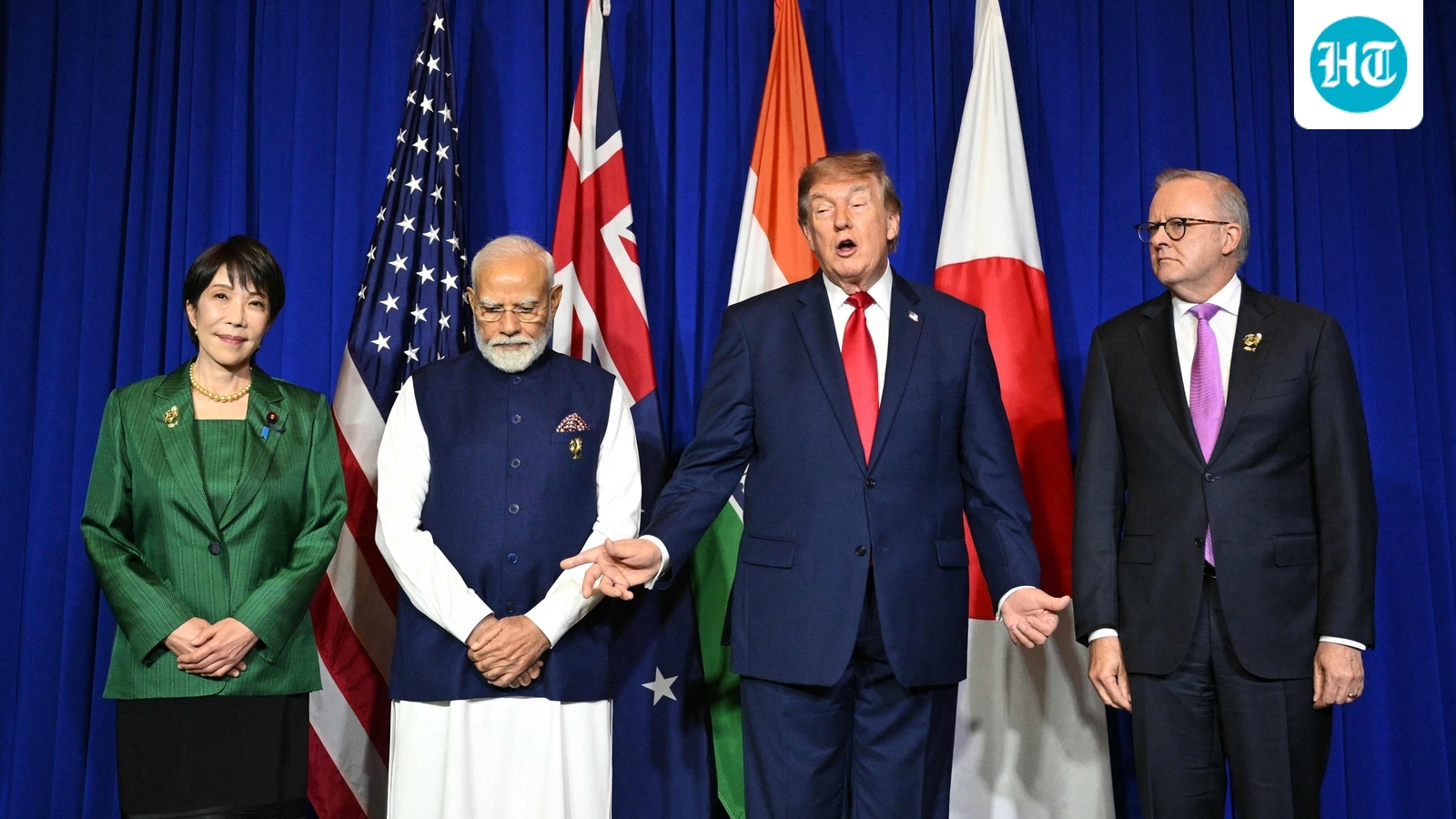
The leaders of the four Quad nations met in Manila on Tuesday for the first time in more than two years, reiterating their commitment to a free and open Indo-Pacific and unveiling new initiatives meant to bolster maritime surveillance, trade and connectivity across the region.Japan's Prime Minister Sanae Takaichi, India's Prime Minister Narendra Modi, US President Donald Trump and Australia's Prime Minister Anthony Albanese in Manila. (AFP)Prime Minister Narendra Modi joined US President Donald Trump, Australian Prime Minister Anthony Albanese and Japanese Prime Minister Sanae Takaichi for the Quad Leaders Summit, which – without naming China – opposed unilateral actions to alter the status quo by force or coercion and expressed concern over economic coercion, including arbitrary export restrictions.ALSO READ: 'He's a very tough man and a great leader’: Trump praises Modi during Quad Summit meetThis was Trump’s first Quad Summit and came ahead of his participation in a meeting of the Asia Pacific Economic Cooperation (APEC) forum to be hosted by China's President Xi Jinping, who has objected to the Quad as an effort to encircle Beijing, and a trilateral meeting of the leaders of China, Russia and the US on Thursday.“For India, the Quad is a constructive and trusted partnership. From maritime security to trusted supply chains, new technologies and disaster response, our endeavour is to ensure that the Quad delivers trusted solutions to the entire Indo-Pacific,” Modi said in his opening remarks at the meeting.Modi announced Mumbai will host the inaugural Quad Business Leaders Forum in early 2027, while Trump said the grouping will conduct its first military exercise with maritime patrol aircraft to “protect peace through strength”.“As four major market economies, we have a shared responsibility to create greater trade opportunities and build stronger supply chains.
To turn our strategic cooperation into commercial partnerships, India has announced the Quad Business Leaders Forum,” Modi said.The forum will gather business leaders, government officials and policy experts to foster greater business ties across private sectors, including the promotion of commercial deals and partnerships, a joint press release said.“If Australia's mining experience, Japan's recycling technology, America's expertise and India's manufacturing base come together, they could provide new strength to supply chains,” Modi added.The Indo-Pacific Maritime Surveillance Collaboration, which takes forward the Quad’s earlier maritime domain awareness initiative, is meant to enhance information-sharing and maritime awareness. The P-8 and P-3 maritime patrol aircraft of the four countries will join “a maritime exercise for the first time in a Quad context, making our seas safer”, the release said.This exercise will be conducted on the sidelines of Exercise Sea Dragon in Guam in March 2027 to address shared challenges such as illegal fishing and trafficking, foreign secretary Vikram Misri said.The four leaders also announced an expansion of the Quad Partnership for Cable Connectivity and Resilience, currently focused on the safety of telecommunications cables. “This will now expand to undersea energy cables as well,” Misri said, referring to Australia’s contribution focused on electricity cables to strengthen regional energy security.The four countries also welcomed upcoming undersea cable projects in the Indian Ocean intended to strengthen regional connectivity.The Quad acknowledged a “rapid increase in the number and scale of cyber incidents” in the region and announced enhanced cybersecurity cooperation between the four countries to “achieve an open and secure cyberspace”.The Quad nations said in the joint press release that the grouping is a “force for good and a partnership of action, committed to peace, stability, and prosperity”, while strongly opposing “any destabilising or unilateral actions that seek to change the status quo, including by force or coercion, which escalate tensions and undermine regional peace and stability”.This was an apparent reference to China's assertive actions in the South China Sea, where it is engaged in territorial disputes with several Asean states.The Quad expressed “grave concerns about economic coercion, including through arbitrary export restrictions” – again, an apparent reference to China's restrictions on the export of crucial commodities such as rare earths and fertilisers.The Quad nations said they are securing critical supply chains, protecting freedom of navigation and overflight, driving growth through future technologies, including investments in trusted Artificial Intelligence (AI), and responding to disasters with life-saving assistance. “We commit to work together to ensure open, safe, and resilient maritime transit corridors in the Indo-Pacific,” the press release added.Modi noted that the Quad's maritime domain awareness partnership has already created a real-time data sharing mechanism that is used to address illegal fishing and illicit activities in the Indo-Pacific, and said the grouping should aim to promote peace and prosperity, economic and technological resilience, and delivery of public goods.“Safeguarding maritime security begins with ensuring the safety of the seafarers who keep it moving,” Modi said. “Therefore, we must work together to establish a robust international framework for the safety of seafarers.
In this regard, India has proposed the Quad Sea Lanes Safety Initiative.”Democracies should play a leading role in developing emerging technologies and setting standards for them to ensure they become “instruments of freedom and development”, he added.This was the seventh Quad Summit and the first to be held outside the member countries. However, Manila has a special connection with Quad – it was in the Philippines capital that officials of the grouping first met in 2007, and activities of the grouping were subsequently revived after a hiatus at a meeting held in the city in 2017.The Quad reiterated it will work with regional partners to tackle shared challenges and drive opportunities to deliver benefits to the Indo-Pacific, and emphasised the importance of the AI Accelerator, announced at a recent Quad foreign ministers’ meeting in Atlanta to coordinate and fund efforts to support trusted AI access, deployment and technical assistance.The four countries also unequivocally condemned all forms of terrorism and violent extremism, including cross-border terrorism, and said they are committed to strengthening Quad’s ongoing cooperation on counter-terrorism.While India struggled to convene a Quad Leaders’ Summit last year mainly because of uncertainty over Trump’s travel plans amid widespread bilateral differences over trade issues, the US President said the grouping’s members are the “four corners of a free, open, stable and prosperous Indo-Pacific”, and his “phone…and the Oval Office is always open to you”.Trump added, “We have outstanding relationships and coordinate closely on matters of regional security, economic security and diplomacy, and we talk quite often.
The three countries that we deal with, we talk a lot when they have a problem, when they have difficulty, when they want to tell me something.”The Quad states have also made several important critical mineral deals to secure supply chains and “ensure that none of our nations is vulnerable to coercion by any single foreign supplier”, Trump said. He said initiatives by the Quad states on rare earths and other issues “over the next 12 months…will very much surprise people”.Takaichi said the Quad will work with regional partners to shape a free and open Indo-Pacific by strengthening the resilience of countries and promoting their freedom to decide for themselves in a wide range of areas, including maritime security, economic security, energy and emerging technologies.
Albanese said the Quad has a critical role in achieving the common objective of a peaceful, secure, stable and prosperous Indo-Pacific, which in turn will make the world a safer and more secure place.However, former US deputy secretary of state Kurt Campbell said the Quad had lost ambition under Trump, and credited secretary of state Marco Rubio with the reconvening of the grouping. “Part of what [Rubio] is thinking is that this is probably the best possible signal if you're going to go into a trilateral meeting,” Campbell said, referring to Thursday's US-China-Russia talks.The short time allotted for Tuesday's meeting meant it was unlikely to extend beyond pleasantries, Ryan Hass of the Brookings Institution told AFP. “It's a way of inoculating Trump against criticism of caving to authoritarians when he meets with [Chinese President Xi Jinping and Russian President Vladimir Putin] in Shenzhen,” Hass said.