


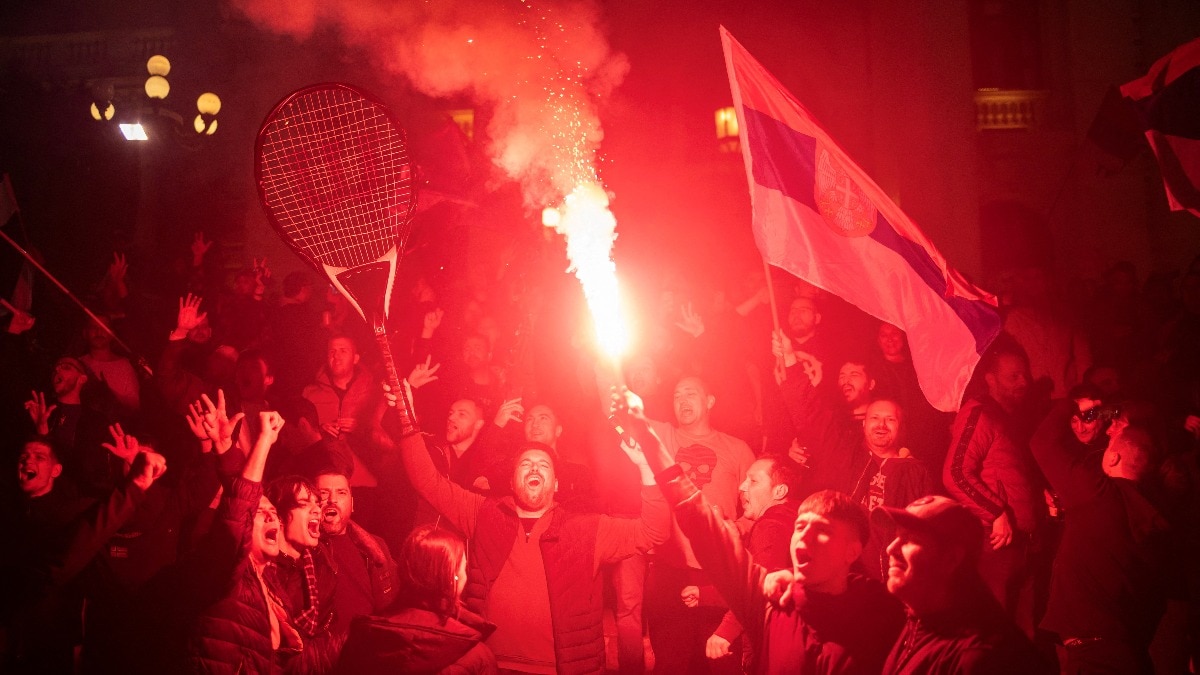
For the last two years, they occupied universities, filled city squares and challenged Serbia’s most powerful political establishment. Now, a movement that began with students demanding accountability for a deadly railway station collapse, has scored a major electoral victory over the ruling establishment all without a single student contesting the election.The name of the projected winning party is the Student List.
But the people preparing to take seats as its representatives in Serbia’s parliament are not students.They include a 56-year-old cardiologist, a former central bank governor, a celebrated basketball player, an actor, an opera singer and professionals from several other fields. United and backed by a movement born on university campuses, they are now expected to carry the core anti-corruption demands into the country’s political institutions.But students or not, the projected victory of the Student List will undoubtedly be watched by a world that has seen students' anger over issues ranging from corruption and civic development to education and job security, spill out on to the streets.
In Serbia, that anger now appears poised to translate into parliamentary power, with a student-backed movement taking its demands from the streets to the seats of government.THE STUDENT LISTThe Student List, registered as Studentska lista, secured around 52% of the vote and a projected 138 seats in the 250-member parliament, according to the first Ipsos/CeSID projection broadcast by N1 on October 25, 2026. The alliance led by Aleksandar Vucic’s Serbian Progressive Party (SNS) received 39.3% and was projected to win 104 seats.
Official results from the Republic Electoral Commission are awaited. (Credits: Reuters) The result marks a major challenge to Vucic’s political dominance.It also presents an unusual experiment: a movement driven by students has entrusted its electoral success to people from outside student politics, deliberately keeping the student organisers off the ballot.So, who are the people behind the Student List, and how did a movement without student candidates become Serbia’s biggest projected electoral force?ILIJA SRDANOVIC: THE CARDIOLOGIST AT THE TOP OF THE LISTAt the top of the Student List’s candidate slate is 56-year-old Ilija Srdanovic, a cardiologist and professor based in Novi Sad. His professional background reflects the movement’s decision to turn to established figures from society rather than produce a conventional slate of student politicians.Srdanovic became one of the movement’s most visible representatives as it evolved from campus blockades into a nationwide political campaign.
Ilija Srdanovic. (Credits: Reuters) Ahead of the election, he described its energy as unstoppable.In comments reported by the BBC, Srdanovic said the list sought to restore the core values of a democratic society that citizens had lost under the previous political establishment.But his position at the top of the candidate list does not automatically make him the movement’s choice for prime minister.The Student List has not named a candidate for the post, stressing that the list is a collective effort rather than a vehicle for one individual’s political ambitions.Srdanovic’s role captures the distinction at the heart of the movement: students created the political platform, while professionals such as him are expected to represent it within parliament.DEJAN SOSKIC: THE FORMER CENTRAL BANK GOVERNORAnother prominent name on the list is Dejan Soskic, an economist who previously served as governor of the National Bank of Serbia.Ranked 27th on the slate, he brings experience in monetary policy and economic governance to a movement seeking to reshape the country’s institutions. Dejan Soskic. (Credits: Reuters) Soskic’s name has been mentioned in discussions about who could take on a senior government position, including the prime minister’s post.
However, the Student List has not announced a formal choice.His background could become particularly relevant as the movement pursues proposals on public finances, state-owned enterprises and the appointment of officials.The list has pledged to curb political influence over public institutions and prevent ruling-party loyalists from securing senior positions in state-run companies.Soskic’s inclusion also illustrates how the movement has sought to broaden its appeal beyond young protesters, drawing on established expertise to turn its demands into policies.DEJAN BODIROGA, TIHOMIR STANIC AND OTHER FACESThe Student List’s candidates also include prominent figures from sport and the arts, giving the movement a public profile that extends well beyond university campuses.Former basketball star Dejan Bodiroga, ranked 24th on the list, is among the familiar faces expected to enter parliament if the preliminary projections hold. Dejan Bodiroga. (Credits: Reuters) Renowned actor Tihomir Stanic, ranked eighth, is another prominent candidate.
Tihomir Stanic. (Credits: Instagram/Tihomir Stanic) Opera singer Nikola Mikic, ranked 46th, also features on the slate.Their inclusion reflects the movement’s attempt to bring together people with different professional experiences under a common political programme.Rather than relying on established party leaders, the students selected candidates whom they believed could represent their demands inside public institutions.The list also includes professors, doctors, farmers, activists and other professionals.The students have said the candidates emerged from their assemblies, known as plenums, rather than from traditional party negotiations.The distinction is important: the candidates come from different backgrounds, but their political mandate is tied to a movement that has sought to keep leadership collective and accountable to its original demands.STUDENT PROTESTS SPREAD ACROSS EUROPESerbia’s student-led movement can be seen to be a part of a wider wave of youth mobilisation across Europe, where students are taking to the streets over education funding, rising living costs, housing shortages and government accountability.In France, school blockades and demonstrations have spread nationwide over teacher shortages, overcrowded classrooms and poor school infrastructure. Protests in France (Credits: Reuters) Students in Belgium and Italy have also protested against education funding cuts and deteriorating facilities, while demonstrations in Ireland have focused on university fees and affordable accommodation.The European Students’ Union recorded 54 student protest actions across 22 countries between March and May 2026, highlighting the geographical spread of the unrest.
Europe rocked with student protests (Credits: Reuters) However, the protests are not part of a single coordinated movement.Their demands vary by country, ranging from better access to education and improved living conditions to opposition to corruption and concerns over democratic governance.WHY IS IT CALLED THE STUDENT LIST IF NO STUDENTS ARE CONTESTING?The answer lies in how the movement was formed and how it chose to enter electoral politics.The movement began after a concrete canopy at the renovated railway station in Novi Sad collapsed on November 1, 2024, killing 16 people.The disaster triggered widespread anger, with critics linking the reconstruction project to corruption and negligence. (Credits: Reuters) On November 22, students at Belgrade’s Faculty of Dramatic Arts were attacked during a silent vigil for the victims.They responded by occupying their faculty, and blockades soon spread to universities across Serbia.The protests initially focused on demands for accountability.Students wanted the publication of documents relating to the station’s reconstruction, action against those who attacked protesters, the withdrawal of charges against arrested demonstrators and a 20% increase in higher-education funding.As the movement expanded, students organised through plenums - open assemblies where participants could speak and vote.Representatives rotated regularly, helping prevent the movement from becoming dependent on a single leader or a small group of public figures.The protests grew beyond university campuses, attracting support from farmers, artists, professionals and other sections of society. (Credits: Reuters) A rally in Belgrade on March 15, 2025, drew an estimated 275,000 to 325,000 people, according to the independent Archive of Public Gatherings. The interior ministry put the peak attendance at 107,000.By May 2025, the students were calling for a snap election.They subsequently developed a political programme and rules for selecting candidates.Those rules excluded students, as well as people who had previously belonged to the ruling coalition or held official positions in the parliamentary opposition.The decision meant that the movement would not simply turn its student organisers into politicians.Instead, it would select people from wider Serbian society to take its demands into parliament.The Student List’s name therefore reflects the force behind the movement, not the professional backgrounds of its candidates. (Credits: Reuters) WHAT DOES THE STUDENT LIST WANT TO CHANGE?The movement’s programme centres on fighting corruption, strengthening the independence of the judiciary and prosecution, improving public services and reducing political influence over state institutions.Its proposals include stricter public procurement rules, independent reviews of major construction projects, reforms to the public broadcaster and measures to prevent political loyalists from being appointed to lead public enterprises.It has also promised improvements in education, healthcare and agriculture, along with a higher minimum wage.On foreign policy, the list has emphasised Serbian sovereignty, territorial integrity and military neutrality, while providing fewer details about its approach to the European Union.These proposals will now have to be taken up by the elected representatives - the doctors, economists, artists and other professionals selected to carry the students’ demands into the legislature.CAN A STUDENT-LED MOVEMENT GOVERN THROUGH NON-STUDENT POLITICIANS?The Student List’s projected victory is only the first stage of a much larger challenge.
It must now turn a protest movement into a functioning parliamentary force and demonstrate that its chosen representatives can deliver the changes promised during the campaign.The students have said their elected candidates are expected to transfer the struggle from the streets into public institutions. (Credits: Reuters) But questions remain over who will lead the government, how the MPs will coordinate their work and how the movement will hold them accountable to its programme.Vucic, who resigned as president on September 27 to run for prime minister, conceded defeat after the preliminary projection emerged.He has previously portrayed the protests as a foreign-backed attempt to destabilise Serbia, a claim rejected by the student movement.The final results and subsequent negotiations will determine the composition of the new government.Serbia’s parliament must convene within 30 days of the official results, and a government must be elected within 90 days or parliament faces dissolution.For the students who launched the movement, the task now is to ensure that their demands survive the transition from protest to politics.For the candidates they selected, the challenge is to prove that people drawn from different parts of society can work together to reform the institutions they were elected to change. (Credits: Reuters) The Student List may have no students on its candidate slate, but its political identity rests on the movement that gave it its name.Whether that identity can hold together a diverse group of parliamentarians - and translate public anger into lasting reform - will determine what comes next for Serbia.- Ends