


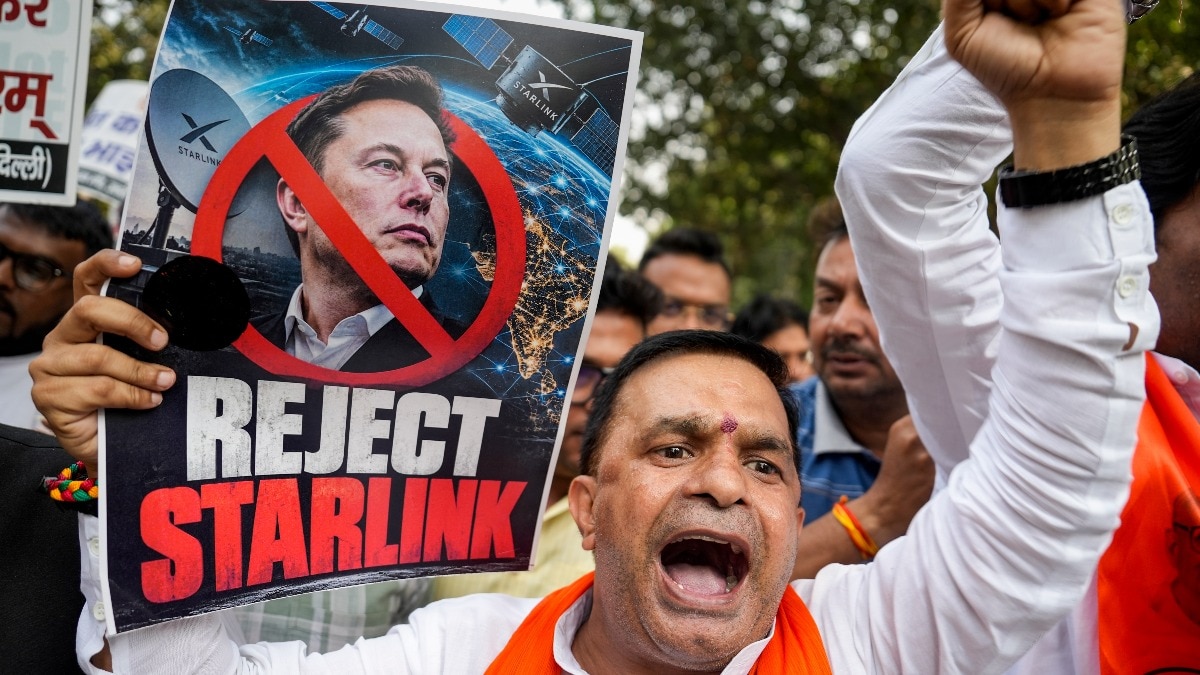
Tesla and Starlink boss Elon Musk has picked the wrong moment to lecture India. On October 7, the world's richest man accused unnamed Indian "oligarchs" of blocking Starlink to protect their "monopolistic chokehold" over the market, calling it a "crime against the people of India".
A day later, he named Mukesh Ambani, asking on X, "Is Ambani the real boss of India?"The bigger story, however, might go beyond the rivalry between Musk and Ambani. While the timing of Musk's tweets, just days before Reliance Jio's much-anticipated IPO, fuelled allegations that he was trying to sabotage the IPO, journalist and columnist Fareed Zakaria argued that Musk might have misread a larger shift — the growing distrust of America.
The Indian-American journalist said that the distrust was driven in part by doubts over Washington's security commitments and President Donald Trump's outreach to Pakistan's military chief, Field Marshal Asim Munir.On his CNN weekly international-affairs show Fareed Zakaria GPS (which stands for Global Public Square), he argued that Musk misread the mood in India, where trust in the United States is seemingly weakening. "Musk did not understand that in India, as in much of the world, trust in America is collapsing," Zakaria said.On October 10, Musk argued that Starlink would have to keep its prices affordable to attract Indian customers. "Obviously, if Starlink is too expensive in India, no one will buy it, so SpaceX will need to make pricing affordable," he wrote on X. He added that competition would benefit ordinary Indians by giving them more choices, even if it meant lower profits for Ambani.
The Indian government had rejected Musk's allegations two days earlier.In a statement on October 8, the Ministry of Communications said it had a "fair and non-discriminatory authorisation framework" for satellite communications. It added that security assessments were underway for all three licensed operators, Starlink, Reliance Jio and Bharti Airtel-backed Eutelsat OneWeb.
The ministry called the suggestion that the framework or its application was unfair or discriminatory "baseless and misconceived".MUSK'S ATTACKS TIMED WITH JIO IPO, ALLEGE MANY The timing of Musk's public attacks on Ambani — coming just days before Jio Platforms' IPO targeting a valuation of around $106–108 billion — prompted widespread speculation that the remarks were intended to dent confidence in the offering at a critical moment.Many users explicitly framed the attacks this way. One observer wrote that "Elon Musk was attacking Mukesh Ambani to Hammer the JIO IPO, direct competition to Starlink." Another asked, "Elon trying to target reliance right before JIO's IPO.
Attempting to hamper something?" A third questioned whether the comments were "an attempt to pushing away foreign investors and retail investors participation in IPO," while others called the timing "fishy".Similar posts described the barrage as an effort to "sabotage the Jio IPO" or create negative sentiment ahead of the roadshow and subscription window.News coverage also repeatedly highlighted the proximity to the IPO, reinforcing the perception that the tweets risked influencing investor psychology even if no causal link was proven. Reliance later welcomed competition and noted that its own satellite plans faced the same clearances as Starlink, while the IPO ultimately drew strong demand.TRUST IN US IS DISAPPEARING: FAREED ZAKARIAFor Fareed Zakaria, however, the controversy was beyond a clash between two billionaires, reflecting a wider loss of confidence in American power and the people who control it."American power was formidable, but American trust was priceless.
That trust is disappearing," he said on his show.Analysts had already flagged the erosion of trust in the India-US relationship well before Musk's October comments. In July 2025, foreign-policy commentator and partner at The Asia Group, Ashok Malik, observed that the partnership was "in its toughest spot since the mid-1990s", adding that "trust has diminished", and that President Trump's messaging had "damaged many years of careful, bipartisan nurturing of the US-India partnership in both capitals".Nearly a year later, in June 2026, former Indian Foreign Secretary Nirupama Menon Rao pointed to a series of accumulating signals — including Trump's remarks, cooler G7 optics, and Prime Minister Modi's public emphasis on a global "shortage of trust" — and concluded that "the exuberant phase of India-US relations may be ending".
The relationship, she wrote, was becoming "more normal, more transactional, and perhaps more difficult".These earlier assessments suggest that Musk's spat with Ambani played out at a time when trust in America was already wearing thin.TRUMP'S PROXIMITY TO PAKISTAN'S MUNIR DAMAGING CONFIDENCE: ZAKARIAZakaria pointed to the growing scepticism towards Washington among countries that have long relied on the US for security. In India's case, he argued, President Donald Trump's approach to Pakistan has damaged the confidence built over decades of bipartisan American outreach to New Delhi.Indians have watched Trump move closer to Pakistan's de facto ruler, Field Marshal Asim Munir, Zakaria said.
They [Indians] have also watched the US president's handling of the Ukraine war, where restrictions on the military use of Starlink have raised questions about the risks of depending on a privately controlled American satellite network, he said.Zakaria posed a question with direct implications for India's national security: "Were India to find itself in another crisis with Pakistan, would it want its armed forces to be utterly dependent on a US satellite system controlled by Trump and Musk?"The concern of American trust is not limited to India. A Pew Research Centre survey found that China was viewed more favourably than the US in 26 of 35 countries surveyed.
In South Korea, favourable views of the US fell from 77% in 2024 to 45% this year. In Japan, they dropped from 70% to around half.Meanwhile, European countries have increased defence spending and stepped up efforts to reduce their dependence on Washington.
Canada has sought closer commercial ties with China and stronger links with Europe, while some US partners in the Gulf have questioned whether American military bases make them safer.Zakaria warned that weakening trust could have consequences far beyond diplomatic disagreements. For decades, countries such as Germany, Japan and South Korea relied on the American nuclear umbrella rather than developing their own nuclear weapons.That restraint could weaken if US security commitments become less dependable.
A survey found that 65% of South Koreans supported acquiring nuclear weapons, while Saudi Arabia has not ruled out pursuing them, according to a Washington Post report cited by Zakaria."Donald Trump believes he's making America's allies pay their own bills," Zakaria said, adding, "He may end up making them build their own bombs."For Musk, the immediate dispute was about entering India's satellite internet market, but Zakaria's argument is that the billionaire's confrontation has unfolded at a moment when American influence can no longer be taken for granted, and when national security concerns might outweigh promises of cheaper technology.- Ends(Written by Anand Singh)