


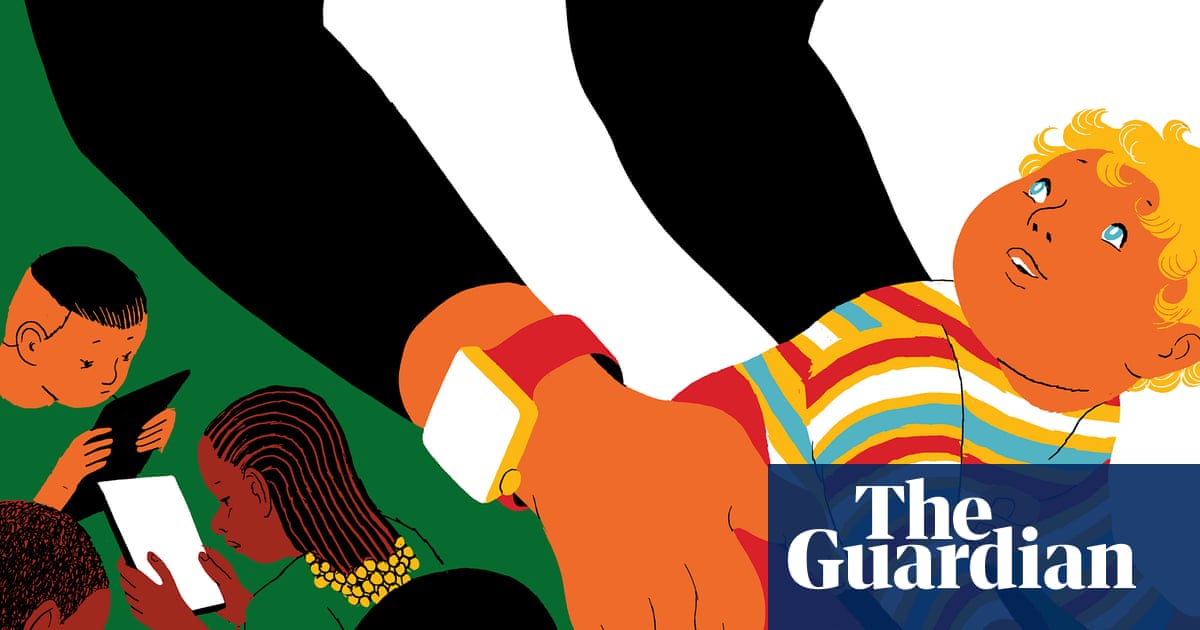
German Gil spends most of his waking hours looking at screens. Since moving to the San Francisco Bay Area in 2015, the software engineer has bounced between start-ups and giants including Netflix, Facebook and GitHub.But when it came to the education of his daughter, Victoria, he wanted her to have a different experience, one in which his “kid could be a kid”.Gil and his wife enrolled Victoria at the San Francisco Waldorf school, a private school built around nature-based play.
Now in fourth grade, Victoria spends her school days free of screens. Instead of working on Chromebooks, the students in her class are binding books by hand.This sort of experience doesn’t come cheap.
Kindergarten tuition at the school, which sits in San Francisco’s affluent Pacific Heights neighborhood, just two miles from the headquarters of AI giant Anthropic, runs $40,000 a year; high school, close to $60,000. But the program is intensely popular.It may seem a contradiction, but in the past years, many well-paid tech workers in Silicon Valley have paid a premium to keep their children away from the platforms they help build.
Applications for early childhood enrollment at San Francisco Waldorf have grown notably, according to the school’s executive director, Lauren Smith, and many of the new parents work in tech.Now, parents in the region are pushing for changes beyond private school campuses to public districts, where screens have become a ubiquitous part of life in the classroom. Parents in California tech enclaves such as Mountain View, San Mateo and others want public schools to re-embrace the emphasis on human connection over screen time that schools like San Francisco Waldorf offer.
They are organizing, and they are making a dent, with some public schools banning phones or rolling back their use of computer-based tests and assignments.As evidence mounts of the damage social media and other platforms do to young people – and as courts have begun to agree – parents, and governments, have started to re-evaluate kids’ relationship with tech, and its role in education. Major US school districts such as New York City and Los Angeles have recently embraced tech rollbacks.
Parents in other countries, too, are increasingly scrutinizing tech’s encroachment into education.“There is much more buzz around this today than there was a few years ago,” said David Monahan, campaign director of Fairplay, a US advocacy organization fighting to limit screen use among children.Silicon Valley parents bring something to this fight that many other communities don’t have: firsthand knowledge of the industry. When San Mateo union high school district put together a taskforce last year to examine the role of AI in schools, at least two of its volunteer members worked at large tech companies, including one in Google’s AI division, according to Jennifer Jacobsen, a school board trustee.“These professionals know more than the average community member about the products,” Jacobsen said. “They can see a longer runway of where these products are headed and their potential impact on education.” Many American public-school parents are dismayed to learn how early screens enter the classroom.Jillian Kolonski, a writer in San Mateo, was stunned when her five-year-old daughter was sent home with a Chromebook for math practice. “I was like, what?!
She’s in kindergarten!” Kolonski recalled.Candice Wei, a Palo Alto college counselor, was similarly shocked to learn that her kindergarten-age son was using screens in class with few guardrails. It prompted her to dig deeper into what local high schools allow. “YouTube isn’t banned.
Generative AI isn’t banned. It’s almost criminally negligent,” she said. “I don’t allow this in my house.
Why is it allowed in schools?”In its early days, ed tech was viewed as a sign of a more equitable and accessible digital future. The pandemic made it an essential part of remote learning, and many tools stayed once students returned to classrooms.
In 2025, 99% of school teachers surveyed by the New York Times said that their students received school-issued devices, and 81% said that their school gives students screens by kindergarten.But experts, and a growing number of parents, are worried about the omnipresence of tech in day to day learning. Half of US teens spend four or more hours a day on screens, not counting schoolwork.
Monahan, of Fairplay, sees classroom screen time as reinforcing those trends. “What sorts of habits are we fostering at school if students spend hours staring at screens with the seal of approval of their teacher?” he asked.Research suggests that students retain what they learn with pen and paper better than what they learn on screens. Critics also say excessive ed tech replaces, or at least stunts, the student–teacher bond that is critical to emotional learning and strips away the productive struggle that fosters learning.“You as a human being are much more likely to put in effort for a teacher you love or a parent you love than for a computer that is not really going to give you love,” explained Yvonne Kao, senior director of learning sciences and technology at the nonpartisan educational research non-profit WestEd.Kao points out that the use of technology can vary widely across US school districts.
She describes hearing about rural districts that lack the staff to vet technology or keep up with best practices for buying it.Silicon Valley parents are in a different position: “There’s a savviness around tech that I think you acquire from being immersed in the tech environment,” Kao said. “You know better what it is good for and what it is bad for, and you can kind of try to thread the needle.”It’s pushed many in the arms of private schools. Unbound by state and local bureaucracy, private schools in California are able to more quickly change direction, are free to enact policies that limit tech and have more money to spend on teachers instead of apps.Wei, who started her local chapter of parent advocacy group Schools Beyond Screens, said classroom screen time is an increasingly common cause for leaving the public system that she hears about. “I’ve been approached by parents who considered [our public school], toured it, saw kids on screens, and were like, ‘I guess I’m going private,’” she said.But it has motivated others like her to push public school districts to vet the companies landing multimillion-dollar contracts with schools and to demand proof that their products improve on learning. “That means asking for data about what specific outcomes they’re looking for that this tech is supposed to help with, and knowing what the plan is if they aren’t seeing those outcomes,” said Kolonski, whose husband works for an AI company. “A lot of these companies have really sexy pitches, but then on the ground, the work doesn’t quite bear out.”Amid pressure from parents, public schools in San Mateo have stopped sending Chromebooks home with students in kindergarten through second grade, and high schoolers are subject to a blanket ban on cell phones.
In Mountain View, schools are moving away from using i-Ready, an adaptive reading and math program used in school districts across California that has drawn criticism for repetitive lessons and been accused of sharing students’ data without consent. Palo Alto public schools, meanwhile, have prohibited the use of a technology developed just next door in Silicon Valley: “smart” glasses.While proponents of human-centered learning are heartened by the progress, they are concerned that less-resourced districts will be left behind, stuck with the digital learning tools wealthier ones are abandoning.The “techlash” is broad, said Jon Valant, director of the Brown Center on Education Policy, and parents across income levels want the same thing – high-quality, human-to-human education – for their kids.
The difference is who can pay for it. Staff salaries are the biggest expense at any school, Valant explained: “The reason [private schools] cost a lot of money is that they have a lot of adults in those buildings … It’s when budgets get tight that the temptation to replace people with technology is especially hard to resist.”The gap could only widen: the Trump administration has thrown its weight behind school choice programs, which give families some or all of the public money that would have been spent on their child’s education through vouchers or education savings accounts to use on private schooling.
It means that when parents take their children our of public schools and into the private system, they take the funding with them.“I am worried about this technology rolling out in ways that are very unequal across communities,” Valant said. “What we end up seeing is it’s the kids who are in the lowest income areas that find themselves spending a whole lot more time on screens, even if their parents don’t want them to be.”San Francisco Waldorf offers financial aid to families who can’t afford the price tag. But Antero Garcia, a professor at Stanford’s Graduate School of Education, too, worries that in some regions private schools are the only route to a screen-free education, and that every student who opts out of public school takes funding with them. “What that looks like is fewer teachers, maybe a longer commute if a school were to close, and larger class sizes,” explained Garcia.The parents with the means to leave, Garcia argues, are also the ones best equipped to change public schools for everyone else. “They have the social capital and resources, and they probably understand how to work within the bureaucratic system,” he said.